

Coming back stronger
We will come out of this one way or another — whether staggering, uncertain of where we are going, or coming back stronger than ever remains to be seen. But for now, we still need to produce — and, in fact, many manufacturers continue to do so in the midst of the crisis. Others are preparing to return to work soon.
Can producers come back stronger? I sense that some sectors will eventually be stronger than others, finding opportunities in the midst of the crisis. Some companies will be stronger simply by virtue of coming back more openly than their competitors. Others will be seriously wounded, some fatally. How can each of us ensure that we come back as strong as possible, with as much stability as possible to face the new uncertainties ahead, the as-yet-unknown new normal that awaits us after we all finally return to work?
I have written about how lean thinking applies to the design of production work under normal circumstances; and I have explored how lean thinking and practice — and the Toyota Production System — never stray from the task of looking deeply at the value-creating work to be done when they are in the process, engaging those who do the work in a partnership to make the work more meaningful. But what about work design in this unprecedented circumstance, which may well become the new normal? How can we let lean practice anchor our thinking during a time of great disruption to the foundations of how we work together to create value?
Above all, what does lean thinking have to say about work design in light of the concerns, constraints and challenges posed by the coronavirus and social distancing?
Many of you are extremely engaged in establishing effective working conditions in real time in the gemba right now. Although I am not writing this from a production site, I have had the opportunity to talk with people who do the hard work and who will share some principles and practices that we know to be true. Lean practitioners are inventing innovative countermeasures as they face unprecedented yet common challenges.
I contacted two companies with deep lean experience — GE Appliances (GEA) and Herman Miller — to learn how their leaders and their production teams are responding. Rich Calvaruso, of GEA, and Matt Long, of Herman Miller, report that lean thinking and practices have allowed them to respond promptly and with great agility to the current challenges on the front line.
Applying lean principles
GE Appliances and Herman Miller are still operating. For GEA, household appliances are considered essential infrastructure — people need to refrigerate their food and wash their clothes —, so it is authorized (under national and local guidelines) to continue operating. For Herman Miller, production for general industry has stopped, but it continues to receive critical orders from healthcare organizations and government agencies, as well as producing PPE for nearby hospitals (West Michigan).
Leaders of both companies generously shared the many details of how they addressed their current situations by implementing practical countermeasures to keep production going. In this article, I will share the lean thinking that was used as the basis for the changes, with a focus on the physical work of production rather than office or knowledge work — although I believe the principles can also be applied there. You can see more details on how the companies identified and implemented the changes here (in English).
Problem 1: What is the problem to be solved?
The efforts of GE Appliances and Herman Miller reinforce several core lean principles and basic lean practices that can lead to the necessary solutions while developing essential mental models and skills. Let's start with the first — and perhaps most primary — principle: applying lean practice begins by considering what problem needs to be solved. The question “what work needs to be done?” applies to many principles and practices associated with work design.
Regardless of the current state, we always want to develop work that is safe, efficient, effective and friendly to those who perform it. Today, the conditions that affect safety, effectiveness and efficiency present enormous challenges. In addition, work comes in varieties, so work design must specifically address the problems found in the gemba. A job shop is different from a huge assembly plant, from an emergency room and from other workplaces. Even so, changes in the work process derive from the same or similar questions:
- How does social distancing affect the work?
- Are companies jumping to conclusions or adopting solutions to problems without breaking them down for a deeper understanding?
- Are they stuck in unproductive worries, unable to move forward productively?
- Are they addressing the problems methodically?
Problem 2: Getting to work safely
A company's first obligation is to get people to the plant safely. Knowing what we know about how the virus spreads, we do not want sick people in the plant. This virus can be carried by asymptomatic people. How do you know if a person is sick? So far, the standard approach is to check whether they have a fever (this is not a perfect method, but a logical first step). It sounds too easy. But, as with all problems, even those that seem easy, it may require many trials. That was the case for the GE Appliance team, which was guided by Rich and was a cross-functional team that included quality, EHS (environment, health and safety) and operations. When the group first looked at the problem, they found they had two problems to solve: what kind of test to use and how to scale the solution.
As a result, designing the work of checking the temperatures of thousands of employees entering the huge GE Appliance Park facilities involved conducting a series of trials. With each trial, the team identified a safe way to measure each employee's temperature and achieve cycle and takt times that were practical, The result so far? Each employee has their temperature measured with a simple test by a thermal camera when entering the building, and they are separated into two lines: pass and go to your workplace; fail and head for the exit. The resulting cycle time was an impressive six seconds. Still two seconds above the takt time, which was four seconds, but they were getting close!
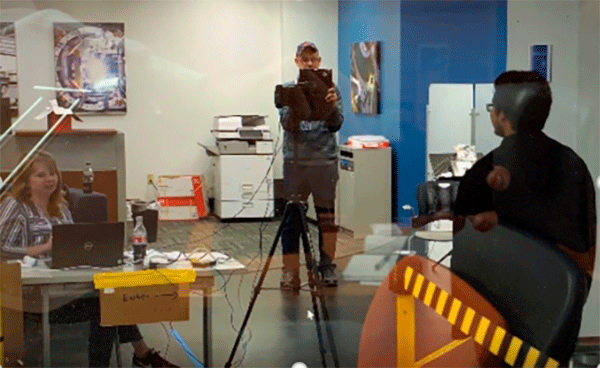
Rich Calvaruso testing the thermal imaging process at GE Appliance Park
As soon as the first (simple?) barrier is passed — entering the plant safely without putting others in danger —, we need to work. And thousands of other problems appear.
And one of these problems, not the least important, is the configuration of the work itself.
Work design – standardized work under normal conditions
Setting up, improving and addressing the problems raised by standardized work are among the most fundamental lean practices. Standardized work means recognizing the required output, defining the steps and their sequence and determining the amount of standard work-in-process (the amount of material that needs to be available and maintained to complete the process). It also requires defining the takt time (the rate of customer demand) and the cycle time (the amount of time needed to do the work as currently designed). Sometimes the rate of customer demand is fairly constant over a specified time; other times, not so much. The cycle time is sometimes consistent, repeatable and stable; other times, not so much. Struggling with all our might against these variables is a focal point of standardized work in normal times, and this principle is even more fundamental during the crisis.
To establish and constantly improve standardized work, we have three main tools: the standardized work chart, the standardized work combination table and the process capacity sheet, which are often combined with other tools, such as the operator balance chart, now known to many as the yamazumi board. It is important (always, but especially today, given the challenge at hand) that we define standardized work not just for one person, but for all employees. We must be aware of how the work of different employees connects, paying attention when designing the work and seeing how the work of employee A affects employee B, and how they can help and not hinder each other.
Problem 3: Creating standardized work that meets social distancing conditions
Take as an example an assembly line with a takt time of 30 seconds and a workstation with a pitch of three feet (about 90 cm). Three feet is not enough space – too close to one another for these days. What to do? Can you slow the line down by half (60 seconds) and increase the pitch to six feet? Or reduce it to 120 seconds and 12 feet? Obviously, this reduces the line's output (unless you have room to extend the line, which would take time to implement).
If it is not possible to slow down the line and increase the space between pitches, can you use safety shields between each employee? They would need to be purchased or fabricated, of course, but perhaps something simple could be enough. They do not need to be pretty – just a barrier between employees. It would be great if they could be transparent (think of curtains that protect employees from the sparks coming off welding equipment).
And what about the team leaders who respond to andon calls? Normally, team leaders go in person to where the operators are to help. What precautions need to be taken under these social distancing conditions? Can you create rules of engagement with carefully and visibly marked “safety boxes”?
At the sites that are in operation, Herman Miller responded to this challenge by redesigning all jobs and developing new rules of engagement for team leaders. The company used the operator balance chart (OBC) and yamazumi boards to balance its assembly work.
Social distancing guidelines: moving line and the facilitator's response
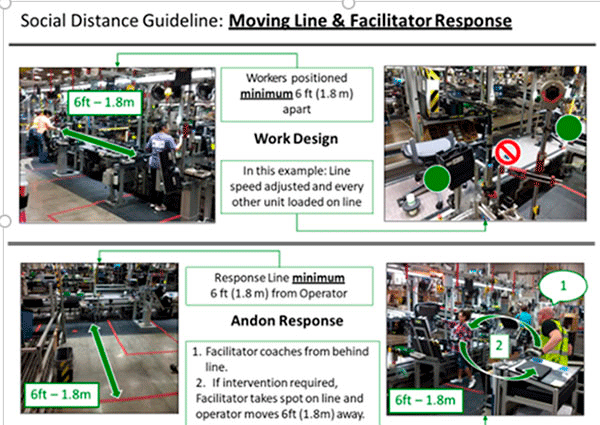
Example of Herman Miller's guidelines for work design and the team leader's andon response with social distancing
Problem 4: Creating standard work to keep team leaders safe
Team leaders have long been trained to act quickly and help any team members who are having problems — this is a preexisting and almost genetically coded habit at both Herman Miller and GEA. Team leaders now keep a distance of six feet (approximately 1.8 m) when responding to a call; this standard is reinforced by markings that clearly indicate the safety zone, while team leaders practice to develop new habits.
With the new standard, when team members call, the team leader will respond as usual, but will stay six feet away. If the operator's problem has to do with timing or something else the team member can solve alone, the leader allows them to take the time needed to figure it out and inform the leader about the problem, so that it can be documented. If the problem is something that requires the leader's help, the team member steps out, the leader steps in and intervenes. Then the leader steps out, and the team member returns to the station. This is the new choreography.
Another challenge Herman Miller faced is how to handle the training of new team members. In this case, the leader, who is already wearing a mask, adds a face shield to protect the team member while delivering job instruction training a little closer. The company is also testing technologies to help team members see the step-by-step instructions while they try things out.
Andon response processes / Visual elements in progress
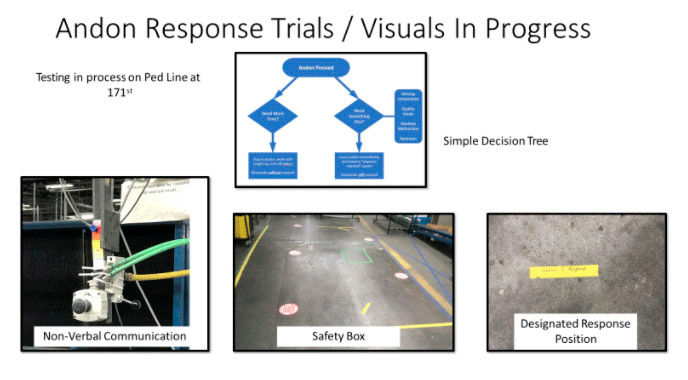
Safety box: a designated response position for the leader. It involves and requires nonverbal communication.
A new normal for lean operating practices — at least for now
Traditionally, we use lean work design tools to bring things closer together. The workbook “Creating Continuous Flow”, for example, describes the conversion of traditional process village layouts into U-shaped cells. Bringing equipment closer together and reducing the distance, time and amount of work-in-process between each machine (combined with carefully orchestrated handoffs between employees) enabled several advantages. Among them: shorter lead time , reduced inventory, less space, greater visibility of quality performance, easier problem solving, more team member engagement and better teamwork.
At least temporarily, the direction of “improvement” will, in a way, be exactly the opposite — things will be separated. Manufacturing cells may become larger. Assembly lines, longer.
In addition, takt times will probably fluctuate, likely becoming more unpredictable than ever.
So the winds have changed direction. As Kiyo Suzaki says, “we cannot change the wind, but we can adjust our sails”. In this environment, those most skilled at adjusting their sails will win the race. The lean capabilities developed by lean producers such as GE Appliance and Herman Miller will not prevent order losses or a sudden tsunami of orders (like the one toilet paper manufacturers faced). Even so, these capabilities will allow companies to adjust as quickly and nimbly as possible.
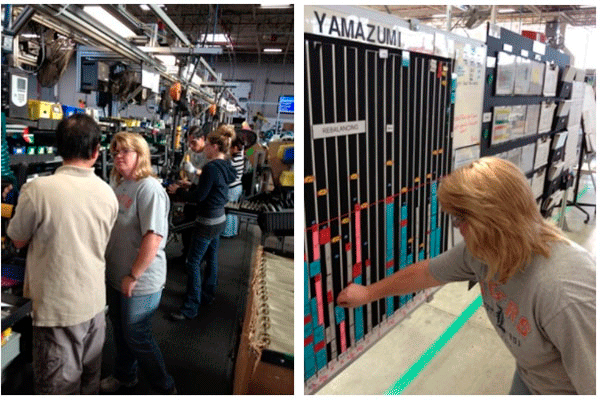
These two images are from my December 2012 article and show Herman Miller assembly line leader Dawn Lowrie, in one supporting an assembly line employee and in the other working with a yamazumi board. One of the scenes (team leaders examining work reconfigurations) is likely to become increasingly common. The other scene (team leaders working close to team members) may not be seen for a long time.
How the new practices created in the crisis will lead to sustainable improvements
Will team leaders learn to get into the habit of stopping to check before rushing in, relying more on training and letting team members solve more problems on their own? Could this reward us by fostering a greater sense of problem ownership and skill development on the part of employees?
Will we eliminate overburden instead of spreading it around? Job rotation to distribute the burden of difficult work is common today in many companies. Herman Miller found that the need for clean surfaces and equipment required them to reduce the frequency of job rotation. They discovered that the reason for frequent rotation in some jobs was the burden of doing them. Since they can no longer rotate as frequently, they were forced to look at the work itself, asking what could be done to eliminate the burden, rather than merely sharing it more frequently. This led to the recognition that, in some cases, frequent job rotation was being used as a workaround to compensate for poor work design! With this insight, they are re-examining jobs with classic lean thinking: seeing the problem for what it is (go see), identifying the cause of the problem (ask why) and eliminating it at its source, relieving employees of unnecessary burden (show respect).
Cleanliness. Awareness of the benefits of a clean workplace has never been higher. It seems reasonable to expect that these new habits will pay off in the next flu season, helping to prevent the spread of flu and common colds.
Don't come to work sick. Mom's advice was right — when you are sick, stay in bed. Even so, many of us ignore the advice and go to work even when sick, perhaps to show the boss and our colleagues that we are dedicated and tough. Or, sadly, we do not want to use up our limited sick days (“I don't want to waste a day of leave staying home sick…”). And this is compounded by the poor sick leave policies (and healthcare benefits in general) of many companies (not GEA and Herman Miller!).
As operations engineers and employees make social distancing improvements in production cells and shop floor environments, what practices can we bring to office work? Although I am a longtime proponent of the open office, how will the new normal impact the trend toward more open office environments? Will it trigger the revival of cubicles with high partitions? Or even, unfortunately, private offices?
GE Appliances and Herman Miller have adjusted many existing standards. They are looking at other standards, especially those in the gemba, such as stopping the use of personal fans that blow horizontally, limiting the “incidental closeness” that occurs at drinking fountains and restrooms, and safely providing new PPE, such as masks and face shields, to all employees. For more examples and details on the countermeasures they applied to various other problems they faced, read The Impact of Social Distancing on Assembly Operations.
The question of when auto plants will be able to return to work is a hot topic here in Michigan. The state's governor, Gretchen Whitmer, is expected to provide guidance soon, which will lead auto assembly lines to return to work. The United States and Canada auto workers' union is hesitant. Whether you produce cars, parts, appliances or furniture, you can go through the same process as GE Appliance and Herman Miller to redesign your assembly lines — and other jobs too. The greater your experience with the lean tools associated with standardized work, the more skillfully you will be able to make the necessary changes and return to work QUICKLY and SAFELY.
The perfect rallying cry
I believe the expression “Coming back stronger” is the perfect rallying cry for all of us. I borrow this expression from a lean advocate at another company, Bernardo Solé, at oil and gas supplier TechnipFMC, who coined this term as an operating theme for dealing with the virus crisis. Facing the same challenges as GE Appliances and Herman Miller (in addition to having to adjust to a market collapsing due to the drop in oil prices), TechnipFMC has been struggling with imposed protection, uncertainty in customer orders, financial market jitters and, where on-site work continues, social distancing. After the initial turmoil most of us went through, TFMC is defining new routines and new ways of collaborating when employees cannot meet face to face, with the determination to come back stronger. Going back to the old ways is not an option for them. Companies are challenging the way everything is done, recognizing that they need to come back stronger or face the possibility of not coming back at all.
For all of us, the crisis is happening, whether we like it or not. What choices and actions can ensure that you and all of us come back stronger?







