The long journey toward lean management
One of the most important discoveries of the lean community over the past 30 years has been that lean techniques, on their own, cannot create consistent and lasting lean enterprises without a lean management system. And we have been running experiments for many years to create these systems.
My first involvement with these experiments was as an advisor on Pascal Dennis's book, published by LEI (Lean Enterprise Institute) in 2006, Getting the Right Things Done (in Portuguese, Fazendo Acontecer a Coisa Certa). The book advocated starting by defining the organization's true north, identifying the hoshins (directives) needed to steer it in the right direction and only then deploying the strategy throughout the organization, introducing improvement management (through A3 and kaizen) and daily management to ensure basic stability, as needed. I loved, and still love, Pascal's book, but many organizations found the method beyond their capabilities. In other words, they could not implement strategy deployment, often because of the basic instability of their own processes.
My next contact with the topic was as editor of Jim Lancaster's book, published in 2017, The Work of Management, also published by LEI (published in Portuguese by Lean Institute Brasil as "O Trabalho da Gestão”). Based on many years of experience with unsuccessful attempts at hoshin planning in his manufacturing company, Lantech, Jim concluded that the starting point for developing a lean management system should be the gemba — on the shop floor, in engineering, in purchasing, in customer service and anywhere else value was being created for customers. He proposed achieving basic stability in every value-creating process through daily management, in order to quickly detect each problem and apply countermeasures, preventing managers from continuing to devote most of their energy to dealing with crises as problems worsened. They would then have time to conduct robust improvement activities (kaizen) on a stable foundation, and to carry out hoshin planning with confidence that strategic goals could be achieved. (The kaizen and hoshin processes themselves would also benefit from the daily management methods developed in the gemba.)
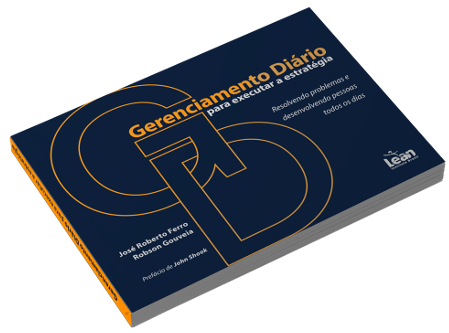
Both books sold well, and many experiments were carried out. However, when visiting companies in the post-pandemic world, I found that lean management had been introduced in only a small fraction of organizations. That is why I was interested when José Ferro (my partner in founding the Lean Global Network in 1998) and Robson Gouveia (who learned about lean thinking at Alcoa, as a participant in its remarkable lean transformation in the 1990s) approached LEI with a proposal to publish the English version of their new book, Daily Management to Execute Strategy, released by LEI on October 15, 2024.
What is new in their approach is the proposal to work from the top and the bottom of the organization at the same time. And to implement this method through a series of incredibly detailed steps, which I believe readers will find very useful as a guide. Perhaps this is the key to success for many organizations intimidated by the challenge of knowing where and how to start.
The core of the method is daily in-person meetings in front of boards in each operational area of the company, followed by daily meetings at higher management levels, all the way up to senior leadership.
These boards have three sections.
On the left are the objectives of the area or of the whole organization, as defined by the company's hoshin goals. For example: reducing rework by 90% in three months in an operational area, or increasing the customer satisfaction index by 20% over the following six months in a service department. In addition, there is always an objective, for each indicator, of continuously reducing the variation in daily performance, quickly tackling each abnormal event along the path to improved performance.
In the center of the board is the performance achieved day by day and the deviation (gap) from expectations. For the indicators linked to the hoshin objectives, the daily target may not be static; instead, it may improve steadily (or at least periodically), rising step by step. Each number is green or red, and all attention is focused on responding quickly to red.
On the right of the board are the problem-solving methods to be used, the current list of problems to be solved, the method chosen, the estimated deadline and the person responsible for resolving each problem.
Problems that can be countermeasured at the lower levels never move beyond those levels. When escalation is necessary, it takes place through a carefully specified “help chain”, up to daily management meetings at higher levels, in front of higher-level boards. The boards that guide these meetings include the same three sections: true north objectives, the day's actual performance and appropriate countermeasures with a responsible person. At this level, it can also be useful to track end-to-end metrics that cut across different departments.
This simple method of daily meetings in front of boards, at the operational and management levels, turns out to be a great challenge for any organization. It requires managers to provide the necessary assistance to the lower levels, rather than showing up with ready-made answers. It also demands more management time at the beginning, in order to reduce management waste later — especially the waste of “firefighting” without really solving problems. In addition, it requires developing problem-solving capability in every employee, at all levels. (Otherwise, the default tends to be delegating problems to corporate operational excellence, quality, manufacturing engineering teams, etc., where they may be prioritized by Pareto and solved much later, if at all.)
For all its difficulty, this is an experiment that deserves serious effort in any organization. We only advance through rigorous experiments; and failing to try new experiments guarantees there will be no progress.
Getting the Right Things Done and The Work of Management, now joined by Daily Management to Execute Strategy, form a true treasure trove of ideas for creating a complete lean management system. I hope we are now at a tipping point in the lean community's adoption of this system. But we have also learned that each organization needs to conduct its own experiments to find its best method, as we all continue on our journey toward lean management as the essential foundation of a sustainable lean enterprise. So let us keep experimenting with management systems and sharing the results of these experiments as a central activity of our movement.