

Blockchain and lean supply chain
Blockchain and lean supply chain
Connecting organizations with a value purpose
Blockchain has been establishing itself as a technology that supports Lean management. In this article, we explore how the integrated adoption of Blockchain and Lean Supply Chain can improve the traceability, collaboration, reliability and response time of logistics processes, based on a digital architecture developed by Brazilian researchers.
Lean practice and emerging technologies
When the use of emerging technologies is approached from a Lean understanding, value creation and rapid adaptation to changes in demand or in competitive scenarios are strengthened. It is in this context that the concept of Lean Automation emerges as the fusion of the principles of Lean thinking with Industry 4.0 technologies such as the Internet of Things (IoT), cloud computing, Big Data and Blockchain.
The adoption of Lean Automation, particularly in manufacturing, has shown gains in two major respects. First: “Operational Stability,” achieved by combining the Lean principles of continuous flow and pull systems with technologies capable of supporting and improving management, involving, for example, automation with sensing, Blockchain and remote monitoring. Second: “Agility in Serving the Market,” which consists of the situational use of technology and management artifacts to improve flexibility and responsiveness in the supply chain.
At this point, Blockchain and cloud computing form a strategic technological pair. The cloud provides scalability and connectivity, while Blockchain ensures the integrity of transactions. This combination makes Lean practices viable even in complex environments, such as networks with multiple suppliers, distributed production or chains with a high degree of customization.
What blockchain is and why it matters to lean practitioners
Essentially, Blockchain is a distributed ledger technology that allows the secure and immutable storage of data among different agents, without depending on a central authority. Blockchain networks have computing resources that allow the programming of functions and applications that make up smart contracts. These documents, which are recorded on the Blockchain, have the capacity to verify and automatically execute processes.
In the context of supply chain management, this means that various stakeholders can share information in real time with transparency and security. In addition, they can rely on the automatic execution of routines and transactions pre-established between the parties.
This logic resonates with the essence of Lean thinking practice by helping to make possible operational stability, visibility and collaboration between the links in the value chain. Instead of linear, centralized flows, Blockchain enables decentralized management, in which multiple stakeholders view, validate and act on the same data. This reduces wasted time, improves decision-making, favors quality and supports practices such as pull systems and customized production centered on customer value.
The tracking and monitoring of product location along the supply chain can also benefit from the advent of Blockchain technology. The visibility and integration of information strengthen the management capacity of companies, suppliers and consumers, making it easier to schedule production and to schedule shipments and receipts. In addition, they allow more precise real-time control, reducing the risk of loss and fraud across the network.
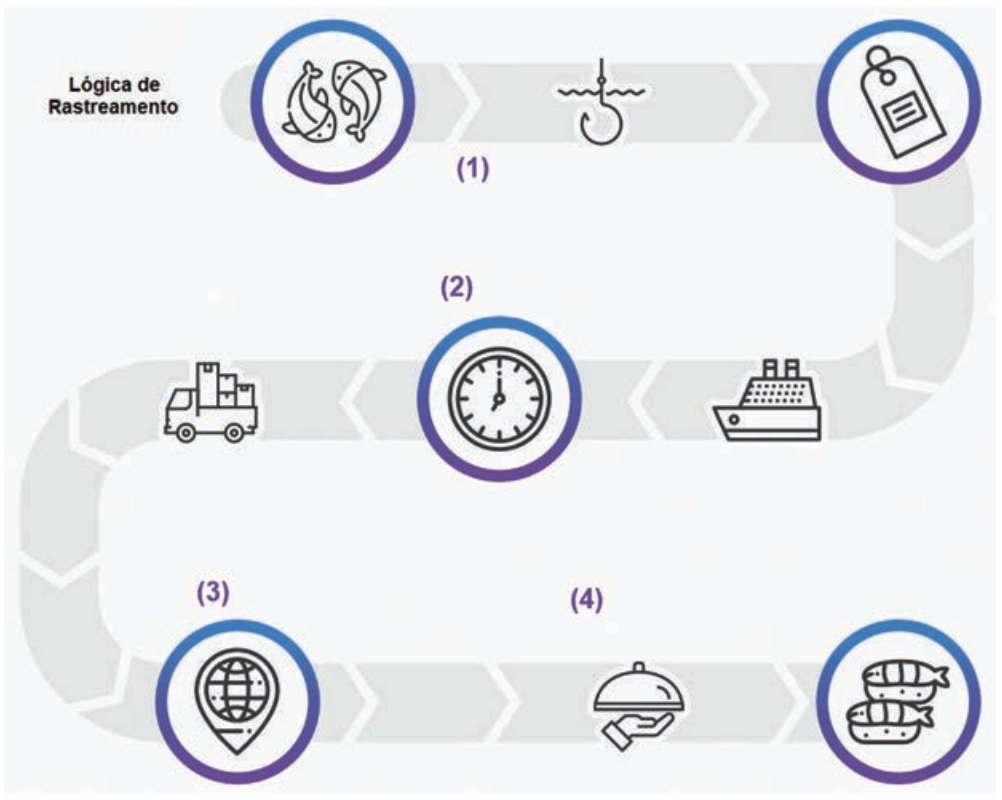
Figure 1 is an illustrative example of traceability in a seafood supply chain. The model records and distributes information from the moment of fishing, through transportation, storage and distribution, until it reaches the end consumer. In this system, Blockchain distributed-ledger technologies, IoT sensors and advanced telemetry are combined to communicate and process the parameters of materials in transit.
(Source: Adapted from Blummer et al., 2018)
Understanding figure 1
1. At the moment of fishing, sensors are attached to the fish to record information such as location, temperature and humidity.
2. This information is continuously recorded, transmitted and made available in real time through the Blockchain network.
3. The system makes it possible to track the custody and movements of the food throughout its entire distribution chain.
4. Consumers, both intermediate and final, can transparently access all the records of their food's origin.
Practical case: a pull chain driven by blockchain
Starting from the pull system (the Lean logic developed from Toyota's just-in-time practice), Brazilian researchers from the School of Applied Sciences at Unicamp (see the reference at the end of the article) simulated a Blockchain architecture in a manufacturing value chain to enable real-time tracking of orders, inventories, purchase orders and production. The simulation was carried out using “Hyperledger Fabric” technology, with data processed in a cloud computing environment.
The proposed model uses a decentralized platform that allows information to be shared among all players in the chain, without interference from intermediaries. The non-linear chain makes possible transactions and data exchanges between different links, whether adjacent or distant, avoiding loss and distortion of information.
Understanding figure 2
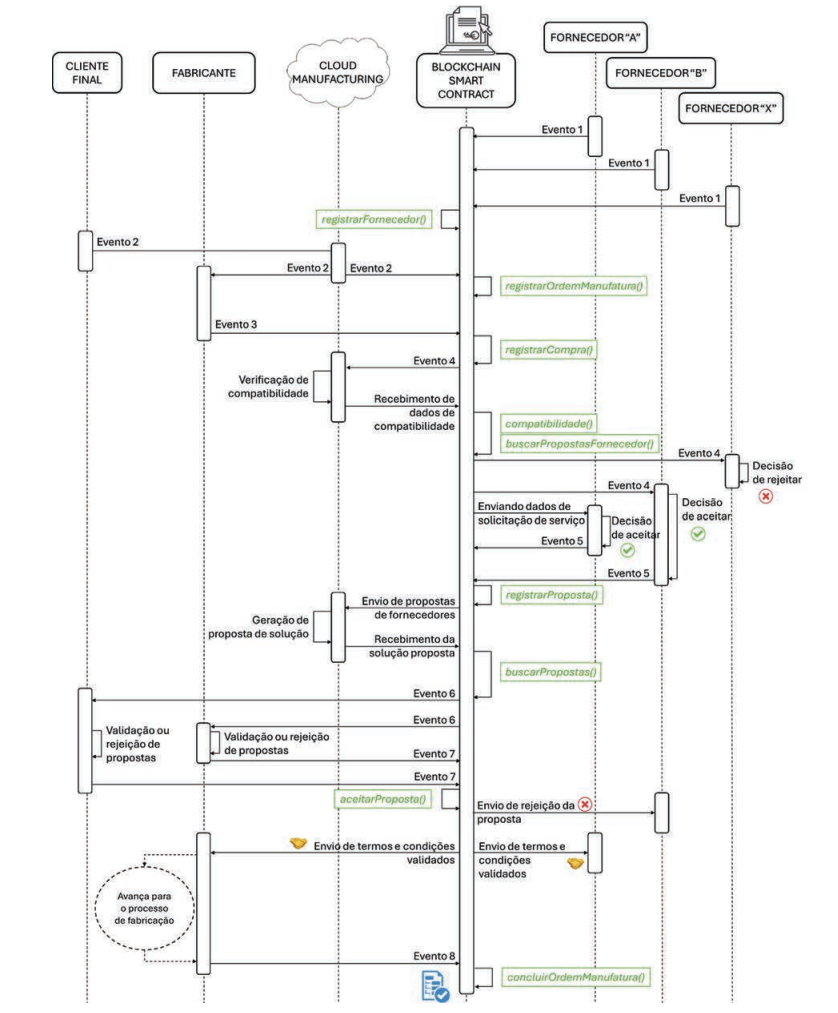
• Event 1: Suppliers register their manufacturing resources and services on the Blockchain network, which may later be requested by their customers through the cloud digital platform.
• Event 2: The end customer requests, on the cloud platform, the order or delivery of a customized product according to the specifications they need (oriented to the value purpose they need). With this, the system triggers the start of the material's manufacturing process at a manufacturer.
• Event 3: During the manufacturing process, the manufacturer identifies the need for a customized component or service to meet the end customer's request and then opens a collaborative production demand on the cloud digital platform.
• Event 4: The digital platform carries out the processes of checking compatibility and prospecting for potential suppliers able to meet the collaborative production need.
• Event 5: Potential suppliers able to meet the terms of service send their technical and commercial proposals to the smart contract.
• Event 6: The digital platform generates a solution proposal with the details of the potential suppliers and transmits it simultaneously to the intermediate manufacturer and to the end customer, enabling decentralized evaluation by both players and allowing consensual validation or rejection by at least one of the parties. This parallel process makes it possible to reduce decision lead time compared with a linear sequence.
• Event 7: With the consensual acceptance of the proposal of one or more suppliers, the collaborative production contract is concluded. The smart contract forwards the final validation to the suppliers selected in the process, which starts the collaborative production involving the intermediate manufacturer and the selected suppliers.
• Event 8: After the collaborative production process is completed, the intermediate manufacturer validates the finished product, confirming that it complies with the end customer's specified request. Finally, the manufacturing order is closed in the system, recording the entire production history and enabling traceability of the components and of the participating service suppliers.
How blockchain favors the lean supply chain
The simulation of the model indicated significant gains in chain performance: shorter lead time, reliable data, greater transparency and lower operating costs. Real-time traceability and the elimination of intermediaries allowed faster and more integrated decision-making. This led the entire chain to be oriented toward the purpose of delivering value to the end customer. Operational stability and agility in serving the market, benefits of Lean Automation, were observed in practice.
The system was considered robust, even with multiple participants, thanks to traceability, data immutability, real-time transparency and automation via permissioned Blockchain — in which access and participation are controlled and restricted to a specific, authorized group of participants. The tests showed potential for scalability, with low latency times and processing costs, allowing broad participation by producers, customers and suppliers.
Network data sharing allowed specifications to be controlled from raw material to finished product, eliminating the waste of waiting by reducing intermediaries and optimizing the production cycle. Real-time information made it possible to monitor productivity and identify problems, even at distant suppliers, functioning as an “Andon” (a tool for signaling abnormalities) for the entire chain. Information security was also reinforced through Blockchain cryptography, encouraging collaboration among the agents in the chain.
These results were reflected in direct improvements in typical Lean Supply Chain indicators: reductions in overall end-to-end inventory, lead time, defects and rework. In addition, the robustness observed in the network indicated that small and medium-sized companies can also benefit from adopting the technology in their value chains, especially when it is combined with affordable cloud platforms.
Between technological hype and purposeful adoption
More important than adopting Blockchain because of the technological hype, what should be sought are solutions consistent with the real problem the company needs to solve. Lean thinking brings the focus on value, with continuous flow, pull systems and the pursuit of perfection (through the everyday surfacing and solving of problems). Technology does not replace management processes; it amplifies their potential and requires a prepared organizational foundation.
Implementation, in turn, is not trivial. It requires alignment among the stakeholders in the value chain, investment in training and attention to interoperability and standardization barriers, as well as cultural issues such as paradigms regarding the use of technologies. Also, low familiarity with the tools can lead to failures in interpreting and using data, in managing or in executing the production processes that run in parallel with automation.
The greatest risk lies not in the technology, but in replicating old problems with new tools. That is why the role of Lean leadership remains essential to point to the value purpose for the customer, recognizing the potential of digital tools, using them to drive innovation and efficiency, promoting a culture of learning and adaptation, and avoiding, for example, the automation of processes that should not even exist. The central question is not to use Blockchain for its own sake, but to ensure that its application improves the delivery of value to the end customer.
Lean, transparent and intelligent value chains
By integrating Blockchain with Lean practices in supply chain management, organizations expand their capacity to respond with agility and intelligence to market demands based on reliable, shared information. This is a paradigm shift: from traditional chains to collaborative networks, in which the value stream is sustained by data, trust and the common purpose of serving the end customer.
More than a technological trend, Blockchain oriented to the Lean Supply Chain is a bet on more resilient and flexible systems, in which all agents can be guided by the value purpose, and no one has to operate in the dark. It is in this sense that Lean Automation emerges as an ally, integrating technology with continuous improvement to simplify processes, reduce waste, improve quality and strengthen real-time decision-making.
References
• BLUMMER, T.; SEAN, M.; CACHIN, C. An introduction to Hyperledger. 2018. Available at: https://www.hyperledger.org/wp-content/uploads/2018/08/HL_Whitepaper_IntroductiontoHyperledger.pdf
• MORELLI, D. A.; IGNÁCIO, P. S. A.; ZANUTIM, N. L. Blockchain-based Lean Supply Chain: a simulation approach. International Journal of Innovation and Technology Management, v. 21, n. 05, p. 2450038, 2024.
• OLIVEIRA, D. F.; TORRES JUNIOR, A. S. Lean Supply Chain e Logística. E-book – Lean Institute Brasil, 2024. Available at: Leanshop.com
• ROSSINI, M.; COSTA, F.; TORTORELLA, G. L.; VALVO, A.; PORTIOLI-STAUDACHER, A. Lean Production and Industry 4.0 integration: how Lean Automation is emerging in manufacturing industry. International Journal of Production Research, v. 60, n. 21, p. 6430-6450, 2022.







