

Lean Learnings in China
Fluid infrastructure and integrated ecosystems
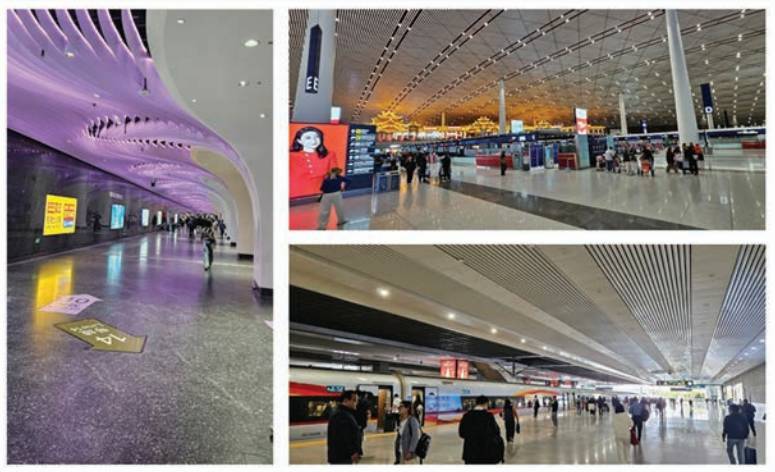
One of the first things you notice upon arriving in China is the central role infrastructure plays in making processes flow. Airports such as those in Beijing, Shanghai and Xiamen are impressive for their modernity and their integration with public transportation systems, allowing fast, predictable travel with no unnecessary transfers. This logic of eliminating waiting and waste, typical of the Lean philosophy, extends to urban transport modes, travel between cities and freight transport.
The connectivity between physical and digital infrastructure favors continuous flow, an essential principle of Lean thinking. Efficiency emerges as the keyword, noticeable from the moment you arrive at the airports — connected by subway to the city center — to the seamless experience on intercity transportation networks. See Figure 1.
Although many consider tools such as Google Maps, WhatsApp and Uber indispensable, China has developed local versions that operate with equal or greater effectiveness. Daily life, especially in large cities, is completely interconnected through smartphones. Being connected is not a differentiator, but a basic condition for accessing services.
This digitalization goes beyond automation: it integrates logistics, payments, mobility and the consumer experience into a single ecosystem. To board the high-speed train, for example, all you need to do is present the passport number used when buying the ticket. For payments, apps integrate banks, restaurants, public transportation, events and retail, eliminating lines, paperwork and barriers.
The result is a significant reduction in waiting times and the elimination of unnecessary steps — concrete examples of removing waste (muda), especially waste related to motion and overprocessing. The customer journey (or the flow of material) is designed to flow without interruption, with minimal friction.
When it comes to means of payment, China goes beyond adopting technologies such as QR codes and digital wallets, expanding integration. Many transactions (from a street snack to a train ticket) can be completed through mobile apps. Payment confirmation is instantaneous and integrated into the services' operating systems, approaching the concept of logistics that is invisible to the consumer.
A case in the metals sector: scale, efficiency and industrial policy
According to data from the International Monetary Fund (IMF)1, China's Gross Domestic Product (GDP) grew from US$ 1.21 trillion to US$ 18.27 trillion between 2000 and 2024; an unprecedented advance that no other country managed to match during that period. This growth was driven, to a large extent, by international trade. In 2023 alone, China accounted for 17.5% of world exports, according to Eurostat and UNCTAD2. However, this prominent position brings with it a vulnerability: when the global economy slows down, the effects are felt domestically. To reduce this exposure and sustain growth, the State plays an active role in fostering new projects, with emphasis on infrastructure initiatives.
Today, China occupies a central position in global supply chains, especially in strategic sectors such as metals and minerals. The country leads in the consumption and refining of critical raw materials such as copper, lithium, cobalt, nickel, antimony and germanium. The logistics structure that sustains this performance combines modern infrastructure, advanced digitalization and public policies focused on efficiency and innovation. During an immersion in the metals sector, it was possible to observe how the principles of Lean management, with a focus on flow, waste reduction and the intentional use of technologies, are present concretely and on a large scale.
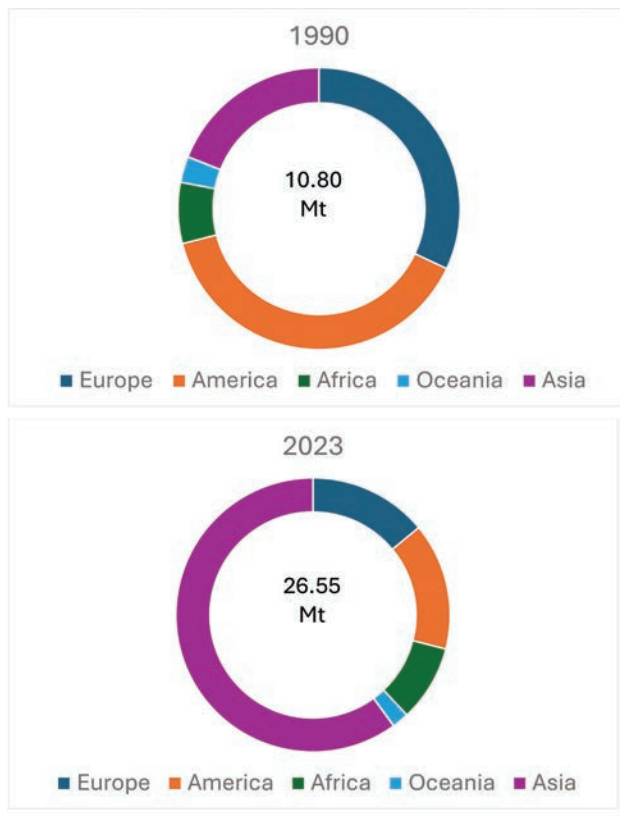
Unlike models based exclusively on market dynamics, the Chinese government acts as the coordinator of logistics and industrial strategy, encouraging the construction of factories and logistics corridors and directing resources to sectors considered strategic. A clear example of this is the evolution of Asia's share of global refined copper production, which jumped from 19% in 1990 to 60% in 2023, driven mainly by Chinese expansion, according to data from the International Copper Study Group. China alone accounted for 45% of world refined copper production in 2023, totaling 12 million tons. In the same period, the Americas saw their share fall from 39% to 15%, which shows a significant shift in the geopolitics of the copper industry.
Investment in new factories takes place even in contexts of low utilization of installed capacity. In the base metals sector, for example, the utilization rate is between 60% and 70%, according to data from Shanghai Metals Market3. This decision reveals a long-term vision, sustained by a centralized government that prioritizes job creation and economic growth, even if this means operating below the point of efficiency in the short term.
This model, however, puts constant pressure on companies, which find themselves challenged to innovate and reduce waste. The pursuit of operational excellence becomes a necessary path, especially when there is idle capacity. In this context, the principles of Lean thinking, applied to the management of production capacity and the rational use of resources, become even more relevant.
Efficiency and innovation in metal recovery
China has established itself as the world's largest consumer of metals. Among the most demanded inputs are those considered critical for renewable energy technologies and electronic products, such as lithium, nickel, cobalt and rare earths. In the case of copper — an essential metal because of its high electrical conductivity —, the country has led global consumption since 2002. Figure 2 — Share of refined copper production by region, 1990 versus 2023 (Source: International Copper Study Group)
Growing demand for solar panels, wind turbines, semiconductors and batteries has stimulated investments that go beyond mining. Chinese companies have been expanding their operations outside the national territory and strengthening the metal recycling and recovery chain. Restrictions on importing materials with low metal content drove the development of efficient methods for recovering valuable components. What was once considered waste came to be treated as a resource.
This dynamic helped Chinese industry evolve at an accelerated pace, especially with regard to the quality and application of final products. Almost all metals are being transformed, whether through new extraction techniques that make previously inaccessible products viable, or through the intensified recovery of value from tailings or recycled materials.
In the case of nickel, China's mastery of technologies such as High Pressure Acid Leaching (HPAL) marked a turning point. This process allows the efficient extraction of the metal from oxidized ores, which are more common in recently discovered reserves. Before HPAL, these ores were used mainly to produce class 2 nickel, intended for the stainless steel industry. With this technology, the nickel obtained reaches the grade needed for lithium batteries, opening up new market opportunities.
In the lead sector, the ban on importing used batteries aimed to prevent waste from entering the country. The measure, although positive from an environmental standpoint, caused a shortage of raw material given the refineries' high installed capacity. As a result, prices of used batteries rose in the domestic market. Today, the average utilization rate of lead refineries in China is below 70%. The industry's response has been to improve its processes to increase the recovery of lead and also of other metals present in batteries, such as tin, antimony and higher value-added elements.
Antimony, for example, is used in flame retardants, batteries and defense industry applications. Chinese companies master techniques that make it possible to separate antimony from lead in more complex ores, as well as to recover precious metals such as gold. This capability broadens the range of viable raw materials and strengthens the country's position in the global market.
The Lean logic, with its focus on creating value and using resources efficiently, connects directly to this reality. The refinement of processes that makes it possible to extract antimony, tin, plastics and other materials from waste is an example of Kaizen applied to the value recovery chain. This model has been driving innovation and raising the level of efficiency of Chinese industry, which is consolidating itself as a leading player in the production of technologies based on strategic metals.
The new frontier: artificial intelligence and data-driven logistics
With robust infrastructure and digitalization already consolidated, China is taking new steps toward higher levels of efficiency, betting on the intensive use of Artificial Intelligence (AI). The digitalized behavior of the population and companies creates favorable conditions for the adoption of predictive solutions, autonomous systems and real-time decision-making.
This technological advance has another direct effect: increased demand for metals. The introduction of the AI platform DeepSeek, already integrated by Chinese telecommunications and technology companies, is an example of the movement under way. In the United States, platforms such as ChatGPT have also been expanding. As the use of AI spreads into everyday life, the need for computing infrastructure, made up of high-capacity servers and data centers, grows. This implies the expansion of power transmission and distribution systems.
In this context, metals such as copper and aluminum become even more relevant, since they are widely used in electrical conduction, equipment cooling and the structure of data centers. In addition, elements such as indium, gallium and germanium are gaining visibility due to the growing complexity of technological components.
China has been aligning its industrial strategy with these trends, often acting as a leader of the movement. Anticipating growing demand, the country is strengthening its supply chains, investing in mining, processing and recycling technologies, both at home and abroad. In doing so, it expands its presence in strategic sectors of the new digital economy, where metals play a central role in technological development.
From a Lean point of view, this scenario can be interpreted as the combination of technology and the purpose of value to give meaning to the transformation. The application of AI makes it possible to detect deviations quickly, act on the basis of reliable data and maintain the stability of flows even in unstable and uncertain contexts. It is an extension of a way of thinking that values the effective use of resources, the control of variability and continuous improvement.
Clues for strengthening supply chains
The Chinese experience shows that an efficient supply chain does not depend only on isolated technologies or tools, but on the combination of well-aligned strategy, infrastructure, digitalization and operating practices. In this context, Lean management, by connecting people, processes and purpose, is in tune with this approach and can inspire the transformation of production chains in Brazil as well, including in the metals sector.
Adopting a mindset geared toward continuous improvement, reducing waste and strengthening collaboration between the links in the chain are steps that help raise the country's competitiveness on the global stage. What can be seen in China goes beyond a technological showcase: it is a practical example of how a resilient production ecosystem is structured, with a systemic vision and discipline in execution.
China's progress in the metals sector did not happen by chance. The country anticipated trends such as the energy transition and digitalization and incorporated them into its development strategy. It has acted all the way from the acquisition of raw materials to the export of high value-added products, including refining and manufacturing. This movement allowed China to occupy a central role, not only in production, but also in controlling the global flows of critical metals.
The Chinese case shows that building an integrated and efficient supply chain depends on strategic decisions and coordinated execution across different fronts. For Brazil, this represents a relevant lesson. It is not enough to extract or export raw materials; it is necessary to move toward a more active role in the global value chains that shape the economy of the 21st century.
This article proposed a reflection based on one of the authors' recent experience in China, with a specific focus on the metals chain. It is therefore not a broad or definitive diagnosis of the Chinese reality. Several other dimensions — technical, political and social — remain outside the scope of this work, as they call for their own, more in-depth approaches. The intention here was to share observations and lessons that, even from a limited perspective, may inspire relevant discussions and offer clues for strengthening supply chains in Brazil.







