

Pets and management: Modern Pets' lean journey to ‘scale’ veterinary service
By Larissa Goto Sala and Lívia Romeiro, founders and, respectively, Product Manager and Operations Director of Modern Pets, and Stela Maris Coelho, Lean Specialist at Lean Institute Brasil (LIB)
For a long time now, the pet market in Brazil, covering companion animals and household pets, has been one of the most vigorous and resilient in the national economy. According to Instituto Pet Brasil (IPB), the sector had revenues of more than R$ 68 billion in 2024, and projections always point to growth, even in times of crisis. So much so that the love, care (and spending!) of Brazilian pet owners have already placed the country in third place in the world ranking of this business, behind only the United States and China.
Anyone who thinks this makes things easier for the veterinary services segment (consultations, tests and procedures), however, is mistaken. It is the second pillar of the sector's revenue in the country (second only to nutrition), accounting for between 15% and 18% of the market.
Amid a phenomenon that experts call the “sophistication of demand,” pet owners are becoming more protective every day, demanding standards of care equivalent to or even higher than those of human medicine. They often arrive at clinics with prior information, having researched symptoms, treatments and medications, which requires veterinarians, clinics and hospitals to have ever higher levels of training, experience, facilities, technology and service.
This is even more challenging in the State of São Paulo which, according to Instituto Pet Brasil and the Regional Council of Veterinary Medicine (CRMV-SP), concentrates about 40% of the national market, with the state capital as the engine of this performance, due to the high purchasing power of certain areas and the population density of animals.
Given this dynamic, prosperous but challenging scenario, Modern Pets, a veterinary services startup founded in 2023 in the city of São Paulo, is implementing the lean system to improve its management and thus have a solid foundation for creating innovative services.

The clinic recently launched a subscription-based veterinary services package on the market, with an average monthly price of R$ 65, thus offering an alternative to the traditional fee for service system, which is often criticized for being costly, fragmented and inefficient.
With a hybrid, physical and online structure, the clinic seeks to consolidate a primary care model – for example, the first consultation – that is sustainable, scalable and replicable. And to achieve these goals, the startup began a lean implementation focused on eliminating waste and standardizing clinical conduct.
‘Three Es’ and good indicators
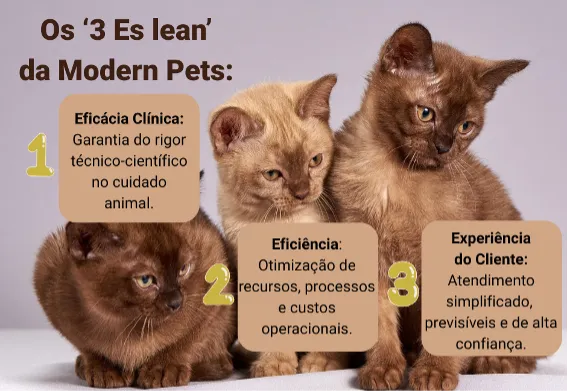
Modern Pets' vision of expanding the business, spreading the subscription service and, why not, democratizing access to quality veterinary care rests on three fundamental pillars, internally called the “Three Es.”
The first is “Clinical Efficacy.” The goal, which should be basic but is not always delivered in this market, is to guarantee technical and scientific rigor in all the animal care offered. Consequently, the second “E” is “Efficiency,” which translates into the pursuit of constant improvement of processes and resources and the day-to-day optimization of costs, to keep the business viable. The third “E” is the “Customer Experience,” whose focus is to provide care that builds a relationship of absolute trust among pet owners, professionals and the clinic.
This strategic mindset is already paying off. Even before the lean implementation, the clinic already showed interesting indicators. For example, an NPS (Net Promoter Score) of 85 – a customer loyalty metric widely used in the corporate world to measure the degree of satisfaction and the likelihood of a consumer recommending a company's services to other people.
Likewise, a CSAT (Customer Satisfaction Score) of 4.9, a performance metric that measures how satisfied a customer is when interacting with a service or product. The so-called “clinical resolution rate” is also high: 95% of consultations (in person and online) end in resolution by the startup's own general practitioners, with less than 5% referred to specialists or emergency hospitals.
The problem: variability in the use of resources
Despite these indicators, the cost of tests has always been a problem area. Typical of veterinary medicine, the clinic faced the challenge of balancing the "overuse" of tests (which generates unnecessary costs and risks for the pet) and "underuse" (negligence that can worsen clinical conditions and cost more in the long run). The lean improvement initiative then set an ambitious goal: to reduce the average cost of tests by 35%.
To understand the origin of these operating costs, Modern Pets carried out a detailed mapping of the main clinical complaints it received, in an attempt to get a clear view of the demand.
The historical survey revealed that “preventive” matters (actions taken while the animal is still healthy, with the aim of preventing diseases from developing or detecting them at early stages, before they become serious or too expensive to treat) led the volume of consultations, accounting for 26% of the total.
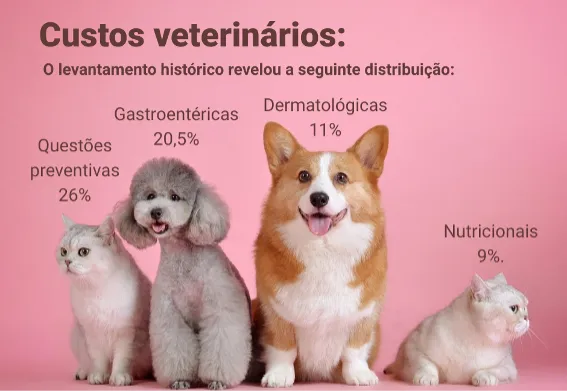
Next came gastroenteric complaints (symptoms and health problems affecting the animals' digestive system, including organs such as the stomach and intestines), which totaled 20.5%. Completing the picture of the most frequent occurrences, dermatological complaints (problems related to the skin, the coat and the ears (the animals' ear canals) accounted for 11% of demand. And nutritional ones (related to guidance and treatments focused on the animals' diet and metabolic balance) represented 9% of the cases seen by the clinic.
To manage this variability, the startup decided to strengthen clinical standardization. Before the study, only 25.8% of complaints had “clinical protocols,” that is, systematic guides that define the "step by step" of veterinary decision-making in the face of a set of signs and symptoms. And veterinarians' adherence to them was only 62%.
Countermeasures: protocols, care pathways and navigation
By looking more closely at the work done in the gemba, the clinic's management realized that the existing protocols were PDFs shared on internal channels. The poor usability of this material – which was “hidden” in digital folders – led veterinarians to prescribe "from memory," increasing the variability of clinical conduct.
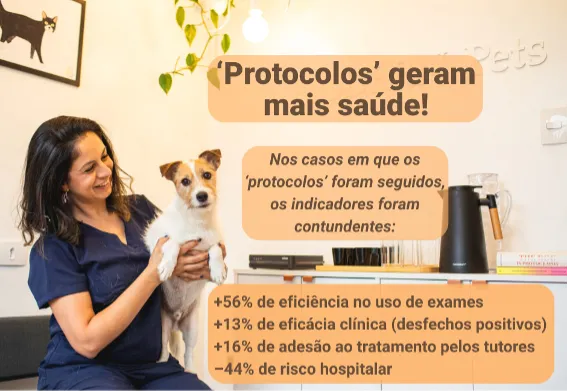
The solution proposed by management was the creation of an internal digital system that made it possible to automatically measure adherence to the protocols. In cases where they were followed, the indicators showed better results: there was a 56% increase in the efficiency of test use and a 13% increase in clinical efficacy, reflected in positive outcomes. In addition, there was a 16% improvement in pet owners' adherence to treatments and a significant 44% reduction in hospitalization risk.
From then on, the improvement strategies were divided into two fronts. The first focused on the technical distinction between “protocols” and “care pathways.”
While a “protocol” is a “decision guide” for a specific problem – for example, vomiting and diarrhea –, a “care pathway” is like a “horizontal route,” designed to follow the animal's life over a certain period, as in the case of an obese pet or a pet with cancer. This differentiation gave the veterinarian a clear and precise “yardstick for conduct.”
The second front focused on processes to try to ensure that routines were followed. To increase adherence to the protocol, the flowcharts were turned into simplified checklists. In addition, the role of "Health Navigator" was created. This professional coordinates care, acting as a link between the patient and the healthcare system, helping the pet owner understand diagnoses and removing barriers to following the treatment plan.
Initial results
During two months of implementing all of this, it was observed that veterinarians' adherence rate to the new processes jumped from 62% to 95%. Although the 35% cost reduction target has not yet been achieved in a consolidated way in the short term, the project delivered something more valuable for the scalability of the business: a structure of standardized processes that can be followed and recorded.
This structure allows the company to predict the “case mix” of conditions. For example, knowing that 3% of the animal base will have an episode of vomiting per month and the average cost per case. And understanding that, in the vomiting protocol, the data showed that 90% of cases were discharged with medication alone, without tests, which reinforces the cost-effectiveness of the model.
Next steps...

This initial learning at Modern Pets showed that, in subscription-based healthcare models, financial efficiency is a by-product of standardization and clinical quality. Reducing costs from unnecessary tests is only safe when it is grounded in data that ensure the pet is receiving neither less nor more than it needs.
The startup's next step is to integrate these protocols directly into the electronic medical record to eliminate the use of paper and automate the monthly clinical audit. The Modern Pets experience signals to the market that cost predictability and the delivery of value to the customer depend on a data infrastructure that turns medical intuition into measurable processes and continuous improvement.







