

Lean as high-impact innovation - GPT Class

Over the course of the 100 issues of MundoLogística magazine, countless technological and organizational innovations have been followed and discussed in its pages. The Lean management model applied to Supply Chain and logistics is part of this effort to stay current, which we celebrate today in this centennial issue. This article discusses the peculiar nature of the organizational innovation that the Lean Model provides when applied in a structured way, producing a major positive impact on various dimensions of the company, the chain and the business. The Lean Model has an impact ranging from the development of people to the introduction of other innovations of a technological nature, as is the case with AI and other digital transformations. This exponential and broad effect of the Lean Model is known as the GPT effect, General Purpose Technologies, and is discussed in this article with the recommendation that Lean be urgently incorporated into companies’ strategic formulations.
Writing in issue 100 of this magazine calls for offering our readers a special reflection. Over the years, MundoLogística has been collecting articles that portrayed the accelerated change and innovation of organizations. It has broadened the world visible to professionals in the field in recent years, bringing up diverse issues that affect supply and logistics management in an environment of diversity and uncertainty — while at the same time seeking efficiency and effectiveness in operations.
This column is one of the cases of this evident broadening, showing the reader how the Lean Model can help in this escalation, with a large and broad impact on various aspects of the operation and the business.
In the early 2000s, Richard Lipsey and colleagues carried out empirical studies that made it possible to identify that some innovations that produced new process, product or organizational technologies had a positive impact on economic and social performance that was significantly greater than the impact most innovations produced. They called these innovations “General Purpose Technologies” (GPT) and identified the Lean Model as one of them and, moreover, as the latest organizational technology available with this broad benefit.
Technological change covers the whole range, from continuous, small and incremental changes, through radical discontinuous inventions — up to the moment when high-impact innovations emerge — of the GPT class, which evolve to permeate a large part of the economy. These GPT-class innovations share some important common characteristics: they start at localized points, as was the case with Lean in automobile production — “Lean Production” — with a limited number of practitioners, and they evolve toward more complex applications, with increases in the range of their use throughout the economy and in the range of economic results they help produce.
As they spread through the economy, their efficiency steadily improves. Being mature technologies, they are widely used for various purposes and have many complementarities in the sense of cooperating with many other technologies, as is the case of Lean with digital transformation and AI.
Some of the important new innovations of the GPT class, such as the Lean management model, bring about major structural changes in aspects such as work organization, company management, skill requirements, the location and concentration of companies, and support infrastructure.
The Lean management model is a special class of GPT innovation, and it is a high-impact GPT-class innovation. Lipsey describes, for example, laser technology as an example of a low-impact GPT. Lasers are widely used throughout the economy for multiple purposes: to measure interplanetary distances in astronomy; to read bar codes on checkout counters; to facilitate various types of surgery in hospitals. They are fundamental in communications; they cut diamonds; they are used to mill materials in new state-of-the-art machine tools; they weld plastics; and, today — we add to Lipsey’s list —, they are being used to bring about various means of Industry 4.0.
Lasers, however, do not qualify as a transformative GPT-class innovation because they fit well into the existing social, economic and institutional structure, without causing major transformations. The Lean model, by contrast, has a great transformative impact.
The lean model as a transformative innovation of great breadth and impact (GPT Class)
The Lean model is one of the few transformative GPTs that evolved from another innovation: the specialized assembly and production line, which was challenged and extensively reformed. Lean kept the concept of low-cost production on an assembly line, but radically changed the degree of organization of labor and capital, with the consequence of increased results.
Toyota took decades to develop lean production before and shortly after World War II, raising its level of competitiveness. The development of its innovations, centered on enabling a growing variety of models on a small scale, left those of the previous mass-production model without an understanding of the foundations of its success. In the transformative innovation process, these innovations were understood and produced “spillovers” to all kinds of companies, constituting what we know as the Lean management model, with large and broad application, including Supply Chain and logistics in any economic sector.
The Lean model makes it possible to produce and transport small fractions of many varieties at low cost, without the need to seek the consolidation of large batches. Two sources of these cost savings are important and innovative in their impact on the entire supply chain. First, small batches eliminated the costs of maintaining huge inventories, since storage and coordination costs are minimized by receiving items only when they are needed. Second, since the items need to be handled almost in continuous flow as they move along the chain, defects, damage or service errors are identified at their origins and causes early on, refining and expanding the innovation process with cost reductions across all and many types of operating stations.
This last innovation enormously reduced the costs caused by defects and led to a more reliable final product and service. In contrast, mass-production techniques, and many companies still inspired by them, devote considerable resources to correcting errors, and many defects go unnoticed in the final stages of the chain’s operations and are passed on to consumers.
On the other hand, making the Lean model work requires innovations in human resource management. The Lean model stops assigning a repetitive task to each worker and instead uses human resources as parts of a team with leaders who develop people, providing comprehensive development throughout the entire work process. Each team receives a set of tasks in flow, with related performance targets, as well as some degree of decision-making power to determine the best way to achieve those targets. Among these powers is the ability to manage the workflow in order to identify problems and their causes.
After an initial learning period, this practice leads to a dramatic decline in the number of defects and operational problems. The result is a reputation for reliability that enables new initiatives to take shape, more innovations, and even greater impacts to be achieved.
Therefore, the Lean model naturally expands within the organization and ends up achieving results and process changes also in the design of new products and services, as well as in the way strategies for creating value for customers and consumers are conceived. A virtuous circle takes hold, strengthening the transformation into a GPT-class innovation of great impact and breadth at all organizational levels.
Along this path, the Lean model achieves integration with suppliers and distributors in a supply chain geared toward delivering value in pull or hybrid scheduling systems, which share information through a cooperation network. Integrated digital systems, shared routes, purchasing intelligence and the advances of an innovative model guide and integrate other innovations.
On the other hand, this transformation also has a peculiar form of implementation, which drives the diffusion and achievement of a GPT-class innovation with a situational model. This model, known as the LTF (Lean Transformation Framework), is the key to achieving this gradual transformation and exponential gain in results with the benefits that Lipsey envisioned and studied empirically in the world economy.
LTF: Lean Transformation Framework
Going far beyond tools that make up a sociotechnical framework for driving improvements and efficiency at a tactical-operational level, the Lean model is configured as a system of thinking. Capable of articulating the strategy of organizations and their ecosystems, its ultimate aim is to provide greater delivery of value to customers. To this end, it considers distinct essential dimensions for conducting the transformation with permanence and sustainability, enabling GPT-class innovation.
These (five) dimensions, drawn from the empirical experience of Lean researchers and practitioners around the globe, connected in particular through the Lean Global Network (LGN)1, were brought to light and systematized in the LTF (Lean Transformation Framework). Following the metaphor of building a house (Figure 1), the LTF is represented as a vivid model that expresses and constitutes the foundations for a bold transformation of great breadth and impact.
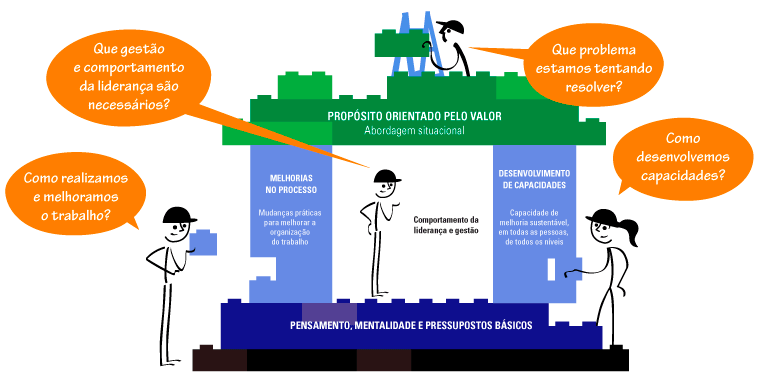
The LTF uniquely consolidates the situational approach required for a successful transformation, driving GPT-class innovation across the entire business ecosystem. The situational approach lies in the fact that the five dimensions address questions applied both at the macro level of companies and supply chains and at the level of individual responsibility.
Lean Transformation Framework questions:
-
What is the purpose of the change? What strategic objective and value are being delivered? What problem are we trying to solve?
-
How are we improving the actual work?
-
How are we developing human capabilities?
-
What leadership behaviors and what management system are needed to support this change?
-
What thinking, mindset or basic assumptions make up the existing culture, and how do they relate to the transformation?
In practice, as each dimension is progressively explored in greater depth, the questions bring out a clear point of view on sustaining and driving the transformation journey. If these questions are not addressed together and with a clear notion of their interrelationships, the high-impact transformation and innovation will have difficulty sustaining its virtuous dynamism for value creation.
In particular, the contemporary transformation and innovation of logistics and the supply chain integrate multiple aspects, such as technology, visibility, integration, orchestration, analytics, collaboration, diversity and sustainability, among many others. In this diverse and plural scenario, the LTF emerges as the rationalization of a structured model for organizing the transformation and innovation journey, allowing decision-makers to better understand the particular scenario of each organization or ecosystem, classify countermeasures and make sounder decisions.
In other words, the LTF is the methodological foundation of the Lean approach to Supply Chain. It is the LTF that makes it possible to accommodate and address the current needs of ecosystems, considering technical and technological tools, human and leadership capabilities, cognitive assumptions and management systems, in pursuit of a common purpose that drives and sustains transformative innovation of great breadth and impact, respecting each specific situation.
In effect, being situational means that each transformation will be specific and different, with its own value purposes. Being grounded in a common set of principles for situational application means offering the opportunity to develop truly profound innovations.
We hope this Lean point of view clarifies and supports the innovation initiatives that you, the reader, are leading or will lead in your Supply Chain roles. May the next hundred issues of MundoLogística magazine be filled with solid cases of GPT-class innovation brought about by the Lean model.
REFERENCES
• LIPSEY, Richard G.; CARLAW, Kenneth I.; BEKAR, Clifford T. Economic Transformations — General Purpose Technologies and Long-Term Economic Growth. Oxford: University Press, 2005.
• TORRES Jr., Alvair S. As revelações do pensamento lean sobre os problemas da logística. MundoLogística, 2022.
• OLIVEIRA, Daniel Felipe; BATTAGLIA, Flávio. Futuro da logística exige aprofundar o lean em pelo menos três grandes “bases”. Lean Institute Brasil em LeanM@il, 2022.
¹LGN is a community of leaders and professionals whose goal is to improve society by advancing Lean practice around the world. Founded by Jim Womack and Dan Jones in 2007, it brings together institutions from 30 countries, with Brazil represented exclusively by Lean Institute Brasil (LIB).







