

Logistics improvement in healthcare generates gains that can save lives
If you are looking for an example of successful lean cross-pollination – the process by which improvement efforts in one place inspire lean efforts in another –, look no further than the city of São José dos Campos, near São Paulo.
The city that is home to Instituto de Oncologia do Vale (the cancer treatment center that has come to be recognized as an advanced example of lean transformation), São José dos Campos has seen several organizations in its health system launch lean experiments in recent years. What inspired these initiatives was the pioneering work of IOV.
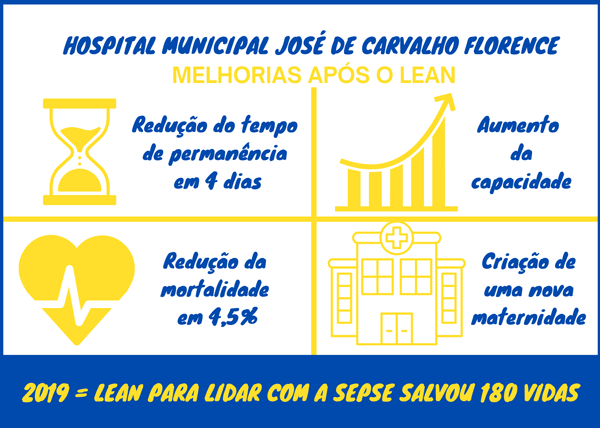
One of the first organizations to see the success of lean at IOV and decide to try it was Hospital Municipal José de Carvalho Florence. Over the years, this organization has achieved impressive results, including a four-day reduction in length of stay, a 4.5% reduction in mortality, increased capacity and the creation of a new maternity ward. In 2019 alone, its lean work to improve the way it dealt with sepsis allowed it to save 180 lives! None of this went unnoticed: the improvements caught the attention of the Municipal Health Department, which asked to visit the hospital (as well as IOV) to see how they were managing their logistics.
Lean in supplying the units
The Municipal Health Department provides and manages infrastructure, staff and supplies (all kinds of medicines and materials) for the city’s 46 primary care units. Before lean was implemented, the process was chaotic. Deliveries to each primary health unit were made once a month in large batches.
A value stream mapping exercise highlighted the shortcomings of this batch-based system and revealed the average time to supply a primary health unit in São José dos Campos: it was 240 minutes. There were bottlenecks and delays throughout the process.
With little space to store this material, most units found themselves with entire rooms filled with boxes. This meant that there was often little or no visibility of which medicines were available and in what quantity. As a result, it was “easier” to simply reorder a given medicine as an emergency delivery (which sometimes took less than 24 hours). There was no control over inventory. For the Health Department, this meant that emergency deliveries had to be scheduled once or twice a week for each primary care unit.
Having to supply primary care units in large batches also meant that the Health Department had to carry large quantities of inventory in its central warehouse, on the order of 500,000 units per month.
Inspired by the lean work it had already seen in other health organizations in the city, the Health Department changed its supply system, moving to weekly deliveries of small batches to each primary care unit and trying to limit the number of emergency supplies.
With smaller, more frequent deliveries, both the central warehouse and the units saw several immediate benefits.
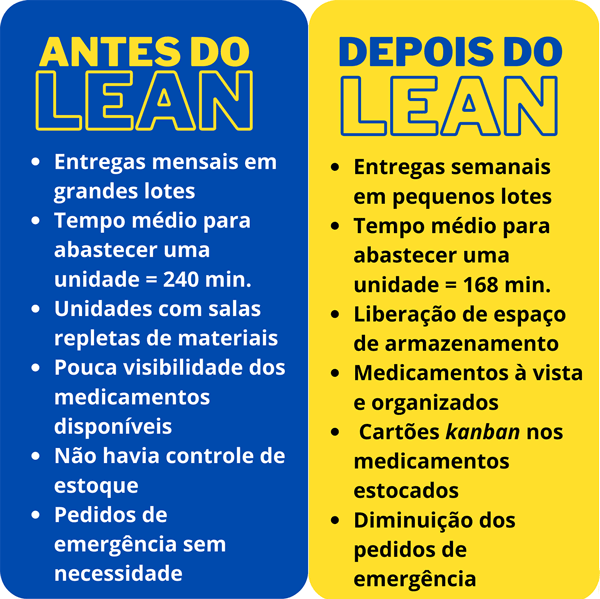
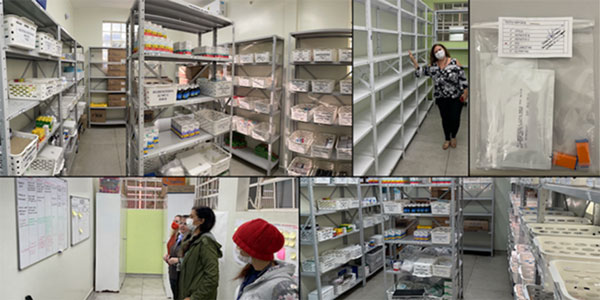
First of all, they were all able to save space. The central warehouse now carries 175,000 items per month, well below the previous half million, while most units were able to free up an entire room and put items on the shelves as soon as they are delivered. This made picking easier for the central warehouse staff and brought inventory visibility to the units. As a result, the number of emergency deliveries requested fell.
In this context, the introduction of a kanban system was fundamental: each item now has a kanban card attached to it indicating the replenishment efforts. A green card means the item is available; a yellow card means an item needs to be replenished, but can wait until the next scheduled delivery; a red card means the item is out of stock and needs to be replenished immediately. Of course, with weekly deliveries, no care unit is left waiting for a medicine or another item for more than a day or two, even when it runs out. If an emergency delivery becomes necessary, a milk run type system ensures that the item can “ride along” with one of the delivery vehicles, based on the route they follow and the destination unit.
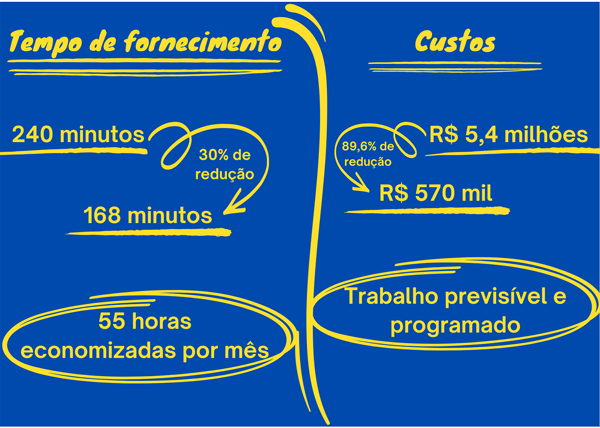
By redesigning the flow and changing the way it organized and delivered inventory, the Health Department was able to reduce the supply time per unit [setup time] to 168 minutes on average (down from the previous 240 minutes). This represents a 30% gain per unit, which, multiplied by 46, equals 55 hours saved per month.
They also reduced overall logistics costs by 89.6%: in 2019, they spent R$ 5.4 million, while today they spend only R$ 570 thousand. These were transportation costs: before lean was introduced, a contractor was used to fulfill the countless emergency deliveries the Department received. Today, they use predefined daily routes (having canceled most of the contracts with the delivery company) to complete weekly deliveries and meet the occasional emergency orders. By eliminating unscheduled emergency deliveries and redesigning the flow, the amount of work decreased; the nature of the work also changed: it is no longer firefighting, but predictable, scheduled work.
Improving blood sampling
Another interesting logistics project the Health Department completed focused on blood sampling. The Department has a central laboratory that analyzes blood samples from all 46 primary health units in the city. Before lean was introduced, there was a huge bottleneck that caused very long waits for the sample to be drawn (which, in turn, directly impacted the follow-up appointment with the doctor and any subsequent course of action). For an urgent blood test, it took 7 days to get the results back. For routine blood tests, up to four months.
Once the blood sample arrives at a laboratory, it is tested within two or three hours. After all, it is machine work. So the problem is how long it takes for the sample to reach the laboratory. Before, there was no flow. With a complicated, bureaucratic process that had several duplicated steps, it was hard to imagine that things could improve. The units routinely used less capacity than they had available. They often had to reschedule appointments (whenever patients showed up unprepared – either because they had not fasted as instructed or because they had not brought a urine/stool sample). In addition, the system did not automatically remove from the schedule patients who – for whatever reason – brought their appointment forward.
The proposed countermeasures included eliminating the physical appointment book, having the doctors themselves schedule the sampling when they ordered it, which in turn increased the number of appointments in line with actual capacity. The Department sent guidelines to all the city’s primary health units, instructing them to optimize the use of materials, reduce the number of steps in the sampling process and simplify it, as well as asking doctors to print the instructions for the patient together with the prescription.
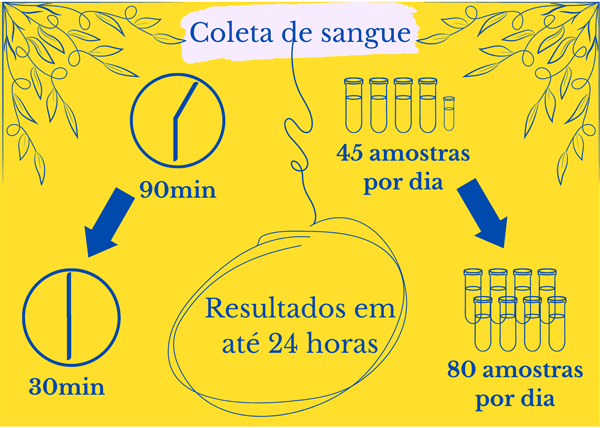
The new sampling process and the redesigned flow helped primary health units across the city save an hour in the blood collection process (it used to take about 90 minutes, and now takes between 30 and 45 minutes), which in turn allowed the central laboratory to process 80 samples a day – up from the previous 45. In other words, they doubled capacity. Today, patients receive their blood test results within 24 hours, for both urgent and routine tests.
This story is a testament to lean’s ability to inspire improvement and spread like wildfire. All it needs is fertile soil!







