
Operational failures and abnormalities are temporarily contained, but reappear shortly afterward because the root cause was never eliminated.
Problem solving
Develop scientific thinking at every level of the organization to distinguish problems, understand causes, test countermeasures and turn each problem-solving cycle into shared learning, reducing reactive decisions and developing people capable of tackling increasingly complex problems.
Go to the gembaObservation at 10 a.m. · Ward B
Countermeasure under testTreated as a hypothesis · cycle 2
Mentor's question“How do you know that?”
Challenges
The challenge of no longer solving the same problem over and over
Many organizations are quick to act when a deviation arises. The challenge is that speed of reaction does not necessarily mean quality of solution.
When the current condition is not understood, the organization may eliminate the effect for a moment without changing what produces the problem. As a result, the same operational problems, quality failures and delays come back month after month.
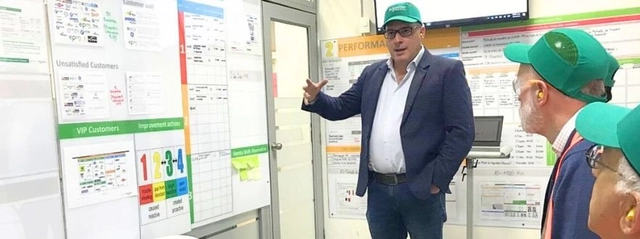
Problem solving in the lean approach was developed to replace guesswork with the scientific method, enabling professionals to go to the gemba and understand what type of problem they are facing, what the gap is between the standard and reality, and which hypotheses need to be tested.
Action plans are rushed into place based on “I think”, without careful gathering of facts and data or direct observation of the actual work.
Faced with an abnormality, teams jump straight to implementing new tools or software without first clearly defining the exact problem to be solved.
The organization responds to deviations by punishing people instead of analyzing the weaknesses in the processes and standards that allowed the error to occur.
Simple day-to-day problems (immediate containment) are handled with excessive bureaucracy, while complex strategic challenges are tackled with superficial solutions.
Successful solutions stay with the people who carried them out and are neither documented nor turned into new standards for the rest of the company.

Transformation
What is the Problem Solving approach (A3 Method)?
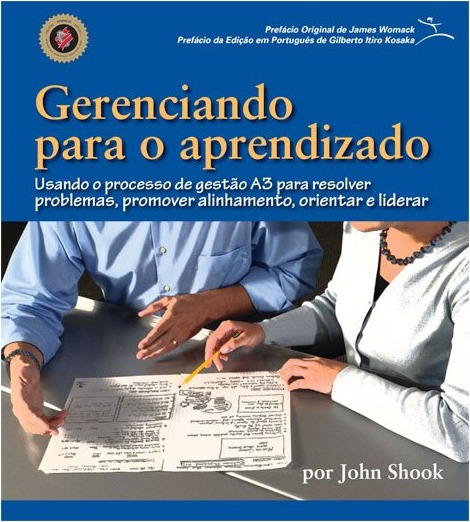
It is a structured process of dialogue, investigation and learning based on the PDCA (Plan-Do-Check-Act) cycle, which uses a single A3-size sheet of paper as a visual guide to synthesize scientific reasoning. The A3 is a mechanism for developing cognitive skills that teaches leaders and employees to see reality, structure hypotheses, experiment with countermeasures and consolidate new levels of performance.
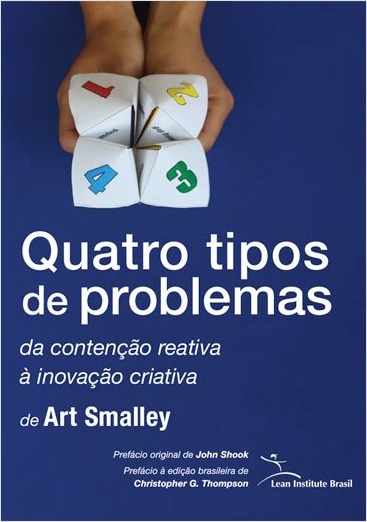
Lean Institute Brasil structures problem solving around the Four Types of Problems typology (Troubleshooting/Containment, Gap from Standard, Target Condition/Raising the Standard and Open-Ended Innovation), ensuring that the organization uses the right tool and the right level of rigor for each challenge.
In lean management, the plan starts a cycle of testing and learning. The more people can work on problems methodically, the greater the organization's ability to react, learn and evolve without always depending on escalation.
What transformation do we aim to create?
By building a scientific problem-solving capability, the organization develops sustainable autonomy and turns operational failures into levers for high performance.
-
For the business
Fewer recurring problems, more consistent decisions, less rework caused by fragile solutions, better use of the organization's knowledge and a greater ability to respond to new situations.
-
For management
Better-defined problems, clear escalation criteria, fact-based decisions, follow-up of countermeasures and a stronger connection between problem solving, priorities and the management routine.
-
For people
Greater ability to observe, ask, analyze, test and learn; more autonomy to tackle problems; development of critical thinking and less dependence on specialists to find answers.
How do we structure this transformation?
Approach
Methods and practices Capabilities developed
-
The Four Types of Problems typology
Training to place each deviation in its correct category. A well-defined problem sets out context, impact and scope, and keeps the organization from starting with the solution.
-
Storytelling and the architecture of the A3 Process
Structures the reasoning needed to understand context, current condition, target, causes, countermeasures, plan and follow-up. It also serves as a tool for dialogue between the person solving the problem and the person guiding their development.
-
Direct observation and facts
Disciplined use of cause-and-effect tools close to where the problem happens. Data, observations, records and evidence replace unverified interpretations and help build a shared understanding of the current situation.
-
Scientific experimentation and hypothesis testing
Countermeasures are treated as hypotheses. The organization plans, experiments, checks the effect produced and adjusts its understanding and actions based on the observed result.
-
Coaching and development through the problem
Using the A3 as an executive mentoring mechanism, in which leaders learn to guide through reflective questions that challenge and develop the thinking of the study's author without automatically taking over the solution.
Journey
How does LIB guide this journey?
-
1
Identify relevant problems
Understand which problems most affect customers, people, processes and results, and where the need to develop internal capability is greatest, establishing the scope of the A3.
-
2
Understand the current situation and the nature of the problem
Go in person to where the work happens to gather facts, data, flow and metrics, breaking the overall problem down into specific points to assess whether the situation calls for moving to a better condition or developing an innovative solution.
-
3
Investigate the root cause and define the target
Analyze cause-and-effect relationships with the cross-functional team, applying direct tests to confirm the real root causes and thus make explicit what needs to change, what condition must be achieved and what evidence will make it possible to assess progress.
-
4
Develop and test countermeasures
Define actions consistent with the analysis, treat each countermeasure as a hypothesis (running controlled tests in rapid cycles) and observe the effect produced on the work.
-
5
Check the results and validate the impacts
Compare the observed result with what was expected, understand the differences and decide whether the hypothesis should be kept, adjusted or discarded.
-
6
Standardize the process and spread the learning
Make the knowledge produced accessible, develop new people and build problem-solving capability into the management routine.
Integrated practices
Practices integrated with
problem solving
Problem solving gains sustainability and reach when it connects with other approaches.
Daily Management
Makes deviations visible quickly, helps distinguish what the team can handle from what needs to be escalated, and creates a regular cadence for following up on countermeasures and learning.
Strategy Management (Hoshin Kanri)
Uses the A3 methodology as the vehicle for detailing and closing the business's major strategic gaps, keeping the organization from mobilizing resources for issues that do not change what really matters.
Lean People / Lean Leadership
Develops leaders who can guide without taking the problem over, ask questions, challenge hypotheses and use real situations to develop other people.
Skills development
Helps turn lessons learned from problem solving into new standards, ways of teaching and capabilities available on the job.
Evidence
When the problem starts generating knowledge
Company:
SMC
Industry:
Automotive components industry
-
Situation:
The company sought to transform its management and respond more quickly to a competitive market. It needed to connect its improvement initiatives, give the areas a common direction and create the conditions for problems to be understood and addressed in a structured way.
-
Approach:
With support from Lean Institute Brasil consultants, SMC developed a strategic A3, the “mother A3”, to guide the company's lean journey. The document organized the diagnosis, set priorities and guided the creation of the SMC Brazil Operations System, SSBRO. Building on it, the company carried out value stream mapping and improvement actions in the prioritized areas.
-
Result:
Lead time reduced from a current state of 83.9 days to a projected future state of 56 days. For some products, delivery time fell from up to six days to up to six hours, with production and delivery on the same day the order is confirmed.
Source: Lean at SMC: a “Brazilian recipe” for transforming a company worldwide — Lean Institute Brasil.

Frequently asked questions
No. The paper itself is only the visual support. The real value of the A3 lies in the thinking process it imposes: the discipline of going to the workplace, investigating facts without preconceptions, talking with the people involved, testing hypotheses scientifically and recording the learning. Filling it out as a mere bureaucratic exercise defeats the purpose of the methodology.
No.
The depth of the approach should be proportional to the nature, complexity, impact and recurrence of the problem.
Simple situations may require only containment or direct analysis. More complex problems may justify a structured A3.
The A3 helps make problem-solving reasoning visible, while PDCA provides the logic of experimenting, checking and adjusting.
In practice, both rely on scientific thinking: understanding the situation, building a hypothesis, acting, observing the result and learning.
They are structured categories of operational deviations:
- Type 1 (Containment);
- Type 2 (Deviation from standard);
- Type 3 (Target condition);
- Type 4 (Innovation).
The first two mainly respond to problems that are caused. The last two involve problems created deliberately to reach a better condition or develop something new.
It is a practice of asking “why?” in succession to trace the causal chain of a deviation back to its original process failure. The secret of lean is that each “why” must be verified empirically in the gemba with facts and tests, avoiding armchair deductions or speculation.
A stopgap fix only attacks the symptom or contains the damage temporarily (e.g., adding an extra inspection step). A lean countermeasure acts directly on the causal mechanism that allowed the error to occur, structurally preventing it from happening again.
The A3 builds competence because it turns the leader into a mentor. Instead of handing over a ready-made solution, the manager asks questions that challenge the A3's author to deepen their analysis, observe reality and create test hypotheses based on the scientific method.
Yes. The scientific method does not depend on the sector. In services, IT, finance and hospitals, the A3 is essential for diagnosing slow approvals, recurring software bugs, tax discrepancies and delays in customer service flows.
It depends on the complexity of the problem. Deviation-from-standard problems (Type 2) are usually investigated and solved within a few weeks. Strategic standard-raising problems (Type 3) may involve 3- to 6-month projects with iterative follow-up cycles.
Assessment
What recurring problem
does your organization need
to solve for good?
Tell us about the chronic quality issues, delays or unexpected costs that keep reappearing in your company. Share the operational context, what has already been tried and the results you want to achieve. Our experts are ready to design the ideal high-performance architecture for your business.

