
Teams wait for answers or approvals on issues they could analyze and solve closer to the work, increasing dependency and slowing things down.
Lean People / Lean Leadership
Develop leaders who can set strategic direction, foster psychological safety, promote genuine respect and build an environment of continuous learning focused on high performance.
QuestionBefore giving the answer
“What is keeping you from moving forward?”
Centralized decision-making8 out of 10 decisions go to the top
Autonomy criteria being defined
Feedback conversation1:1 · line supervisor
Challenges
The challenge of evolving
culture and leading people
The way leaders set priorities, respond to mistakes, run conversations, demand results and react when someone points out a problem teaches, every single day, which behaviors are truly expected.
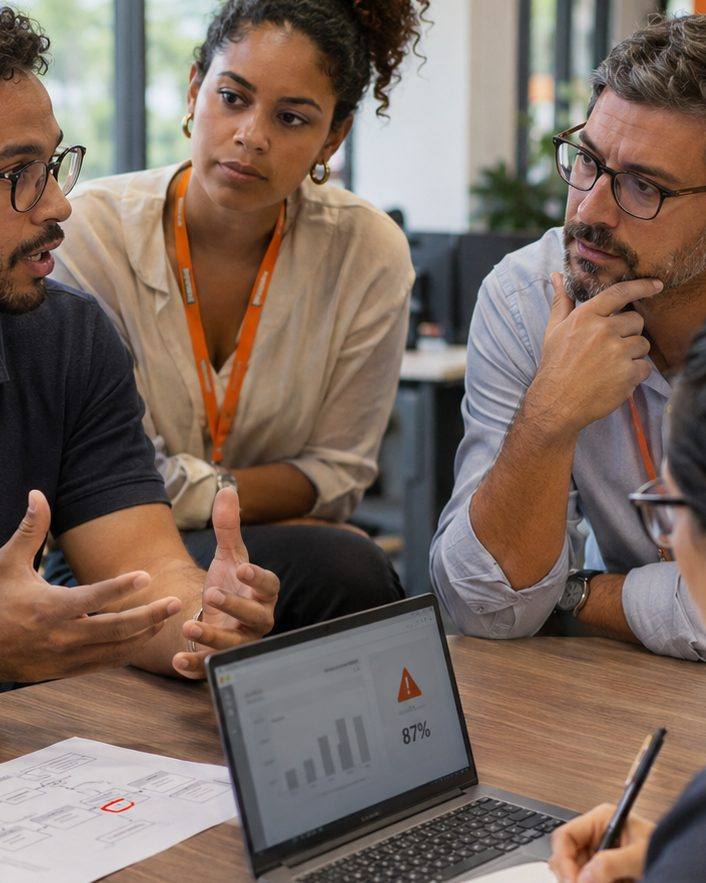
When a command-and-control culture prevails, people hesitate to expose problems for fear of punishment, decisions stay concentrated at the top, and leaders spend their energy chasing targets instead of removing obstacles and developing teams.
The Lean People / Lean Leadership track acts on these conditions. The goal is to help leaders build systems and behaviors consistent with a learning organization: clear direction, dialogue, respect, accountability, problem-solving capability and the safety to bring hard facts into the conversation.
People avoid exposing failures, disagreeing or questioning decisions for fear of reprimand, which keeps the root cause of problems from being identified and addressed in time.
Meetings end without visible disagreement, but doubts and objections resurface later, outside the forum where they should have been discussed.
Tensions between areas, people or leadership levels are treated as individual issues, without examining the working conditions, decisions and systems that feed those behaviors.
There are leadership programs, performance reviews and HR initiatives, but day-to-day management practices keep teaching behaviors different from the ones the organization wants to develop.
Lack of support at the gemba and pressure focused only on short-term results create emotional overload in teams and the loss of strategic talent.
Transformation
What is Lean People / Lean Leadership?
It is the set of principles, behavioral models and management practices that places human development and respect for people at the center of business strategy. It starts from the idea that culture is not built only by stated values, development programs or leadership speeches. It is also shaped by the decisions, conversations, routines, incentives and reactions that repeat themselves every day.
In this context, Lean Leadership means creating the conditions for people to understand the direction, see the problems, think about their causes, learn from experience and progressively take on greater responsibility for the work.
This requires combining a demand for results with respect, listening, clarity, discipline and development. It is about building relationships in which problems can be discussed candidly and rigorously without being mistaken for personal failures.
What transformation do we aim to achieve?
By evolving leadership and culture through the lean approach, the organization builds a resilient, innovative environment with sustainable high performance.
-
For the business
Problems exposed earlier, decisions based on more complete information, greater adaptability, less dependence on a few leaders and teams better able to tackle issues that affect customers and results.
-
For management
Leaders with greater clarity about their role, better-quality conversations, more explicit criteria for decision-making and autonomy, problems handled closer to the work and people development built into management routines.
-
For people
More confidence to speak up about difficulties, clarity about responsibilities, the opportunity to build capability through real problems, more consistent feedback and autonomy backed by criteria and accountability.
How do we structure this transformation?
Approach
Methods and practices Capabilities developed
-
The role of leadership
Defining the fundamental behaviors of a leader at different levels and how their actions should contribute to direction, people development, problem solving and results.
-
Psychological safety, listening and trust
Developing the ability to hear facts, doubts, tensions and different perspectives, building a relationship of trust and creating the conditions for problems, mistakes, risks and disagreements to surface while there is still room to act on them.
-
Difficult conversations and feedback
Sharpening the ability to address performance, behaviors and conflicts with clarity and respect, without avoiding relevant issues or turning the conversation into a personal judgment.
-
Autonomy with accountability
A clearer definition of which decisions teams can make, which require alignment and which need to be escalated. Autonomy grows when there is direction, criteria and the capability to decide.
-
Development through problem solving
Using real problems as opportunities to build capability. Instead of handing over the answer right away, leaders help people observe facts, form hypotheses, investigate causes and develop countermeasures.
-
Leadership routines
Building the desired behaviors into everyday practices: performance follow-up, visits to where the work happens, meetings, feedback, decisions, development and recognition.
Journey
How does LIB lead this journey?
-
1
Assess culture and leadership maturity
Identify the business challenges, the current way of managing, the prevailing behaviors and the situations in which leadership is helping or hindering the desired results.
-
2
Observe how management happens in practice
Follow meetings, decisions, interactions and real work situations to understand how direction, follow-up, listening, autonomy and problem solving happen today.
-
3
Make standards and expectations explicit
Build clarity about the role of leadership, the behaviors required and the responsibilities of the different levels of the organization.
-
4
Develop leaders in real situations
Work on concrete problems, conversations and decisions so that new behaviors are tried out in the leaders' own management context.
-
5
Create new leadership routines
Build listening, follow-up, feedback, development and problem-solving practices into existing routines.
-
6
Consolidate the people development cycle
Check whether behaviors and management systems are producing greater trust, autonomy, problem exposure, skill development and the growth of new leaders (leaders developing leaders).
Integrated practices
Integrated lean leadership practices
Leadership develops when new practices become part of everyday management and are connected to the problems the organization needs to tackle.
Daily Management
Creates frequent opportunities for leaders to develop teams, make deviations visible, define responsibilities and respond to problems without automatically taking over their solution.
Skills development
Helps leaders turn knowledge into capability, teach in a structured way and support people's development on the job.
Strategy Deployment (hoshin kanri)
Connects leadership action to organizational priorities, helping translate direction into choices, behaviors and responsibilities at every level.
Problem Solving
Provides a structure to replace opinions and quick answers with investigation, facts, causes and learning, allowing leaders to develop people while problems are being tackled.
Evidence
Leaders who learn on the job and develop their teams
Company:
Leroy Merlin Brasil
Industry:
Home improvement and building materials retail
-
Situation:
The logistics transformation required integrating operations with strategy and developing teams that had until then been focused on operational processes. The company saw the need to broaden its leaders' skills and change the way they think and act.
-
Approach:
Logistics supervisors and managers were trained as multipliers in partnership with Lean Institute Brasil. The development combined on-the-job learning, A3 problem solving and mentoring by the company's own professionals. Each participant had to involve peers and direct reports in building the improvements.
-
Result:
Leaders more present where the work happens and an expanded Daily Management system. The program connected managers' development to operational improvement, with progress in standardization and in the organization of workplaces.
Source: Lean practice driving results in Leroy Merlin's supply chain — Lean Institute Brasil.
Content
Expert knowledge to dig deeper


Frequently asked questions
It is a way of leading that is connected to the real work, to people development and to problem solving. The leader sets direction, helps make problems visible, builds capability and creates the conditions for decisions to be made ever closer to where the work happens.
Traditional programs can develop important knowledge and skills, but they often take place apart from the management routine. In the lean approach, development also happens through real situations: decisions, problems, conflicts, meetings, results follow-up and team development. Leadership behavior has to show up in everyday work.
Psychological safety is the shared belief that the team is a safe place to take interpersonal risks — that is, to expose mistakes, ask questions and propose ideas without fear of punishment. In lean it is indispensable, because without transparent exposure of problems it is impossible to act on the root cause.
Not exclusively. People and HR teams can play an important role, but this track deals with the way the organization is led and managed. That is why it involves executives, managers, frontline leaders and the areas responsible for management systems, in addition to People teams.
Leadership is one of the forces that shape culture, but it does not act alone. Behaviors are influenced by systems for evaluation, recognition, decision-making, goals, processes and routines. That is why transforming culture requires consistency between what the organization declares and what its systems and leaders reinforce every day.
No. The challenges change with the level of leadership. Executives need to set direction and create the conditions for the system to work. Middle management connects priorities and areas. Frontline leaders directly influence the work, learning and the way problems are handled.
The approach can be adapted to each of these levels.
It depends on the challenge, the number of leaders involved and the gap between current practices and the desired conditions. Change can start with specific behaviors and routines, be tested in priority areas and then expanded as learning and results emerge.
C-level engagement is essential. LIB's consulting team works directly with senior leadership through executive mentoring, strategic alignment sessions and support at the gemba, ensuring that executives model the new behaviors for the entire company.
Assessment
What leadership and
culture challenge does your
organization need to transform?
Are decisions overly concentrated? Do problems take too long to surface? Do people avoid disagreeing? Are there recurring conflicts? Do leaders struggle to build autonomy in their teams? Our experts can help you understand how behaviors, relationships and management systems are influencing results and which leadership capabilities need to be developed.

