
New employees need weeks or months to reach the expected level of safety, quality, productivity or autonomy, overloading the team and driving up onboarding costs.
Skills Development (TWI / Training at the Gemba)
Turn tacit knowledge into teachable skills and speed up people development so work gets done with autonomy, quality and consistency.
Structure how knowledge is identified, taught, practiced and followed up to reduce reliance on experts and build capabilities where the work actually happens.
Learning at the gembaShow, practice and verify
Show›Practice›Perform
Concentrated knowledgeWelding relies on 1 person
Training plan in progress
New multiplierAssembly · instructor certified
Challenges
The challenge of developing people and standardizing
how work is done
In many organizations, much of the knowledge needed to do the work lives in the experience of a few people. They know the details, sequences, decisions and precautions that never fully make it into procedures. When they need to train someone, they teach the way they learned, explaining what they consider important and expecting experience to fill in the rest.
The result usually shows up as long learning curves, differences in how people perform the work, recurring errors and dependence on experienced professionals.
The Skills Development (TWI) practice area was designed to structure the organization's practical know-how, make knowledge explicit, identify what really needs to be learned, build the capability of those who teach and create opportunities to practice until people can perform the work independently.
Strategic operations depend on experienced professionals, creating operational vulnerability when these people change roles, leave the organization or simply can't keep up with every training demand.
Without a common baseline for execution, you get variation, rework, quality issues, unstable cycle times and unpredictable swings in the outcome of the same activity.
Traditional classroom courses and lengthy manuals are handed out, but the team struggles to apply what they learned once back in the daily routine on the shop floor or in the office.
Staff turnover breaks the continuity of learning, causing spikes in process errors, scrap and customer service failures.
Technical mastery doesn't guarantee the ability to pass on knowledge. Those who teach may skip critical points they consider obvious or present too much information without structuring the learning.
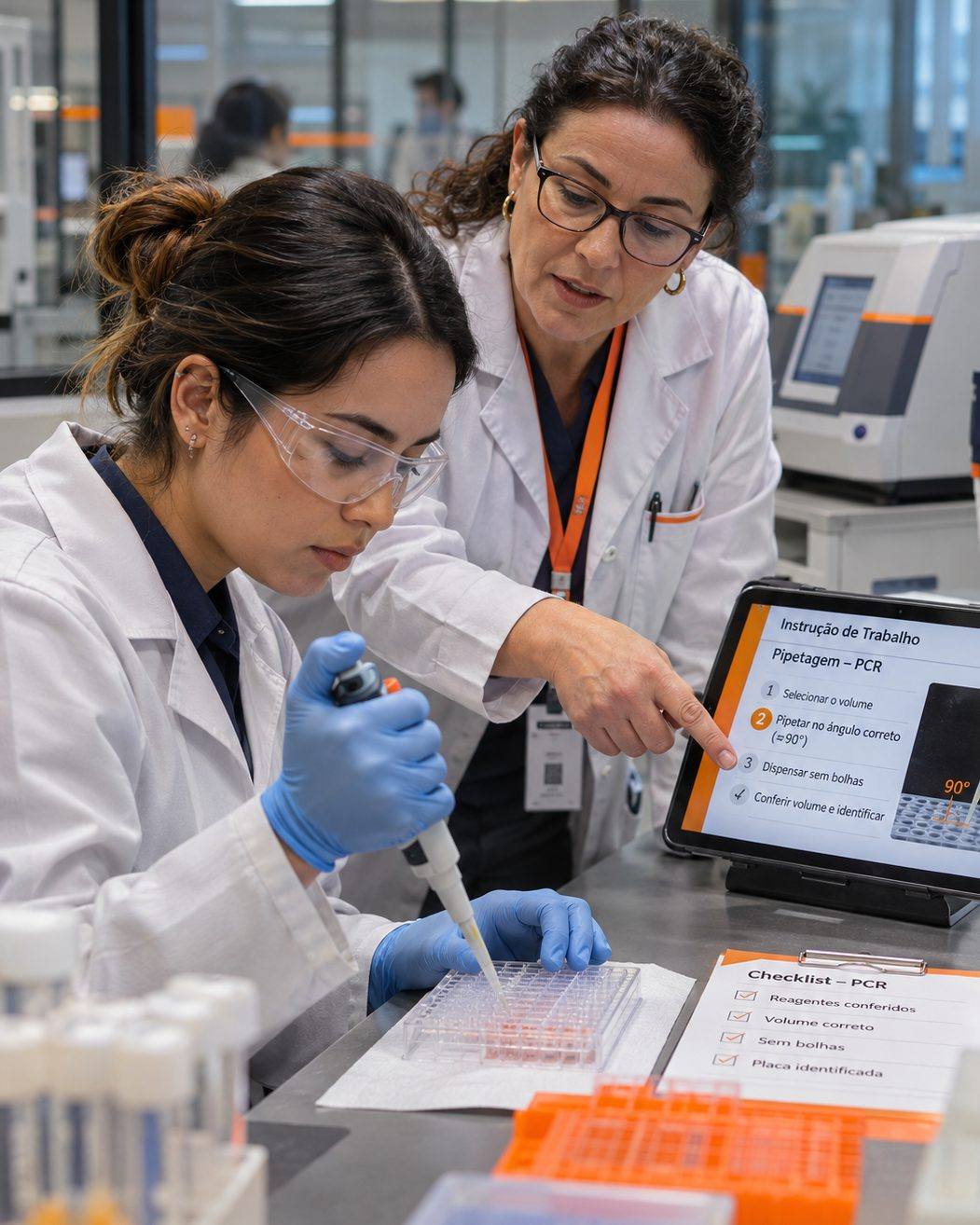
Transformation
What is Skills Development (TWI)?
It is a proven capability-building methodology (Training Within Industry) focused on preparing supervisors, leaders and multipliers to instruct work, improve methods and manage human relations at the gemba. The approach breaks complex tasks down into important steps and key points, ensuring a standardized and effective teaching process.
The approach connects work, standards and learning. Instead of separating people development from daily operations, learning happens close to the real work and can be verified by the ability to perform it. It creates a common foundation for teaching, spotting deviations and continuing to learn.
What transformation do we aim to create?
By structuring TWI, the organization builds a culture of continuous learning in which teaching and learning become core business competencies.
-
For the business
Less time to train people, less dependence on experts, more stable execution, fewer errors caused by variation, greater flexibility to move people between activities and preservation of critical knowledge.
-
For management
Leaders and supervisors prepared to act as true educators at the gemba, clear governance of the team's skill levels through the Skills Matrix and an easier path to scaling the operation in times of expansion.
-
For people
More structured learning, clarity on what is expected from the work, the chance to practice before taking full responsibility, feedback close to the work and progressive development of autonomy.
How do we structure this transformation?
Approach
Methods and practices Capabilities developed
-
Skills matrix
A visual management tool to map the team's current skill level and plan the training needed to cover every position.
-
TWI — Job Instruction
Training in the 4-step method to teach any employee to perform a task correctly, quickly, safely and conscientiously.
-
Dojo
Creates a structured environment to develop skills through deliberate practice. It allows people to experiment, repeat, receive feedback and build mastery before or while applying it to real work, especially when mistakes during learning could create risks, losses or significant impacts.
-
Hands-on learning
Brings development closer to the situation in which the skill will be used. People learn by doing, explain what they have understood, practice the task and receive support until they show they can work independently.
-
Developing multipliers
Develops professionals who can not only perform well but also train others consistently. This expands the organization's development capacity and reduces dependence on a few instructors or experts.
-
Work-oriented development plans
They connect competency gaps to the real needs of the operation, the role and the organization's future challenges. Development stops being a generic sequence of courses and starts responding to the capability that needs to be built.
Journey
How does LIB lead this journey?
-
1
Identify critical skills
Understand which activities, knowledge and competencies most affect safety, quality, productivity, customer experience and work continuity.
-
2
Make knowledge visible
Observe the real work alongside experienced professionals to identify the steps, decisions, key points and knowledge that are currently implicit or concentrated.
-
3
Structure the standard and how to teach it
Organize the knowledge needed to perform the activity and define a learning sequence that makes it possible to demonstrate, explain and practice the essential points.
-
4
Develop those who teach
Prepare leaders, experts and multipliers to guide learning in a structured way, observe difficulties and adjust how they teach when needed.
-
5
Practice and verify performance
Create the conditions for people to practice, explain what they are doing and progressively demonstrate mastery of the activity. Learning is confirmed by performance, not just by attending a training session.
-
6
Track progress and expand capability
Update the skills matrix, monitor gaps, develop new multipliers and build competency development into the management routine.
Integrated practices
Integrated practices to turn learning into capability
Skills development gains strength when teaching is connected to the work, to leadership and to the needs of the process.
Standardized work
Creates a known baseline for performing, teaching and analyzing the work. Without a clear reference, it is hard to tell learning, variation and problems apart.
Daily Management
Makes development needs and execution deviations visible in the daily routine and helps leaders act before competency gaps turn into recurring problems.
Lean People / Lean Leadership
Develops leaders who can teach, coach, give feedback and create the conditions for people to progressively take on greater responsibility for the work.
Local Improvements (Local Kaizen)
Changes to the work method often require new skills. This connection ensures the new standard is learned and adopted, rather than just documented.
Evidence
When learning changes the way people work
Company:
JOST, Caxias do Sul plant
Industry:
Commercial vehicle components manufacturing
-
Situation:
Accidents and quality problems showed that classroom training was not ensuring standards were applied on the job. The difficulty in following safety rules also involved leadership, leading the company to rethink its approach to training.
-
Approach:
Implementation, in partnership with Lean Institute Brasil, of a dojo — a learning environment with simulations and hands-on activities that closely mirror the reality of the operation. The work included developing internal instructors, preparing standardized materials and training managers and teams in safety, standardization and problem solving.
-
Results:
400 people completed the training from its launch in July 2023 to the report published in May 2024. Customer complaints fell from 24 to 9 when comparing the last quarters of 2022 and 2023. The initiative also improved risk identification, with a 110% increase in unsafe conditions reported by the teams.
Source: Dojos change minds — Lean Institute Brasil.


Frequently asked questions
It is building the capability to perform and teach work in a structured way.
The approach seeks to identify which skills are needed, make important knowledge explicit, create opportunities to practice and support people until they can perform the activity independently.
Training can convey concepts or present a way of performing an activity.
Skills development requires verifying that what was taught can actually be applied in practice.
That is why it involves demonstration, repetition, feedback, follow-up and assessment of on-the-job performance.
Training Within Industry, or TWI, is an approach created to develop capabilities directly tied to the work.
Its programs include Job Instruction (JI), designed to help supervisors and instructors teach activities in a clear, practical and consistent way.
While traditional training usually focuses on theory classes away from the workstation, TWI takes place 100% at the gemba (where the work actually happens), is delivered by the operational leaders themselves and uses learning by doing until the employee performs the task without errors.
It is a structured environment for hands-on learning.
There, people can develop knowledge, behaviors and skills through demonstration, repetition and feedback, creating the conditions to practice before or while applying them to real work.
Not necessarily at the same level of detail. The degree of structure should take into account the activity's complexity, risk, frequency, variation and impact.
The goal is not to produce excessive documentation, but to make teachable what is critical for good execution.
No. A standard creates a common reference for the best-known way to do the work at that moment.
This makes it possible to distinguish an abnormality from a deliberate choice, teach more consistently and create a foundation on which the work itself can keep evolving.
It should show the capabilities the work requires and people's level of mastery of those capabilities.
Its purpose is not to record courses taken, but to help leaders see risks, gaps, training needs and opportunities to increase flexibility and autonomy.
The person who teaches needs to master the activity and also develop the ability to teach.
In many cases, leaders, supervisors, specialists or experienced professionals can take on this role after learning a structured way to prepare, demonstrate, practice and follow up.
No. The principles can be applied to industrial, administrative, logistics, healthcare, service, customer support and other work that requires developing knowledge and the ability to perform.
How it is applied changes according to the nature of the skill.
It depends on the number and complexity of critical skills, the number of people involved, the current state of standards and the existing capacity to teach. The work can start with a priority activity or area, test the model and expand progressively based on what is learned.
Assessment
What skills
development
challenge does your
organization need
to transform?
Tell us how skills are developed today. Share the context, the operational area and the results you want to achieve. Our experts can help you understand which capabilities need to be developed and how to structure a learning system connected to the real work.

