
Deviations only reach leadership once deadlines, quality, productivity or customers have already been affected, drastically reducing the ability to respond.
Daily Management (DM)
Build a living structure of visual management and daily routines that makes deviations visible, speeds up problem solving, connects daily execution to business goals, turns leaders into mentors and develops people while the work gets done.
Daily huddle08:30 · 15 min · at the board
ALMRJS+5
Deviation flaggedQuality · Cell 2
Countermeasure underway
Help chainL1›L2›L3
Challenges
The challenge of managing performance while the work is happening
Many organizations have goals, indicators and review meetings, yet they still discover problems too late. Deviations pile up, reach leadership only after they have already caused damage, and the routine becomes dominated by emergencies, pressure for results and corrective actions.
Daily Management brings management closer to the real work. It creates a cadence for comparing expected and actual performance, making abnormalities visible and quickly mobilizing the people closest to the problem.
Indicators are presented and discussed, but there is no clear dynamic for turning gaps into ownership, help and countermeasures.
Much of managers' time is consumed by escalations, follow-ups and personally solving problems that could be handled closer to their source.
The numbers are tracked, but they don't always make clear what the expected condition is, what the deviation is and what action needs to happen.
Teams closest to the work stop developing the ability to recognize abnormalities, understand causes and take part in building the responses.
Corporate goals exist, but they have not been translated into commitments and variables that the people doing the work every day can track and manage.

Transformation
What is Daily Management?
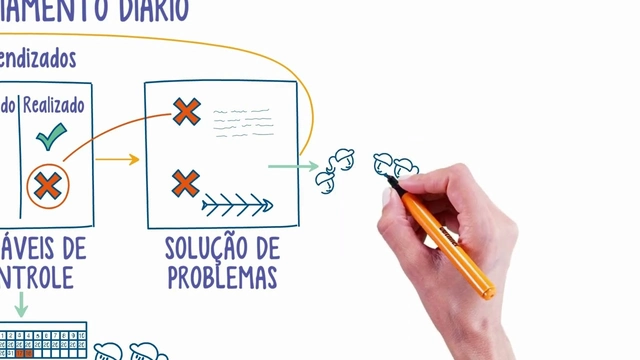
In the model promoted by Lean Institute Brasil, Daily Management is a process for achieving the objectives set by strategy through daily targets, follow-up and the solving of emerging problems. With clear commitments, relevant indicators, visual management, a help chain and structured problem solving, teams and leaders can quickly understand the difference between expected and actual performance.
It brings the management process closer to where value is created. Instead of waiting for a monthly meeting to find out something went off track, the organization develops mechanisms to recognize the deviation when it happens and address it while it is still close to its source.
Daily Management also changes people's relationship with problems. Instead of hiding a deviation, justifying it or simply passing on the responsibility, teams learn to expose abnormalities, ask for help when needed and take an active part in the solution.
What transformation do we aim to create?
By bringing strategy, management and real work closer together, Daily Management shortens the time between a problem occurring and the response to it. At the same time, it turns the daily routine into an environment for people development and organizational learning.
-
For the business
More predictable results, early identification of risks, faster response to deviations, more stable processes, productivity and quality gains, and the ability to adapt to change.
-
For management
Clearly defined commitments and expectations, indicators connected to objectives, transparent exposure of the gaps between actual and expected, a structured help chain and decisions based on facts gathered close to the time and place where the problem occurs.
-
For people
Teams able to recognize abnormalities and empowered to expose and contain problems, take ownership of their own work and ask for help without fear of punishment (psychological safety), with frontline leadership strengthened through standardized work and management acting as a true help chain.
How do we structure this transformation?
Approach
Methods and practices Capabilities developed
-
Commitments connected to strategy
A clear definition of the results each area and team is accountable for, ensuring that everyday work is tied to the organization's broader objectives.
-
Control variables and indicators
Selecting a few measures that show whether the process is creating the conditions needed to meet its commitments.
-
Visual management
Visual organization of expected and actual performance so that deviations can be recognized quickly by everyone involved, provided it is backed by clear standards for the desired condition.
-
Daily Management meetings
Short, focused routines held close to the gemba to understand performance, identify gaps, assign responsibilities and mobilize help.
-
Help chain
A structure that defines when a problem can be handled by the team itself and when it needs support from other levels or areas of expertise.
-
Problem solving
Every relevant gap calls for an appropriate response. Daily Management helps distinguish situations that require immediate containment, root cause investigation, progress toward a target condition or innovation.
-
Psychological safety
Building an environment where people can surface problems, mistakes and difficulties without bringing a deviation to light being equated with a hunt for someone to blame.
Journey
How does LIB guide this journey?
-
1
Understand the context
Investigate strategic objectives, area commitments, processes, current indicators, management routines, leadership structure and the main performance problems.
-
2
Diagnose before prescribing
Observe the work at the gemba and understand why deviations are not being identified or addressed in time, distinguishing symptoms from causes in the management system.
-
3
Define relevant commitments and variables
Connect strategic objectives to what each team needs to deliver and to the conditions that must be tracked to anticipate problems.
-
4
Build and test the system
Develop boards, routines, forums and help mechanisms directly with the teams, testing them in real work before scaling up.
-
5
Develop teams and leaders
Use everyday problems as opportunities to develop observation, reasoning, communication, coaching and problem-solving skills.
-
6
Measure, reflect and adjust
Assess whether the new system is shortening response times, improving performance and building autonomy, adjusting indicators, cadences and help mechanisms whenever needed.
Integrated practices
Integrated practices to sustain execution
Daily Management gains strength when it is connected to strategy, leadership and problem solving, creating the everyday environment where these capabilities come together.
Strategy management
Connects everyday commitments to the priorities set by the organization. Hoshin provides direction; Daily Management makes it possible to check every day whether execution is moving in that direction.
Lean leadership
Develops the behaviors needed to keep the meeting from turning into a blame session. Leaders learn to observe, ask questions, develop people and mobilize help.
Problem solving
Structures the response to the gaps identified by the system, selecting the right approach for the nature and complexity of each problem.
Skills development
Ensures that people and teams build the competencies needed to take on progressively greater responsibility for their own work.
Evidence
Real results in a business environment
Company:
Construtora Ápia
Industry:
Construction and infrastructure
-
Situation:
A dam-raising project showed wide variation in daily output, truck queues and difficulty adjusting resources to operational changes. Monitoring focused on volume produced, without giving the same visibility to productivity and equipment utilization.
-
Approach:
Implementation of Daily Management with visual management boards, meetings at the work fronts, productivity tracking and a help chain connecting the field and engineering. Leaders began following the operation more closely and supporting the solution of problems identified by the teams.
-
Result:
More than R$ 1 million in cost reduction across the two work fronts, with better sizing and use of the truck fleet. Costs fell 4% in materials processing and 7% at the dam front, and the project was completed on schedule.
Source: Daily Management in Construction — Lean Institute Brasil.
Resources
Expert knowledge to dive deeper


Frequently asked questions
A daily meeting is just one of the possible practices in the system. Daily Management connects strategic commitments, control variables, visual management, the help chain, problem solving and leadership development. Without these links, the meeting risks becoming nothing more than a status update.
No. Visual management helps make performance and abnormalities understandable, but it is only one part of Daily Management. A complete system also needs to define commitments, owners, response mechanisms, help and problem solving.
Traditional meetings tend to look at the past (monthly or weekly reports), last for hours and focus on finding justifications or someone to blame. Daily Management focuses on the present and the next 24 hours, lasts 15 minutes at most, takes place standing at the visual board in the gemba and has a single goal: to identify anomalies quickly and trigger the help the front line needs.
There is no universal duration. The reference published by LIB describes short, frequent meetings held close to the work, but the design must respect the nature of the process, the management level and the purpose of the routine.
Red should make an abnormality visible, not signal blame or failure. The team needs to understand the gap, check whether it can handle it locally and, when necessary, trigger the help chain or an appropriate problem-solving method.
No. One of the goals of Daily Management is precisely to build the capability to solve problems as close to their source as possible. Leaders step in when the team needs help, resources, decisions or the removal of obstacles beyond its authority.
Yes. The principle does not depend on a production line. Any environment with commitments, work, expected performance and problems can build tracking and response mechanisms suited to its context.
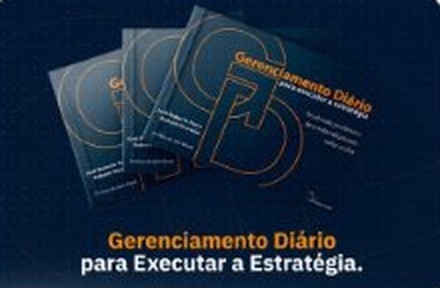
Hoshin Kanri helps define and deploy strategic priorities. Daily Management tracks whether the conditions and results needed to execute them are being achieved in everyday work. That is why LIB's own book presents Daily Management as an ally for executing strategy sustainably while the organization builds capability and adapts to change.
The Help Chain is the mechanism that inverts the traditional command-and-control pyramid. It sets clear escalation rules: if an operator, analyst or nurse identifies a problem they cannot solve within a given time limit, the immediate leader is called in to help remove the obstacle. If the deviation persists or requires cross-functional resources, the issue escalates to managers and directors in a structured way.
Visual boards become obsolete when they are imposed as a bureaucratic obligation or when the problems recorded on them are ignored by leadership. Daily Management is sustained when the team sees the board as a useful tool for asking for help and when leaders keep up the discipline of their Standardized Work, taking part in the routines every day to teach, support and resolve real obstacles.
Assessment
How does your organization
react when results
start to drift off target?
Tell us how your day-to-day management works today. Share the context, the result you want to achieve and where execution is running into difficulties. Our experts are ready to design a high-performance management routine.

