

How insurers are tackling problems in this changing scenario
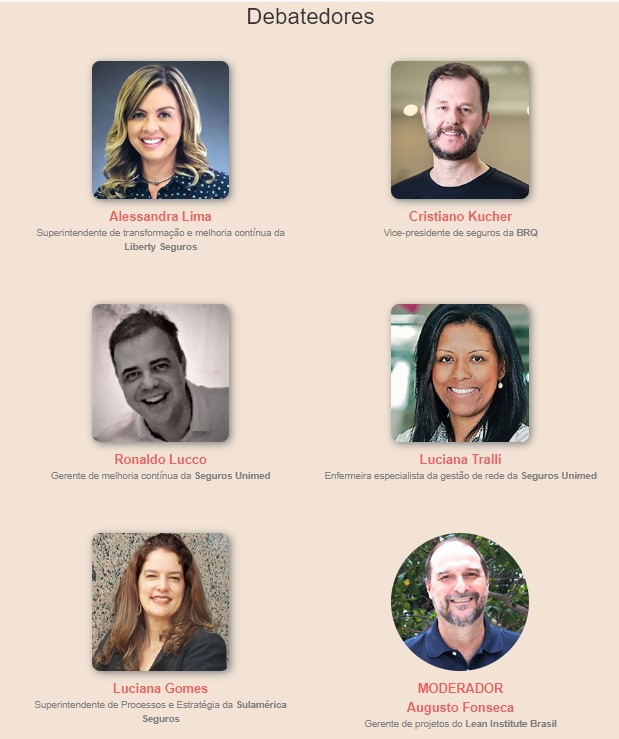
The webinar “Lean in Insurance Companies”, held on June 4, brought together five leaders from four major insurers to talk about how their organizations are creating quick responses to deal with recurring problems in view of the new normal. Below, we have gathered some highlights from this meeting, with very valuable reflections and lessons.
Liberty on focusing on the future: The importance of anticipation
When we think about the changes brought about by the pandemic, we cannot help but think about people and how everything is affecting us. The changes are overwhelming everyone, and this is an opportunity for companies to understand what is happening and use strategies so that the next transitions and changes that will inevitably happen in the future affect everyone involved in the processes to a lesser degree.
With the shift to the digital world, many companies are feeling lost, which makes their employees, partners and customers feel the same way. In scenarios of major change like the one we are living in, a smoother transition to the new normal can only be ensured if people are empowered to act and solve their own problems. The question that remains is “how do we do that?”. For inspiration, we can look at Liberty Seguros, which has been on the lean journey for 12 years and shared the interesting experiences it has been having lately.
First of all, it is necessary to keep in mind that empowering people is not something that happens overnight; it takes time. Therefore, when we think about empowerment, we will necessarily be thinking about the future, with a long-term view. To create the conditions for people to feel empowered, three major areas need special attention: mindset, capability building and systems.
We can see at Liberty how the company’s focus on promoting the right mindset, building people’s capabilities and adjusting systems so that people have the conditions they need to succeed allowed the company to reap good rewards during the pandemic at three levels: its employees, its partners and its customers.
- When we think about employees, remote work is the big novelty now with the pandemic, and this is something that tends to cause them a great deal of stress. Liberty Seguros already had 44% of its workforce working from home office before the pandemic. Now, faced with this new scenario, since people were already used to this type of work (mindset), trained to work from home (capability building), and the company’s systems were already prepared for this type of work (systems), it did not have much difficulty moving 100% of its employees to this new way of working. It is also interesting to note that this change increased employee satisfaction at the company without reducing productivity.
- When we think about the partnerships companies have, digital technologies are becoming more widespread with the pandemic, which can be a challenge for the company’s partners. Liberty had already had virtual branches since 2015. When the pandemic arrived, since the ground was already prepared for it, the digital branches were easily scaled up without partners suffering much.
- Finally, regarding customers, the greater use of technologies required in the current context is also a source of concern for many companies. With a self-inspection process implemented in 2017, Liberty had already faced at the time the initial resistance that comes with every innovation. Today, since self-inspection was already a practice at the company, resistance from customers, who are already familiar with the technology, was much lower.
The key here is always to think about the future. By empowering employees, partners and customers, focusing on spreading the right mindset, building people’s skills and developing a system that allows people to succeed, the company will lay the foundations so that, in the future, everyone can respond very quickly to any kind of change that happens.
Unimed on focusing on the five whys: the importance of getting to the root cause
Companies always need to solve problems, whether in the current scenario or in an in-person work scenario. However, when conditions are unknown, it becomes even harder to understand the causes of the problems we face. That is why the five whys tool, which seeks to get to the root cause of a problem, is more important today than ever for us to respond quickly to the problems that naturally arise in this new normal.
Unimed, for example, is only a short way into its lean journey, but it can already identify the gains from implementing the philosophy. Having started its lean implementation in 2019, Unimed focused its initial efforts on the network management area, which was responsible for 55% of customer complaints. Working with a pilot in this area, Unimed identified some pain points that were hurting its processes:
- Requests were not met on time.
- The flow did not meet current needs.
- There was no standard for receiving requests from internal customers.
- Employees were unaware of some system features.
- Policyholders had difficulty finding services on the website.
- The provider network was insufficient.
Based on these pain points, the company carried out a cause analysis, identifying opportunities and defining countermeasures to tackle each of them. The pilot achieved very positive results in early 2020, such as reducing the average CRM response time from 11 days to just 2, reducing late requests from 51% to 24%, and creating a communication method with the call center, among others.
Lean was clearly helping Unimed; however, another challenge soon arose with the pandemic that is ravaging us today. Being a beginner on the lean journey and having to face a scenario like this is not easy, but the company had gained important learnings in its pilot that served as a basis for dealing better with this pandemic. The work continued, and the focus is on continuous improvement. And one important lesson that remained was: difficulties and problems will always appear (and in this crisis they multiply very quickly), but as long as we are seeking the root causes of problems and developing countermeasures, which must always be followed up, we can be sure that we are on the right path to overcome these problems and overcome this pandemic.
SulAmérica on focusing on adaptation: The importance of constantly adjusting
The reality we are living is unique for all of us. Even those who already have experience with remote work and digital tools had never seen them used on such a global scale as today. We are entering unknown territory, and that is frightening. What can we do to succeed in an environment we barely know? The answer here is to learn. We need to learn, and that means experimenting and, consequently, making mistakes. Experimenting and making mistakes is certainly vital, but it is not the only way to learn: we can look at what other companies are doing in order to grow from shared experiences. That is why we can look at SulAmérica to learn how to create rapid responses in this crisis.
With a journey of more than six years, SulAmérica already had many lean tools in the right place when the pandemic arrived. However, that does not mean it did not face problems. Planning and preparation are essential, but we need to keep in mind that the unexpected will always happen and, therefore, we need to be ready to react quickly and adjust whatever is necessary to succeed. SulAmérica realized the need to act and adjust some of the lean tools it was already so used to, such as the following, among others:
- Daily Management (DM): Doing DM through digital tools is very different from doing it in person. For it to be effective, you need to know how to use the available tools to their full potential (tools such as Google Drive, Meet, Trello and Miro, for example, can be very valuable). As an experiment, SulAmérica decided to start doing DM remotely twice a day instead of once, to see how it would work. After a while, it realized that once a day was enough and adjusted accordingly. DM also revealed some trends in the current market; because of Covid, for example, the number of elective surgeries plummeted, reducing demand in that area. That is why we need to keep in mind the importance of adjusting to the new context through kaizen.
- A3: Another tool widely used in lean is the A3. But what changes with remote work? SulAmérica took the A3 training it used to deliver in person to the digital format, without knowing what would need to change, but soon realized the need to adjust and took some actions:
- Smaller groups, doing one at a time.
- Half-day sessions to make it less tiring.
- Use of opening videos.
- Use of digital tools such as Google Drive and Meet.
- Gemba: You are probably thinking that going to the gemba while working remotely is impossible. That may be true if you have a very traditional view of the gemba, but the point is that the notion of gemba goes far beyond that, meaning closely following the process end to end, wherever you are. This may even be harder at a distance, but planning so that you can follow the entire process through digital tools remains essential.
The new normal brings many challenges for lean and for all of us. How do we do hoshin when the future is so uncertain? How do we continue lean work remotely? How do we foster and standardize problem solving linked to DM and the help chain? How do we do standardized work in the current situation? These are just some of the questions that remain in our minds in this new context. But the lesson that remains is that we need to learn. And to learn, we need to experiment and adjust constantly.
BRQ on focusing on innovation: The importance of looking at the new
If there is one thing that is certain, it is that the pandemic will leave lasting marks on society, on both people and companies; a survey of 78 CEOs, board chairs and board members revealed that 85% of companies are expected to have different business models after Covid, relying more on remote work in the future. In the new normal, digital tools and new ways of serving consumers will be the focus in the near future. In this new scenario to come, companies that seek investments in innovation will be in a better position in the market.
At BRQ, for example, home office work currently applies to 100% of its workforce and, according to an internal survey, remote work brings greater productivity and quality of life for those involved. This scenario certainly has enough positive points to become the new normal from now on. Companies therefore now have an opportunity to invest in innovations that will be able to counter the negative points of this new trend and make better use of the positive ones.
But how does lean fit into this whole process? Lean’s focus on developing and deploying a strategy is the best way companies have today to ensure that innovations are carried out with a clear purpose, adding value to customers and society; otherwise, these innovations risk becoming wastes of time and money that add nothing to anyone’s life.
With this in mind, BRQ defined a strategy to manage its business during and after the Covid crisis, always with a clear focus on the customer, expressed through four major pillars:
- Development of multidisciplinary teams with high technical capability focused on continuous product improvement.
- Squads that are autonomous, self-managing and oriented toward delivering value.
- Digital transformation of business, evolving and accelerating how companies operate and integrate value for their customers.
- Connection of disruptive proprietary solutions that accelerate digital transformation or create new business models.
BRQ shows that if we want to respond quickly to change, we need to be prepared, taking advantage of new scenarios to invest in innovation.
The lean view
“For us at LIB, events like this are extremely important for sharing ideas and learnings. They are moments that allow us to learn from the experiences reported and that make us reflect on our own practice” (Augusto Fonseca). Here we highlight five learnings you can take to your organization:
1 – We cannot accept that carrying out never-ending containment actions (buckets) has any value; it is pure waste. Containment should happen quickly, but only once or for an agreed period of time.
2 – The recurrence of a deviation from standard is the main offender, because it attacks process stability. Moreover, we cannot talk about continuous improvement and operational efficiency if problems come back and are handled the same way.
3 – Continuous improvement is not an event, but a habit, so we cannot talk about improvement and kaizen without understanding the causes that destabilize the value delivered to the customer. Stabilize first, then improve.
4 – Methods that propose innovation must enable continuous learning. The result should be treated as a consequence; there is no innovation without the good mistake, the one that comes from experimentation. We should follow the mantra of lean startup: build, measure and learn.
5 – A management system based on daily management cannot be seen as an option, but rather as leadership’s duty to implement it, support it and, above all, generate organizational learning.
The cases from the major insurance companies presented in this webinar showed us that this pandemic moment we are going through will bring a new reality that will not accept recurrences, much less long cycles for implementing problem solving. The challenge is to learn to expose problems so that rapid cycles can be executed by teams and supported by leaders. Without this mindset, we will arrive heavy and slow wherever we are aiming, which will not be accepted by the “new normal.”







