

Rethinking restaurants after Covid-19
As the world adapts to the devastating impact of Covid-19 on the global economy, it is clear that no sector will be spared. For one industry in particular, the threat of this pandemic is existential.
After weeks of lockdown, restaurants and cafés are living with uncertainty. The overwhelming majority of them are currently closed, and many of them will probably never reopen. The resumption of activities, which has already begun in several countries, will not solve their problems: strict safety measures (such as social distancing) will probably continue for the foreseeable future, and staying in business will be a monumental challenge for most of these organizations.
The businesses that were able to quickly pivot — perhaps reinventing themselves as delivery restaurants — are operating every day with concrete problems they never imagined they would face, while others are just waiting for the day they will have the chance to reopen. Whether you are fighting these problems now or anticipating what they will be, we believe this article can help you.
In recent weeks, lean organizations around the world — from manufacturing companies to hospitals — have shown an extraordinary ability to adapt (read the story of Ben Hartman, the lean farmer). They did this by observing and studying the “new normal” on the front line and engaging every team member in the scientific method of problem solving. If you work in the restaurant business and are reading this, you may not know what we are talking about. In fact, lean thinking is still little known in your world. Over the last three decades, however, this alternative management approach has transformed thousands of organizations forever, helping them harness the talents and capabilities of their people to continuously improve, solve problems creatively and create a sustainable business model.
Every restaurant (indeed, every organization) is unique, and we understand that any approach that seeks to improve things or solve problems needs to take that uniqueness into account. What makes lean thinking so revolutionary is that it does not provide the solutions to your problems, but the tools you need to discover those solutions on your own.
It is in this spirit that we have prepared this article. It draws on the collective experience and knowledge of our team (which includes some of the pioneering organizations in the food industry to embrace lean thinking and the coaches who supported those transformations) to offer a set of practical tips that restaurants around the world can follow to maximize their chances of reopening safely and successfully. We are not prescribing a set of guidelines, but encouraging you to imagine how these practices and principles might apply to your circumstances.
Beyond the acute phase of the emergency and its immediate consequences, we believe the food industry is at a moment of transformation. This is the time to rethink your business, redesign your future and leave waste behind. Lean thinking can help you do that.
The five main ideas around which we are organizing our set of recommendations are:
- Understand what constitutes value for the customer, something that has changed dramatically with Covid-19.
- Design the flow of work to deliver that value to the customer as quickly and safely as possible.
- Rely on standardized work to ensure the safety of customers and employees.
- Encourage the creation of a problem-solving culture that puts the individual at the heart of improvement activity.
- Remove waste to minimize costs, which is deliberately placed last.
- Lean thinkers believe that by delivering value to customers and taking care of your employees, you achieve financial success.
- Clarify customers' new needs and wants and keep adjusting as the situation changes.
- Ask yourself what creates value for your customers in these uncertain times. How have their expectations changed?
- Offer new products/services that respond to customers' new problems (some of your products may not change. But others will certainly need changes).
- To feel comfortable eating out, customers will need to see clearly that cleanliness and hygiene are priorities in your establishment. Clearly communicate protocols and standards and demonstrate that customer safety is the focus. You might ask yourself: “how can this be communicated non-verbally?”. The use of visual signals can avoid the need for close contact.
- Help customers in their transition back to “normal” life. Reflect on how your team can create a more welcoming environment and, if necessary, deal with and learn from customers' bad experiences.
- Identify new sales channels (such as delivery) and adjust your marketing efforts accordingly.
EXAMPLE 1 — ZINGERMAN'S COMMUNITY OF BUSINESSES
Zingerman's Community of Businesses comprises three companies in the sector. For them, pivoting and adjusting to customers' new needs meant starting to provide meal replacements. Customers can now pick up an order, take it home and either reheat it or add ingredients to complete the preparation. Similarly, when the farmers' market was not operating, they began contacting farmers to include bread, cheese and coffee in the CSA business model.
EXAMPLE 2 — CLAY BOTTOM FARM
Ben Hartman's lean farm always starts with the customer and works backward, asking three key questions: what do customers want? When do they want it? How much do they want? In the current situation, priorities have changed, but talking to customers allowed Ben to pivot in just one week. “Your job is to find out what customers value now and restructure your food service around that value,” he says.
- Design the flow for customers and employees and design food and beverages based on the value proposition.
- Analyze customer flow to remove any interruptions and keep customers safe at all times. Draw the layout of your establishment and the paths of employees and customers based on that layout: this will allow you to identify risks to maintaining physical distance between people, both customers and employees.
- Keep people moving. This will reduce lead time and customers' exposure to potential infections.
- Adjust the store layout to accommodate social distancing needs and reduced in-store traffic (for example, restaurants could stop accepting walk-ins).
- Make sure the path customers must follow is clear by building in visual cues and physical barriers so that these rules do not have to be enforced.
- Determine how to level the customer load throughout the day (for example, you may choose to implement flexible opening hours).
- Make all transactions “contactless”: this applies to deliveries, pickups and table service for restaurants that are open.
EXAMPLE 1 — CAFÉ 365, BARCELONA
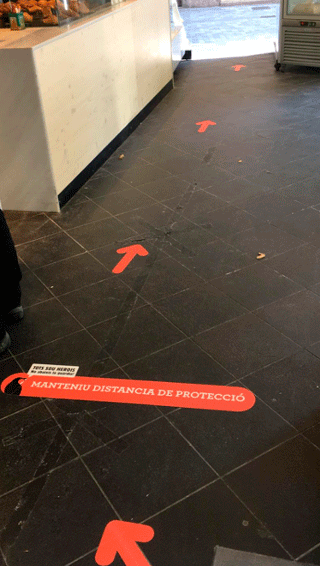
In the Barcelona cafés, in preparation for reopening, visual management on the floor shows customers' flow through the establishment and reminds everyone of the need to maintain social distancing at all times.
EXAMPLE 2 — ZINGERMAN'S COMMUNITY OF BUSINESSES
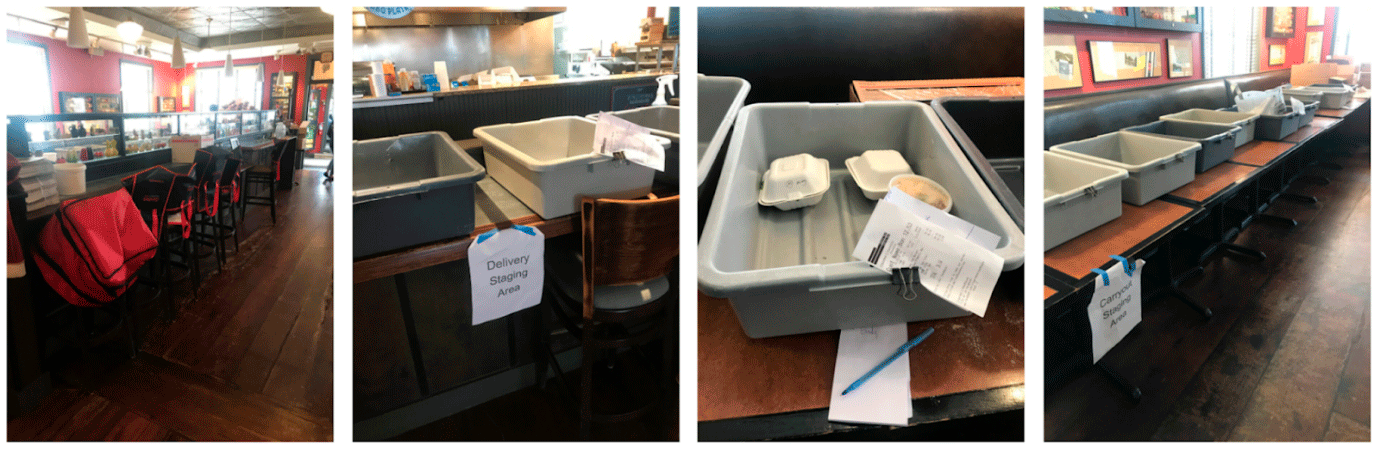
Zingerman's roadhouse closed its doors to dine-in customers on March 16 and quickly switched to accepting only pickup orders, taking advantage of its Drive-Through area. The area where the tables used to be was turned into an assembly line for preparing takeout orders, and 5S (a set of workplace organization practices consisting of sort, set in order, shine, standardize and sustain) was used to improve operations, removing unnecessary items and introducing new cleaning and hygiene standards. To maintain social distancing requirements, most of the preparation process was moved to this area. They created flow and made it possible to meet capacity using these now-empty areas. Orders were filled with kitchen staff placing items in boxes; a second team member bagged the items; the order always moved from left to right, flowing toward the customers, who waited in their cars.
EXAMPLE 3 — DREAMPLACE HOTELS, TENERIFE
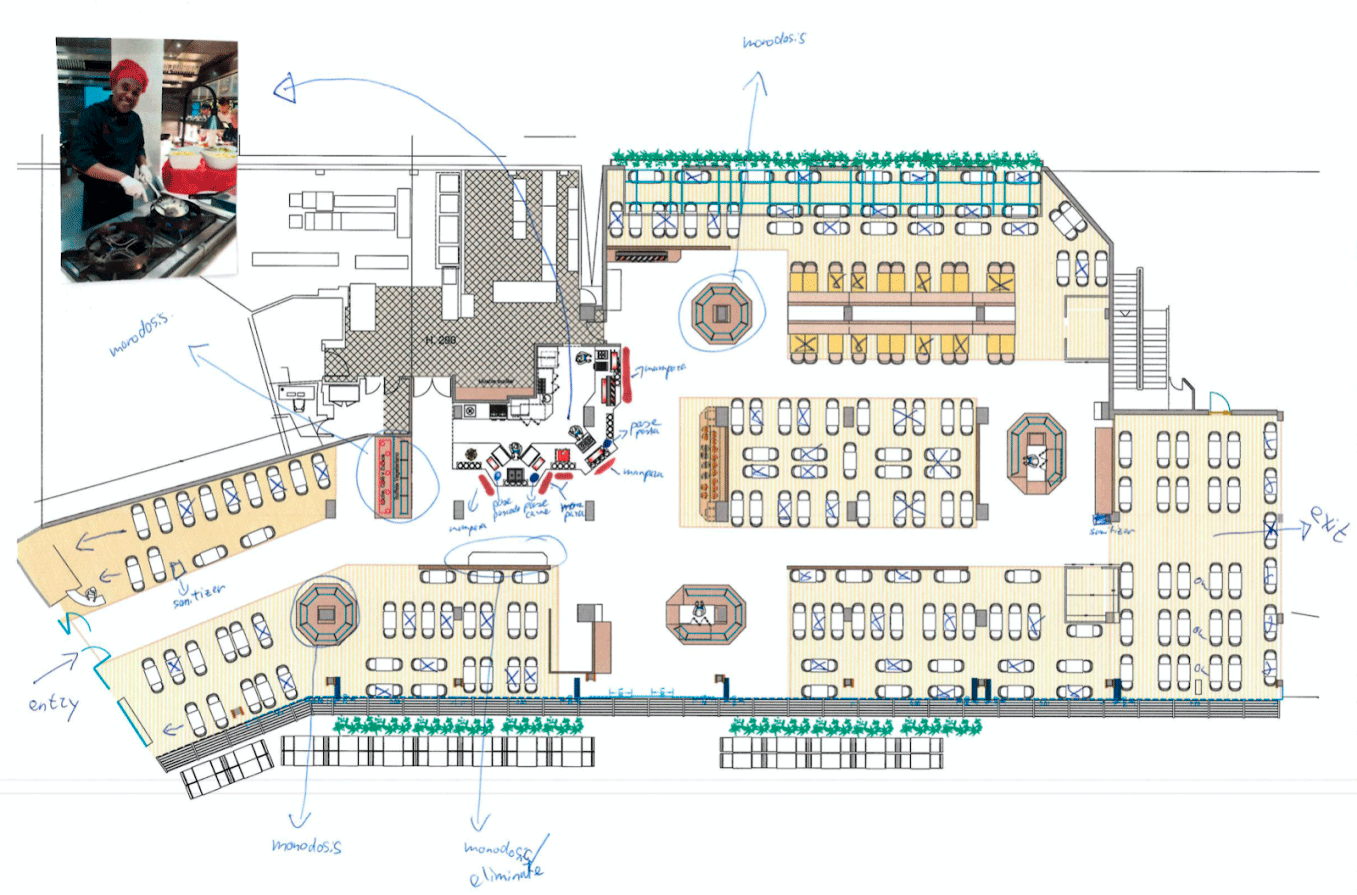
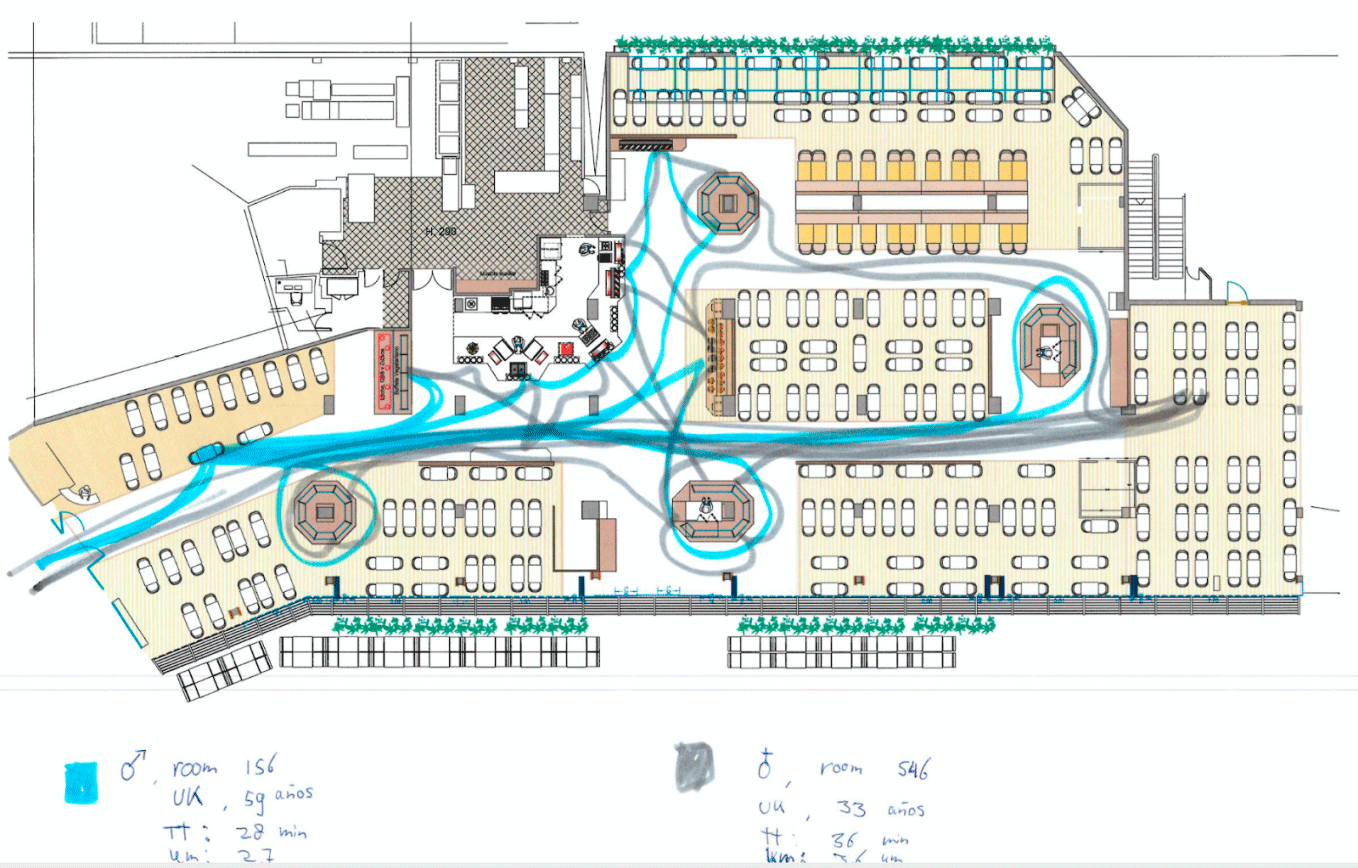
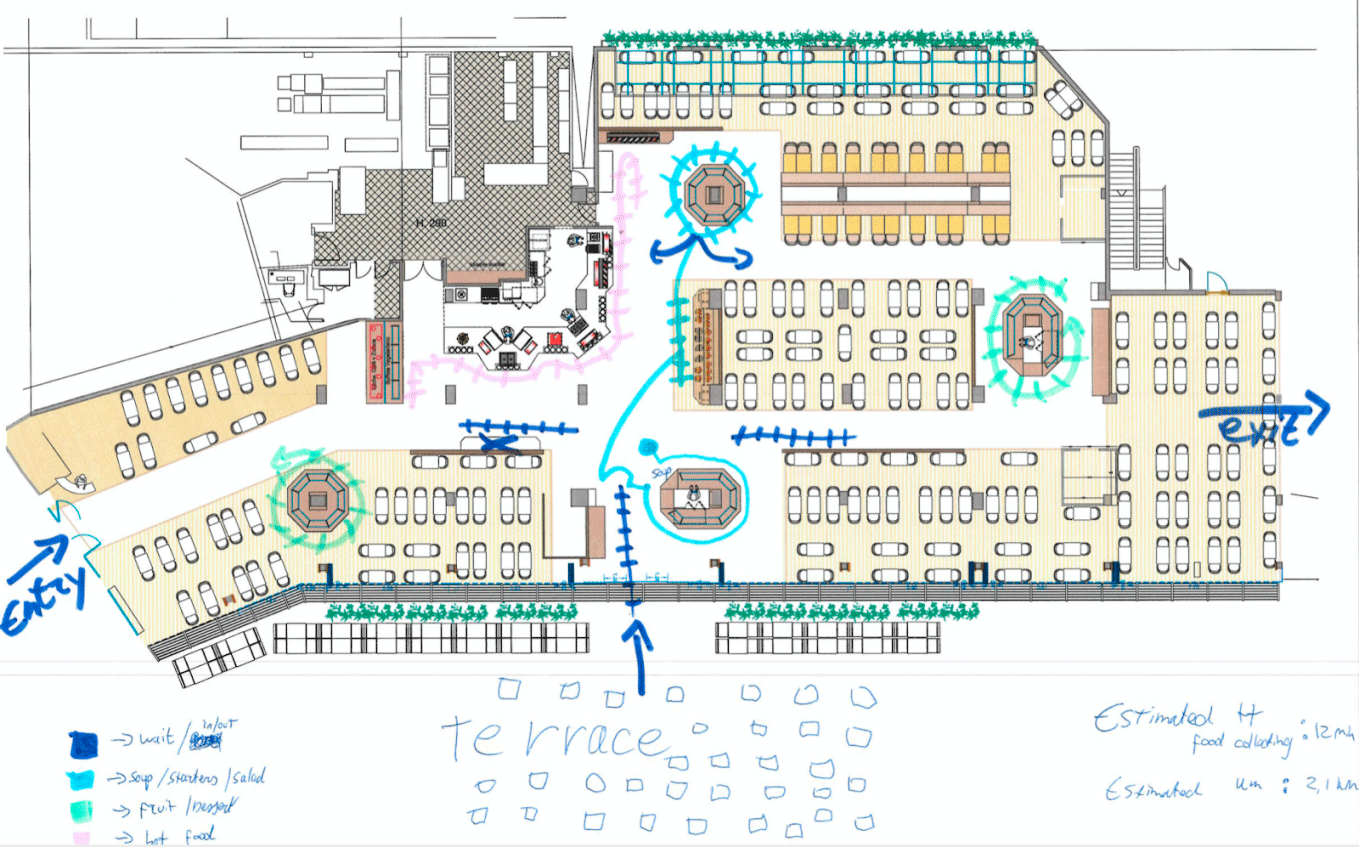
The hotel is using the “business pause” to rethink its systems and flows and run experiments it could not have run if the hotel were operating. They are currently experimenting with the spaghetti diagram (an exercise that consists of drawing lines to map people's movement through a space while they work or serve customers) to determine how to manage the flow of their 750 guests so that everyone gets the experience they are looking for, while maintaining a social distance of 1.5m. In the images below, we can see — respectively — the adjustments needed in one of the restaurants of a Dreamplace hotel, the proposed post-Covid floor plan and an example of a spaghetti diagram.
EXAMPLE 4 — LEGAL SEAFOOD
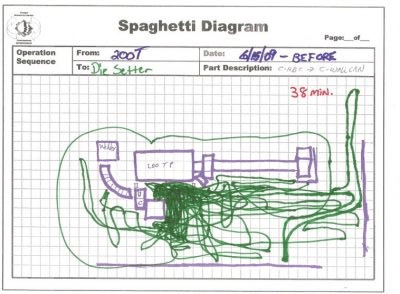
In the image below, you can see the spaghetti diagram mapping the movement of a server plating pie before the process was improved. This tool often opens people's eyes, showing many opportunities for improvement.
- Keep everyone physically and psychologically safe through standard work and simple visual elements.
- Never forget the team's safety, both physical and psychological. Without it, there will be no safety for customers either.
- To win employees' hearts and minds, leaders must show care, resilience, empathy, agility and a clear message of purposeful work to strengthen employee trust and engagement.
- Design every job or task — whether done by an employee, a manager or a customer — with safety in mind.
- Training should be provided with the entire customer and employee experience in mind. For the process to work, teamwork and an understanding of the big picture are necessary. Ideally, provide training without having to do it in person.
- Establish high-frequency, small-batch cycles for sanitizing critical surfaces, especially where handoffs occur. Have clear hygiene practices for cleaning, social distancing protocol, staggered breaks and hygiene standards (wearing masks, washing hands every time the food contact chain is broken, sealed cups, etc.).
- Keep standards simple and easy to remember and rely on visual controls at the point of use to make them second nature. Always document them (to help anyone unfamiliar with the task) and keep them up to date.
- Make your menu and payment contactless whenever possible, to reduce the risk of infection (from objects to humans).
- Limit unnecessary employee movement, which increases the risk of physical distancing violations (for example, consider storing all necessary supplies at the point of use whenever possible).
- Use visual controls to help customers do the right thing and play their part in keeping everyone safe.
EXAMPLE 1 - CAFÉ 365, BARCELONA
The business (which currently serves coffee, snacks and pastries for takeout only) is changing its approach to cleaning. Instead of doing it “when there is time” or at the end of the day, employees now clean the sinks and tables every hour – a task that takes, on average, five minutes. Employees who have been given PPE are being trained on how and when to properly disinfect surfaces. The stores are being stripped down to the essentials to limit the amount of cleaning needed every hour (for example, the napkin dispenser is being removed from the tables). Less is more.
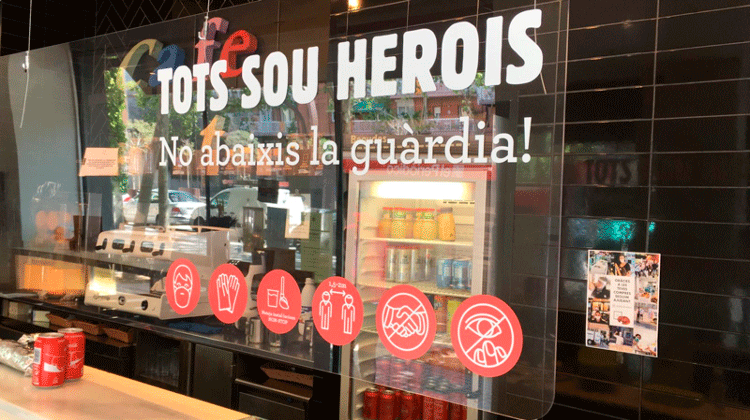
In this photo, you can see the window of a Café 365 in Barcelona displaying a message that says: “You are all heroes. Don't let your guard down” – accompanied by visual cues explaining the safety measures customers must follow. This is one way of empowering customers to do their part.
EXAMPLE 2 - ZINGERMAN'S COMMUNITY OF BUSINESSES
The company normally operates with more than 700 employees. In the first weeks of restaurant closures, they had to let go of more than half of their staff. To ensure that half of their institutional knowledge was not walking out the door with them, they needed to make sure processes were clearly documented. In the areas where they had not planned to do this, it became clear that standards needed to be established quickly and taught during cross-training to give new employees the tools to succeed in new areas.
EXAMPLE 3 - LEGAL SEA FOODS
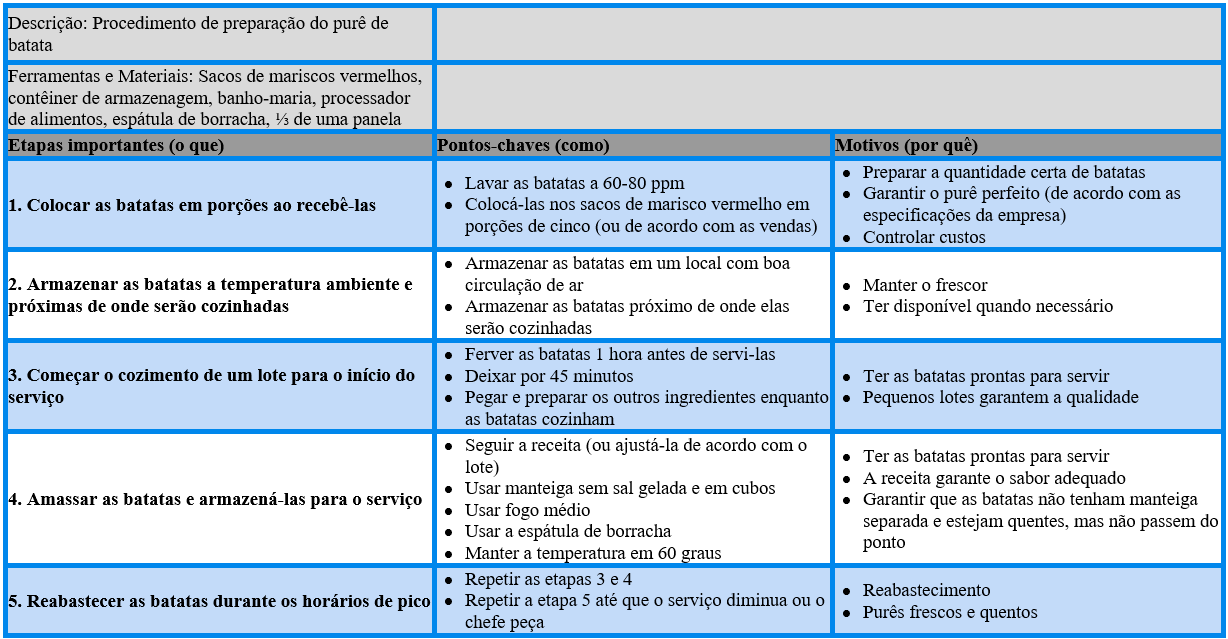
This is a Job Breakdown Sheet developed at a Legal Sea Foods restaurant to ensure proper and effective training in new work procedures and to make sure they are clearly understood. This approach also enables problem solving around the work routine itself.
EXAMPLE 4 - ZINGERMAN
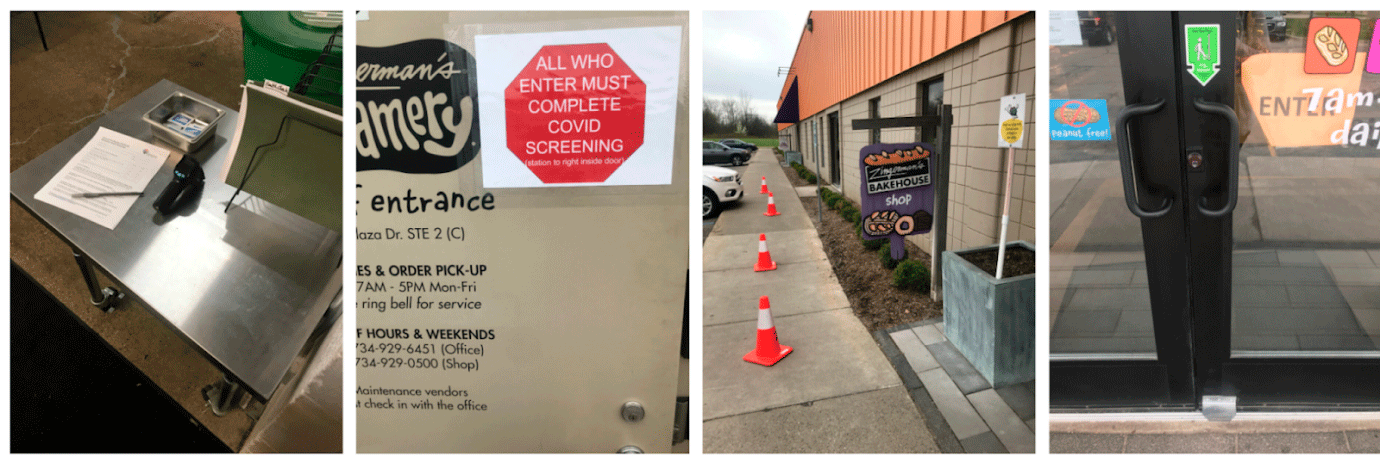
Below, from left to right, you can see: the Covid-19 screening station set up at Zingerman's creamery, at the employee-only entrance; a sign at that same entrance; distancing markers at Zingerman's bakery for customers to wait at because of capacity restrictions; and the foot pull customers can use to enter the bakery instead of touching the door handle.
EXAMPLE 5 – DELRIDGE GROCERY CO-OP
Having to open in the middle of the pandemic, this cooperative in Seattle needed to find a way to make its employees and customers feel safe. For customers, they began booking windows for picking up online orders, with pickup taking place at the curb. Visual management is used on the sidewalk to keep people at least 6 feet apart from one another. The team also used the empty interior space to ensure the safety of volunteers.
- Build frequent problem solving, learning and improvement into everyone's work.
- Be available and visit employees often, to show respect and support them in problem solving. This will speed up change and make your company more flexible. Problem solving happens in the workplace, not in a corporate office.
- Use visual management to distinguish normal from abnormal work and to understand whether you are ahead or behind.
- Identify a task force dedicated to adjusting safety measures, protocols and policies as they evolve (and when new problems arise) and to ensuring that the changes are known and used by everyone.
- Listen to the frontline team and ask them to suggest improvements. Make sure communication (internal and external) is transparent and set clear expectations.
- Finally, a sustainable operating model must be identified and implemented. If your company is still closed, use the time to reflect, review processes and think about what you want your company to be like in the future. Review your strategy and draw up a new plan to execute it.
EXAMPLE 1 – ZX VENTURES
Steve Crowley, global director of retail operations, said: “This crisis started for us in January, because we also serve Asia. We closed our locations during preparations for Chinese New Year and never reopened them. We have been open in China for a few weeks and are starting to see business come back. Initially, we opened for delivery only and had almost zero delivery capacity. When I reflect on this experience, it is clear that, rather than focusing specifically on internal things, what served us best in the crisis was having a problem-solving methodology”.
EXAMPLE 2 – DREAMPLACE HOTELS
The Hotel Tigotan, in Tenerife, expects to incorporate a new set of KPIs into its strategy deployment (hoshin kanri), including the number of cancellations due to Covid-19, the number of complaints about safety measures being too strict or too loose and the number of working days lost due to coronavirus-related problems. Reflecting the “new normal,” when the hotels reopen, frontline employees (who traditionally work in small teams of 6 to 7 people and meet once a week in a 30-minute meeting they use to discuss problems and coordinate) will actively work on the continuous improvement of safety measures. Bart Rozema, the hotel manager, says: “They have already been practicing kaizen [improvement] and problem solving for a few years. So we will have to shift the focus to collective experience, knowledge and intelligence to improve our Covid measures, for both employees and guests”.
EXAMPLE 3
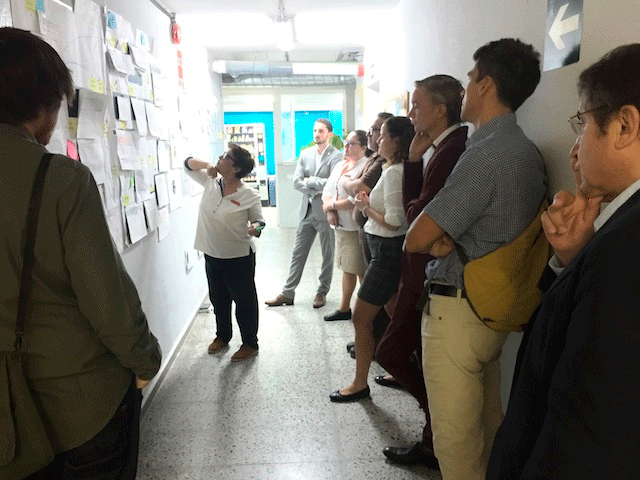
Since leaders do not work on the front line, in order to make the best decisions it is important to understand their impact on the frontline team and on customers. For example, if it is decided that surfaces must be sanitized more often, the leader should involve those who will do that work to understand how they will be able to incorporate the additional work steps. If the job of cleaning a table takes 3 minutes (and now includes refilling the hand sanitizer provided to customers), the time needed to perform this task must be taken into account. Ask yourself questions such as: “Where is the hand sanitizer stored?" or “how will other team members and customers know visually that the area has been sanitized and restocked?”.
- Minimize costs.
- Look for waste throughout the organization to allow frontline employees to make quality and safety decisions. This includes rethinking the workspace, the layout, the delivery systems and the hours of operation.
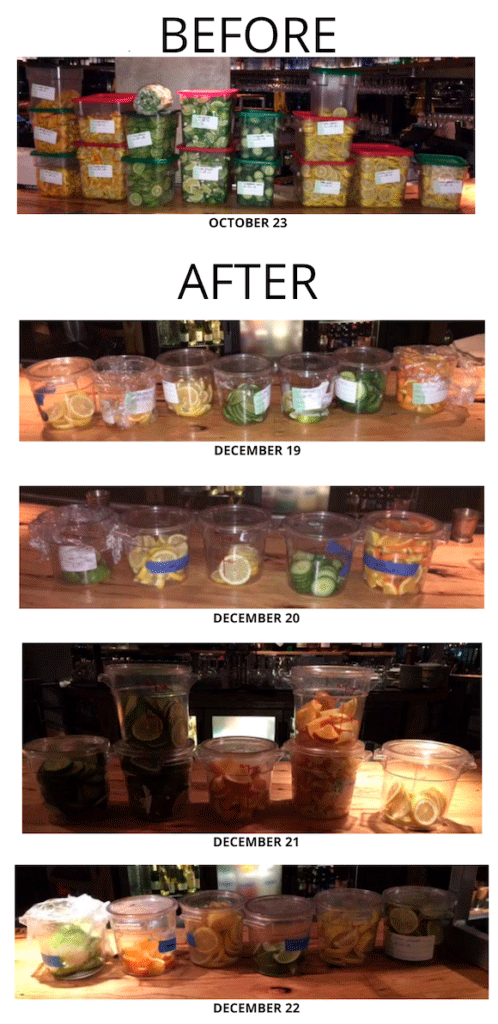
- Ask yourself how work and production can meet demand with minimal surplus. How can inventory turnover time be improved (how quickly items sell versus sitting on the shelf)? What drives the creation of inventory? How can we meet demand in real time?
- Limit food and beverage offerings to reduce the complexity of the work. Give customers what they want: in the Covid-19 era, they are likely to care more about ease of ordering, fast service and cleanliness than about an endless variety of options.
- Be prepared to pivot quickly, if your company is to survive. Delivery seems an obvious opportunity for restaurants and cafés, but it comes with its own challenges (limited marketing capacity for the new business “format” and more fixed costs for commissions, fees, etc.).
EXAMPLE 1
As companies try to reopen and rebuild demand, balancing the amount of labor with the capacity needed to increase it and improve profitability or break even will probably be a challenge. Understanding the time needed to do the work of preparing, assembling and serving food, with all the necessary food safety and cleaning measures, can help inform the number of people you need. During the Newtown crisis, local Starbucks stores were able to adjust to extreme variations in demand because they were able to understand, based on the customer arrival rate and the time needed to prepare and deliver drinks and food, how many people were needed to do the work. They were able to assess how the team would support the community conversations needed to be emotionally present for customers.
EXAMPLE 2 – LEGAL SEA FOODS
EXAMPLE 3 – CAFÉ 365, BARCELONA
In this video (in Spanish, with English subtitles), the CEO of Cafe.365 – Juan Antonio Tena – explains how lean thinking fueled the business's growth by teaching them to do more with fewer resources. Continuously removing waste from the process, thinking creatively about the work, consistently developing people's problem-solving capabilities and always trying to delight customers ensured the success and expansion of the business from a few stores to a regional chain.







