

Spaghetti charts and physical distancing
“Safety first” is a well-known mantra in the business world. Protecting ourselves, our colleagues and our customers has always been of paramount importance, but the advent of the coronavirus seems to have created a new dimension in the planning and delivery of safe processes, one that will likely affect our daily lives for the foreseeable future. One of the measures our governments are trying to adopt to try to stop the spread of Covid-19 is physical (often called “social”) distancing. Now that in many countries the infection rate is finally coming down and people are turning their attention to the difficult problem of resuming their daily lives, it is clear that we need creative solutions to get back to work safely. Once again, lean thinking can help us.
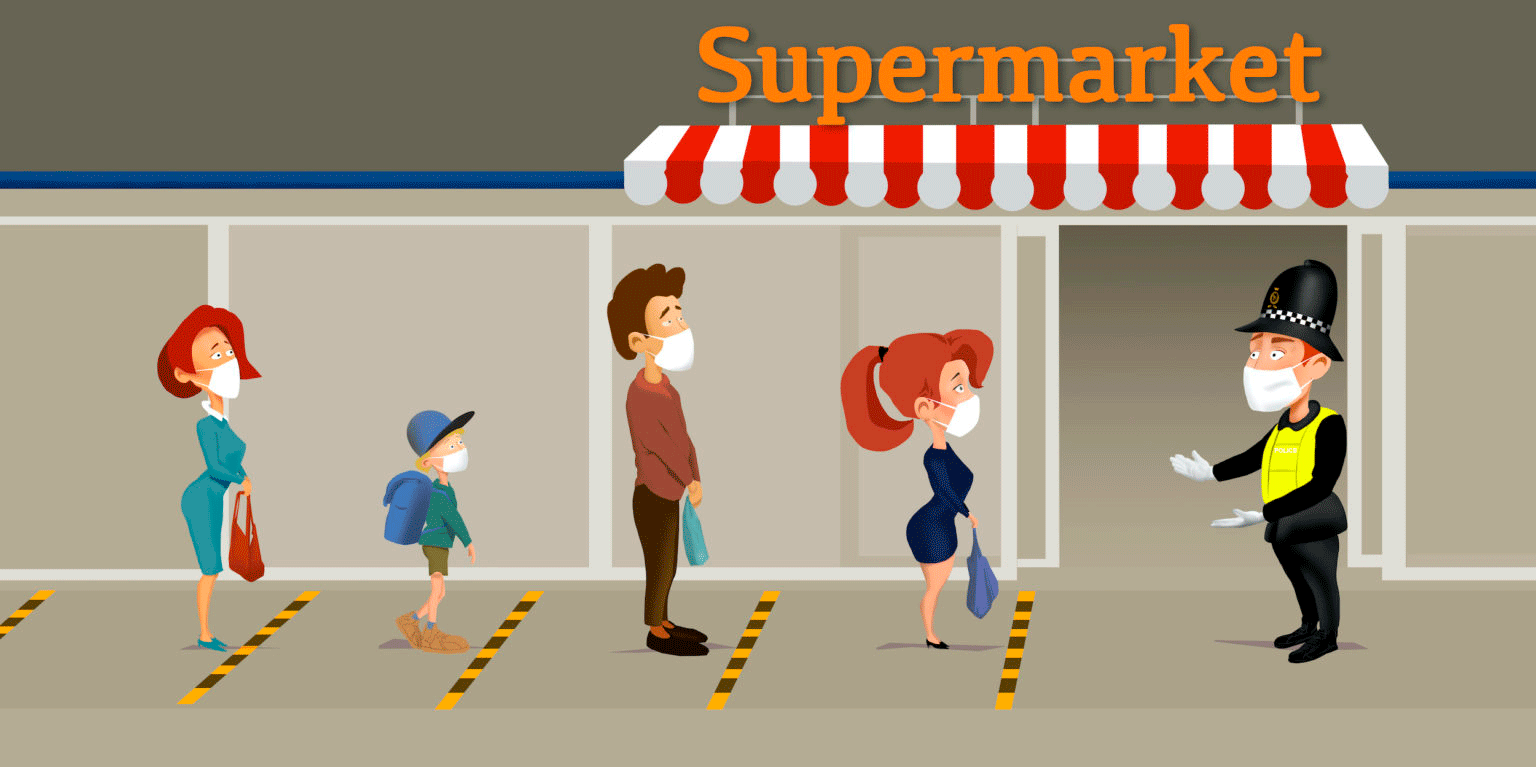
Walk into any convenience store or supermarket these days and you are likely to see visual management everywhere to help ensure that people keep their physical distance while shopping. Lines on the floor, two meters apart, show where we should stand – whether we are queuing to get into the store, doing our shopping or waiting in line at the checkout. The impact of simple visual elements is easy to see. Some places have done this better than others, of course. I don't know why this variation exists, but here are some tips you may find useful as you return to work and look for ways to incorporate the new rules into your daily activities. Whatever your organization (these suggestions apply to any workplace, not just stores), the key here is to start rethinking work and designing safe flows for our processes.
DEVELOPING A SAFE FLOW
Safe flow. In the context of Covid-19, “safe” has a lot to do with distance (the global standard is two meters) and exposure (how long a person is exposed to the virus), and we are certainly hearing a lot about that. The term “flow,” on the other hand, is not being used by the media and governments. I think it should be. For any activity, lean thinkers first define value through the eyes of the customer (and, of course, all customers want to be safe). In the current situation, this requires time compression to ensure that we are exposed to the potential risk of infection for the shortest possible time. For business owners navigating the new rules, this means enabling flow to ensure that value-adding activities can be carried out one by one, without interruption – reducing the time customers spend, for example, in a supermarket, at a medical appointment and, consequently, getting test results back, or even having their car repaired. Not having safe flows results in the risk of turning activities that used to be perfectly safe into dangerous opportunities for infection (not to mention the delays experienced by customers).
To develop safe flows, here is an easy tool that can help you better organize your workplace and establish a check to ensure the new guidelines are followed: the spaghetti chart.
THE SPAGHETTI CHART
This is possibly the simplest and certainly one of the most visual lean techniques. It is used to make the steps of a process visible, by following the movement of people, information or materials and drawing a line on a diagram of the layout to represent it visually. With the aim of understanding how to do the work as effectively and efficiently as possible, we usually note the distance traveled, the number of steps, the time required and any backtracking needed to complete a process. We should also think about any safety problems arising from a layout or from steps in our process that are not ideal. Spaghetti charts are essential for creating standardized work charts, which show the employee's movement and the location of material in relation to the physical environment.
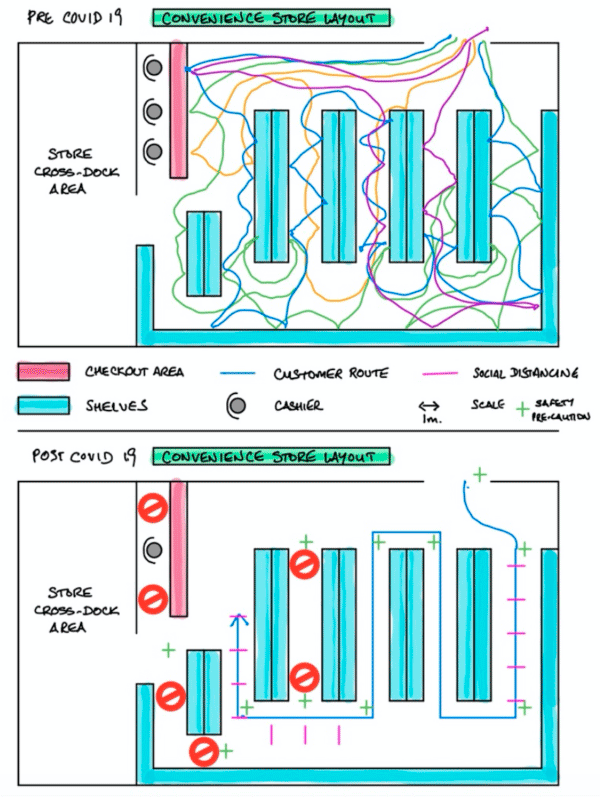
When Covid-19 began spreading around the world, the organizations that remained open had to respond quickly to the challenge of ensuring physical distancing between customers. The spaghetti charts in the example below show typical shopper visits to a convenience store and the flow of customers inside the store, before and after the introduction of physical distancing countermeasures. Establishing a one-way flow with two meters of physical distancing introduces the idea of standardized shopping: it no longer makes sense to place frequently purchased items, such as milk and bread, in opposite corners of the store. These layouts never added value for the customer; they only sought to increase sales for the retailer. Instead, we should “level the selection” of the highest-demand items, placing them at two-meter intervals, interspersed with less frequently purchased products. This can smooth the flow inside the store at a time when the speed of serving customers is more important than ever (fewer queues mean fewer crowds, which means fewer opportunities for contagion). These flows also make it possible to visualize bottlenecks – for example, at the junction of specific products or at the checkout.
Designing and implementing these measures may be a headache for retailers at first, but I bet it won't be long before they realize that the strategic placement of merchandise with longer cycle times can increase sales: while we wait in line, we can look around and decide to buy something at the last minute. Imagine if a retailer changed its layout to make sure the store was safer and faster. Would you think twice before going back to that same supermarket to shop?
But what about employee safety? I'm talking about the cashiers – increasingly seen wearing masks and gloves, often with glass barriers separating them from shoppers –, but also about those responsible for restocking the shelves. While restocking is taking place, it is very difficult to maintain the required physical distance. We will probably see some problems being solved creatively here, potentially leading to new store layouts where replenishment and customer flows are separated. Stocking shelves from behind, for example, can separate store employees from customers, allowing both to keep their physical distance. Whatever experiments are carried out, however, one-way flow will necessarily be part of the equation if we consider that safety matters to customers.
DIFFERENT ENVIRONMENT, SAME FLOW
It won't only be supermarkets that need to implement safe flows. Imagine going to a routine medical appointment at a doctor's office after the lockdown is lifted. The spaghetti of flows can help doctors figure out the best way to separate patients from one another and from their colleagues. Major changes have already taken place in terms of redesigning this process. Patients who contact the doctor's office are first given a time when a medical professional will contact them. The consultation may be by phone or include a video consultation, with the aim of triaging the patient and determining whether or not they will need a physical appointment with a doctor. This triage process drastically reduces the number of patients who will have to physically visit the clinic, which in turn reduces the risk for patients and frontline staff. For patients who attend an appointment in person, safe flow begins at the door, when their temperature is taken before they enter. It seems to me that lean thinking can help improve quality and reduce the time it takes to get test results – for example, by creating a more ideal flow than large, centralized, batch-driven approaches.
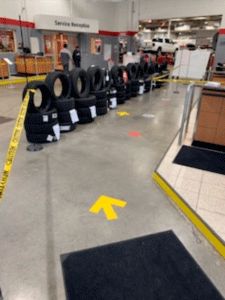
One of our partners in automotive retail has also been working on creating a safe flow at its facilities. At Meadowvale Toyota, in Canada, standardized work at customer reception was changed to allow people to follow the two-meter rule at all times. In addition, the controls of each vehicle – such as the steering wheel and gear shifts – are sterilized and protected. In an attempt to apply methods that help everyone keep a safe distance, the Meadowvale team set up simple physical barriers, using tires and tape, that lead customers from reception to a waiting room, where they can wait for the vehicle to be repaired. From there, the designed path takes them to the payment and vehicle delivery process. This is a simple but brilliant example of an error-proofing device (poka-yoke, as we say in lean) for customers and employees.
So lean thinking already has several tried-and-tested methods that support the creation of safe flows. The spaghetti chart is an essential ingredient for developing standardized work and for ensuring that we can deliver value to customers. Since physical distancing is likely to be with us for a while, it is essential that we leverage our lean knowledge to help us make work safer. After all, this is just a new problem for us to solve.
This article is also available in English and Polish.







