

Leveraging lean learnings to face the crisis
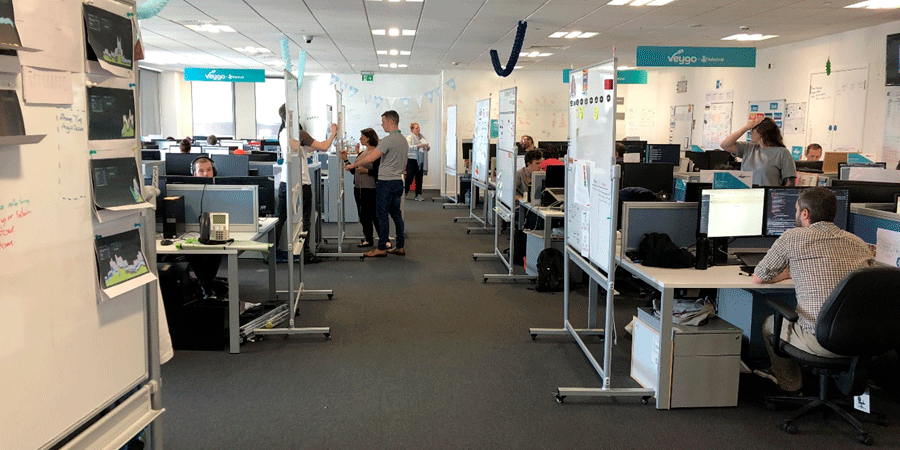
Veygo is a spin-off of the Admiral Group, the insurance company behind the Confused.com website (the UK's first insurance comparison site). I visited them in January, in Cardiff, to learn about their lean journey. My point of contact — and my excuse for visiting a gemba outside France — was Veygo's president and fellow Frenchman Jean Baptiste Limare. Our gemba walk revealed how much lean thinking had helped the company. Last week, in light of recent developments in the Covid-19 pandemic, I decided to follow up and conduct a virtual gemba walk to see how the company was doing after switching to a remote operation.
Working from home may not be a problem for a digital company. After all, remote coding is nothing new in the digital world, with specialized teams often spread across different locations. But is it really that easy? And can lean thinking help make it work?
During our call, I also took the opportunity to talk again with Jean Baptiste about the three points we had discussed intensely a few months earlier: knowing your customer, learning to deliver with speed and quality, and developing autonomous teams.
BEFORE THE CRISIS
Jean Baptiste joined Admiral a few years ago. His job was to design new insurance products, but he knew the company needed to adjust its offering to a market in which younger generations no longer buy cars but use mobility services. Under the circumstances, the insurance world would have to follow the trend and offer temporary insurance cover for every scenario young drivers might find themselves in, from learning to drive with their parents to sharing a car or occasionally renting one. Such policies would have a duration ranging from one hour to 30 days. As the company's motto says, “at Veygo, our goal is to provide the best insurance options for drivers who don't own a car”.
Jean Baptiste also wanted to show that the insurance contract and the associated interactions could be digital. Like most insurance companies, Admiral still relies heavily on letters and call centers to interact with its current or prospective customers. JB was determined to develop an insurance product without personal contact. That is how Veygo was born. It was mid-2016.
Four years later, the company is making more than half a million sales a year, customer reviews are very positive, and the assumption that there is a market for digital on-demand car insurance has been confirmed — at least when it comes to Veygo's insurance products (temporary cover and learner driver insurance). Over time, the team grew from six to 48 people between the second quarter of 2017 and the third quarter of 2018. Today it is made up of 53 people.
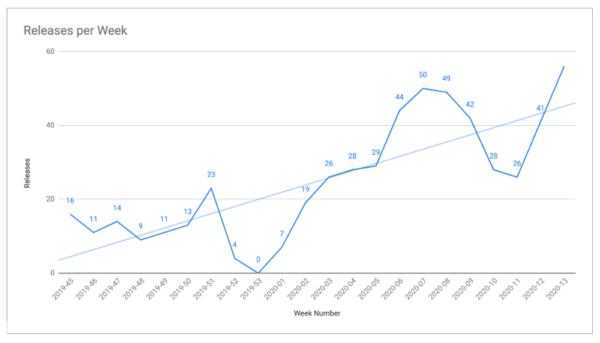
“Lean has really helped me”, Jean Baptiste told me during our gemba walk in January. Jean Baptiste — or JB, as his British colleagues call him — took his first lean steps on his own, reading book after book. At first, he was drawn to the tools (like all of us, right?) and saw lean thinking as a kind of Agile 2.0 — a compliment to lean, I would say, since most “agilists” tend to consider lean a thing of the past. Lean tools, JB recognized, would provide the means to be less dependent on people and to eliminate waste, while helping to sustain a large flow of new features on the website. At the time, JB's favorite KPI was the number of releases that could be achieved in a given period of time. As Taiichi Ohno's book “Workplace Management” reminds us, we are all full of wrong ideas about how things work. And JB is very transparent about the topics on which he has changed his mind. Today he firmly believes that these mindset shifts continue to help him and his team during the Covid-19 crisis.
The first shift required the help of an external sensei, who showed up at Veygo with the question: do you know your customers?
DIGITAL AND LOCKDOWN DON'T MEAN NOT TALKING TO CUSTOMERS
At the time, the sensei's question had come as a blow. In a world of rapid growth, digitalization, websites, agile and millennials as customers, Veygo's focus was on sprints and fast delivery. Back then, the scrum teams fought for minimal management interference, which they got as long as they produced, and JB's vision for the company was a group of technical silos he tried to oversee and align.
Putting the customer back at the center and asking how to better understand their needs, or the level of quality they perceive, was incomprehensible at first. How can you talk to customers when your entire business model is based on a “buy what you need, unassisted” website? The fact that no one had to talk to customers was considered a success factor. And those of us from an older generation can't laugh either: in our day, we thought we could do the same with hypermarkets or shared service centers.
It turned out that five out of six members of Veygo's management team had never talked to a customer. Product owners thought up features without really consulting actual customers. Moreover, if a feature had a poor impact on sales, it was not clear whether the idea was wrong or the execution had failed to add value for the customer. “Either way, we weren't learning”, JB sighs.
And, in fact, during a gemba walk I had seen a big change from that initial approach: customer interview scripts, a takt time for those interviews, NPS and CES indicators. On Veygo's website, the FAQs and Help Center articles are flourishing, fueled by the conversations the team has with customers. Since the start of the lockdown, chat has become the essential mode of communication with customers.
Talking with customers led to some interesting revelations:
- Until then, learner driver insurance had been considered a practical and financial resource to cover risks while children build up their driving experience with their parents' car. As such, the insurance ensures that, in the event of a collision or accident, the parents' no-claims bonus is not affected. The interviews with parents provided another valuable insight: driving with their child and passing on their experience was seen by some as an unexpected opportunity to spend some time with their teenage sons or daughters (many of whom, at that age, tend to avoid family time and seek distance). This important emotional factor is being taken into account by Veygo's teams.
- Many customers complained that it was hard to find help on the website. Since it was also not easy to find a contact at Veygo, they were frustrated or unsure whether the products were right for them. This led the team to develop the Help Center, dramatically improving customers' self-service capability.
This new focus on customers has not disappeared with the Coronavirus crisis.
JB's goal was to sustain business continuity and protect everyone at Veygo. Preparation for a possible lockdown really began as soon as the first districts in northern Italy were placed under quarantine, on February 21. It took Veygo 72 hours to plan and prepare the move to a 100% remote operation, with laptops and a dedicated VPN for remote access provided to every team member. They also worked on the impact of remote work on each job and studied worst-case business scenarios – including a possible lockdown of the Cardiff areas as a result of a local outbreak, with the rest of the UK still operating as usual. They were ready in early March and switched to remote work a week before the UK imposed a full lockdown, on March 23.
The teams were still struggling with bad chairs and the new remote tools when JB asked what could be done to help National Health Service staff, who might need temporary insurance cover to get to work. Action was immediate: the decision to offer a 75% discount to NHS staff was made on Wednesday, March 18, at 9 p.m., and the new feature was in production by 4 p.m. the next day. Not bad for a project led and executed remotely! Within a week, they had 200 orders for this offer and many positive comments. This gave more meaning to daily tasks and routines and highlighted the importance of working as a team. JB tells me how people exchanged internal messages saying how proud they were of their achievements and of being part of the Veygo venture.
As he reflects on today's situation, with developers and product managers no longer working in the same space, JB expresses a concern that output (fast delivery) may once again override outcome (delivering value). Of course, activity is lower – especially in learner driver insurance cover –, but activity for temporary cover has dropped by only 30%. And feature release activity is flowing, unchanged.
PROGRAMMERS SHOULDN'T HAVE TO CHOOSE BETWEEN GOOD AND FAST
Initially, quality was not JB's main goal. With Veygo focusing on the number of releases, and not on talking to customers, questions about current quality problems were met with expressions of disinterest, or even laughter, in the teams: “We'll talk about quality when we have time” or “80% (or even 50%) quality on many things is much better than 100% on just a few items”.
We got a similar response from the teams when we asked about kaizen – "When we have time", they used to say. Kaizen, like quality, is an investment in the future that Deming understood perfectly. “The result of long-term relationships is better and better quality, and lower and lower costs”, he stated. Deming also recommended that we eliminate final inspection and build in quality. “Nobody knows the cost of a defective product. Don't tell me you do. You know the cost of replacing it, but not the cost of a dissatisfied customer”. This is something to think about: with the pandemic, new customer expectations are bound to emerge, and those who fail to perceive and meet these expectations will be pushed out of the market very quickly.
Veygo decided to test quality in October 2018. They saw it as a quick bug-cleaning exercise; nothing could have been further from the truth. The team discovered that it had many customer complaints, but few were visible, and most were not addressed. Critical website features didn't work: for example, the confirmation of an insurance cover went into a loop after sign-up, leaving the customer unsure whether they had actually bought the insurance cover.
When the team tried to solve these problems, they found that they didn't trust the backlog of reported bugs, that unit and integration tests were poorly designed (or missing) and that test programming was something unknown. Developing code as fast as possible to pile up new features had been their only motto until then.
They sat down and worked on it: developers shouldn't have to choose between good and fast. So the product development culture was changed to include quality. Bugs were tracked down in analysis sessions, a tool was used to check the difficulties customers encountered on the website (tracking their behavior and highlighting possible frustrations with SessionCam), and developers were trained to develop tests. This quality intervention paid off, and the conversion rate soared.
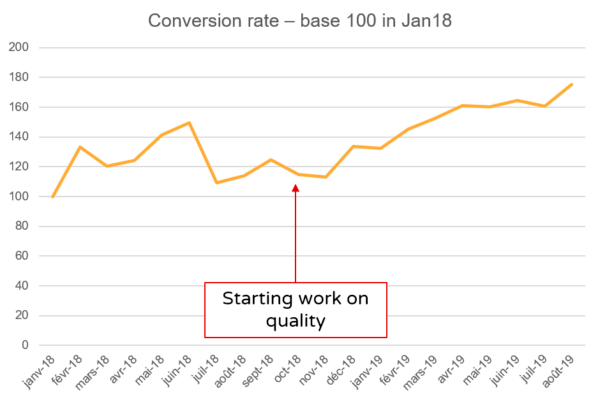
Another positive side effect is that feature ideas now come from real user problems: decisions about new developments are consequently easier to make and more obvious to everyone, and consensus is reached more easily.
JB knows that today's new projects are hampered by the difficulty of evaluating features with customers: what is the outcome for the customer? How do you define success? “Brainstorming is harder to achieve remotely and, as a consequence, the effects of serendipity on innovation are less likely. Having a coffee with a colleague to discuss a problem in person is not the same as doing it on a video call. It's something we'll have to pay attention to in the coming weeks”.
AUTONOMY DOESN'T MEAN INDEPENDENCE
We don't know how long the lockdown will last or whether we are likely to see successive waves of lockdown throughout 2020, as this will largely depend on how quickly we manage to produce protection and testing for all of us. In this scenario, learning to work remotely becomes imperative. But how do you really develop team autonomy in this context?
Veygo's experience over the past two years can teach us a lot. You don't grow from six to fifty-three people in two years without a great deal of reflection on the onboarding process and on how to organize teamwork. There are several aspects to this: you need to create a reliable management team, align everyone around common goals and foster collaboration in the delivery flow. This may also mean a complete change of behavior by senior management.
In January, JB told me the story of how they created standards for developers. When he started looking at how developers worked, his actions were perceived as an audit and not much came of it. So he thought about developing work standards and tried to apply them. That didn't work either, as the teams became increasingly defensive against any intrusion.
This led JB to think hard about what autonomy means and to introduce a completely new approach:
- First, clarify the long-term goals the team wants to reach in terms of lead time and quality. A board in Veygo's office displays this very clearly: developers now track the bug backlog (quality), time to market for a new feature (delivery) and website performance (page load speed and number of releases per week). Customer satisfaction is analyzed through interviews and NPS scores at purchase. Customer feedback is obtained through independent customer surveys, which regularly score high, given the nature of these insurance products. And, by the way, customer satisfaction is still high today, despite the lockdown.
- Next, introduce a form of single-piece flow (at most two products in any production cell) with an andon system and a help chain in place all the way up to management. This is something Veygo still struggles with, as there is a difference between delivering to takt time and autonomy and self-reflection. In this lockdown situation, they still have a daily scrum meeting and a form of andon on tickets that are obviously stuck.
- Finally, JB is learning to develop and nurture the right conditions for kaizen (value for customers, clear objectives and so on). “I learned the hard way, and today I see myself as a gardener: feeding the seeds and waiting for them to grow and bloom”, he comments. Kaizen is also an opportunity to “adjust” the teams as potential new leaders emerge: learning-oriented personalities. Collaboration and self-development generally stay and are encouraged to keep growing, while other people may end up leaving (this has already happened). The new PPM – Principal Product Manager – for temporary cover and learner driver insurance, Dan, is a lean enthusiast and now runs the product (features) and operations (developments) teams.
During the gemba walk in January, JB took me to a board showing a six-step kaizen approach led by a scrum team, with the support of JB and Simon, the other PPM. It focused on smoke tests, which preliminarily simulate the prospective customer's journey with the new code to detect possible failures. About 40 hours a week were being lost running smoke tests that didn't work. The first pass of this kaizen identified parameters to be reworked, to the great relief of the developers. Failed smoke tests dropped from 97% to 0.4%. In turn, this revealed new problems, such as a slow process for releasing new features into production: they are aiming for a 50% reduction and keep working remotely. But JB thinks more work is needed on this: “Cleaning and sorting is one thing, but we need the scrum teams to investigate root causes and find ways to prevent recurrence”.
Talk to your customer, work on quality, develop autonomy and teamwork: JB believes these major changes in his mindset helped him organize the new remote working setup. “The main advantage of lean, as I see it”, JB concludes with a smile, “is that we are learning much faster: we see our problems more quickly, understand our misconceptions more quickly and change accordingly. That is a great advantage when you are trying to gain market share, and it becomes even more crucial when you are facing a crisis like this one!”.







