

Immunity
This Italian manufacturer found in lean a way to ensure business continuity and support a shaken workforce in the midst of the coronavirus outbreak.
On February 21, the first case of COVID-19 in Italy was discovered in Codogno, in the province of Lodi — some 70 kilometers from where we are. We all know what has happened since then, in Italy and in the rest of the world. In a matter of days, our lives changed to the point that we no longer recognize them, and we do not know how long this will last.
In the article he published on Monday on Planet Lean, Michael Ballé reminded us that, when confronted with a crisis, a person can react in two ways: with a fixed mindset or with a growth mindset. At FPZ, we chose the latter. In this crisis, we chose to keep learning and improving; we chose business continuity; in a word, we chose to fight.
We know we have a duty to fulfill, as a key element of an important supply chain. The components we produce are used in industrial automation, for dosing substances in chemical, pharmaceutical and food processes, in ventilation systems, in industrial cleaning and so on. Without products like ours, manufacturing basic goods would eventually be impossible.
We are well aware of our role in this health crisis. If healthcare workers are on the front line, and those who provide services — such as distributing food and medicine — are on the second line, we are contributing to this collective effort behind the scenes. It is this awareness that encourages us to allow our company and the people who work in it to keep operating, in complete safety, of course.
The flexibility acquired through the lean culture, our commitment to problem solving and our determination to always have a contingency plan ready for our critical resources allowed us to communicate quickly with our main suppliers and take internal measures aimed at ensuring continuity in production. What is lean management if not structured problem solving to always satisfy customers and minimize waste? In this sense, business continuity allows us to keep pleasing our external customers without interruption while providing our internal customers with the direction they need in a time of painful uncertainty. Since this crisis began, the quality of our working life has remained as high as the level of service we provide to our customers.
We could never have imagined having to deal with a situation like this, not even in our emergency plans. However, our work to develop managers and frontline staff, which is based on the belief that it is up to each person to ensure the safety of the system, has made everyone at FPZ ready to act smartly and quickly — moving the business in the direction set by the World Health Organization and the Italian government.
OUR RESPONSE
The day after the first case of COVID-19 was announced in Italy, we created a Safety Committee on WhatsApp to coordinate our response. It was a Saturday, and by Monday the first measures were already in place. These measures included allowing people to drink water only from a bottle or using disposable cups, canceling our business trips and trade-fair participation (those that had not already been canceled), suspending all visits and giving leave to employees with pre-existing conditions that made them particularly vulnerable to the virus.
We took advantage of the high adaptability of our IT system to equip people with the tools they need so they could work effectively from home — whether accessing the company servers or the phone lines — and to keep them connected and aware of the progress of all activities. Two years ago, we implemented new standards in our IT department to allow any FPZ workstation to be converted into a remote workspace through any interface (computer, laptop or smartphone). So when the COVID-19 crisis began, all we had to do was follow the protocol: on Monday, February 24, 65% of our office staff were already working from home (that number is now 90%). In the last three weeks, we have seen no negative impact on our customer service — which has been our focus from the start.
Unable to visit customers, the sales and marketing department is using this time to work on the company's image and to plan for when things return to normal. They, too, have been working smartly since the first day of the crisis and adapted very well right away: at least once a day, they hold a remote alignment call, and the quality of their work is as high as ever. They have also completed activities that had been on standby for quite some time and started projects they never had time to begin.
In times like these, reaching everyone at FPZ is critical, which is why we have worked hard to improve our internal communications — especially using videoconferencing, the company's social network and cloud services. We created several WhatsApp groups, with a maximum of six participants each, to share relevant information. People are also encouraged to share lighthearted content, like the thousands of memes circulating on the internet these days, but we ask them not to do so in the groups. It is important to distinguish what is serious from what is fun.
Without the possibility of meeting in person, we have discovered different ways to feel close to one another in these strange times and to give people a voice. For example, we are creating short videos to show how each of us is coping with the current ways of working and the current situation in the country. Here is an example:
And see this tutorial we use to teach people how to use the videoconferencing tools [starring Sergio's children].
To ensure continuity of supply, we are also using part of our extra capacity to make standardized products that we transfer to several warehouses located around the Lombardy region (the region most affected in Italy in this emergency).
As soon as the coronavirus appeared in Italy, we began checking the status of each supplier and opened emergency channels to communicate with the most critical ones. We think it is important to share best practices with them and to make sure they, too, implement all the necessary safety measures to keep operating.
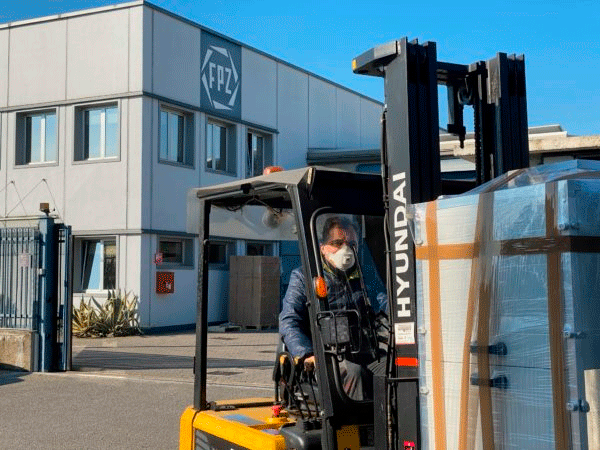
Other companies in the FPZ group have also taken measures established by the Safety Committee — such as extra cleaning and sanitizing (see below). Day after day, every business in our group adapts to the new restrictions introduced by the committee or, at the national level, by the government. At the parent company, at Arivent (our industrial fan company) as well as at Doseuro (our dosing pump company), the teams prepared a risk assessment document. All our companies are mapping the situation of their main suppliers to find out whose production is most affected, who is working at a normal pace and who is closed.
SAFETY ALWAYS COMES FIRST
Managing safety effectively depends on how well we can anticipate risk. In our globalized world, it was inevitable that COVID-19 would not simply remain confined to China. This means that when the news broke that the area around Codogno had been placed under quarantine, our safety measures were already prepared. It was just a matter of applying them. To avoid being caught unprepared, foresight is key — together with the ability to “read” external dynamics and internal requirements.
The speed of our response was a result of the FPZ team's extraordinary ability to work together to find solutions to a common problem. Our people are used to contributing openly to improving the business.
The aggressiveness of this virus and the experience of the Chinese had already taught us that the only way to effectively stop, or at least reduce, the spread of COVID-19 would be to keep people physically apart. We would have to avoid any contact between employees but, at the same time, we had to ensure that this information was communicated in the right way.
So we took all the necessary measures to reduce the risk of infection from day one. In production, we compartmentalized work groups to eliminate contact between people from different production areas. We have two sites (one opposite the other) that are almost completely separated at the moment: only two warehouse employees can enter both, always wearing an FFP2 mask. To further limit the chances of interaction, we physically separated the assembly and finishing areas. The new organization of space has already taught us something new: the importance of transferring only critical information from one area to another and of better synchronizing communication between the different areas.
Only three operators at a time can enter the locker room, to ensure that they keep the recommended safety distance of one meter and to prevent potentially infected individuals (who may not show any symptoms) from passing the virus on to their colleagues. Since the first day of this crisis, we have doubled the number of times the locker rooms are cleaned and sanitized, because every shift is entitled to a clean, virus-free environment.
We have also taken measures in our break room. Here, too, no more than three people stay at the same time, and they must keep a safe distance at all times. To make this possible and avoid crowding and queues at the coffee machines, we scheduled staggered break times for employees spread throughout the day. We also revised our schedule and our shifts to give most of our operators the opportunity to have lunch at home with their partners and children (schools are currently closed in Italy). We have also managed to order enough masks — we are not yet sure when we will receive them — for our people to take home to their families.
We also sanitize all equipment, measuring instruments and tools after each use and at the end of each shift — to ensure that everyone can work safely. Operators regularly disinfect keyboards as well. People are even more aware than before of the need to take care of the equipment they share with their colleagues. As the situation continues to evolve, we are learning to be patient and how important it is to continually invest in educating our people in the face of this threat.
WE TAKE CARE OF ONE ANOTHER
We are touched by the strength and determination our people are showing, and we have committed to doing whatever we can to keep protecting them as they carry out their duties. Most of them are feeling well, but some — understandably — are feeling anxious and stressed.
They may live alone and be having difficulty coping with social isolation; or they may have family far away or vulnerable relatives. Sadly, one of our people lost an uncle. We do everything we can to help everyone who needs it through dialogue and psychological support provided by our in-house counselor Aldo Terracciano via video sessions (he has worked with us for a long time, and people trust him).
In many ways, this emergency is bringing out the best in our people. Some people have told me they feel privileged to be able to leave home and come to work, because it is hard to kill time at home, and watching the news only creates more stress. That is the right spirit, and we agree with it. Even more praiseworthy are those FPZ employees who are working from home while taking care of their children.
We have found that looking to the future with a common goal is a great morale booster and that there is value in treating this situation as another challenge we can learn from: instead of simply enduring what is happening, our people are finding comfort in working to increase safety at work or to ensure continuity in production.
So far, FPZ has not seen a drop in the number of orders. Although we know this situation will certainly hit the entire economy very hard, we are not worried, because we are in a solid financial position and can react quickly to changing circumstances. We will continue monitoring our KPIs and parameters and adapting our production capacity to customer demand. In the past, before we engaged all of FPZ in continuous improvement, we would have had no choice but to keep producing. Today we know that we generate value by producing, but also by improving, strengthening our processes and learning.
It is inspiring to see how quickly our company was able to act in this incredibly challenging situation, making balanced choices and creating shared countermeasures. In a way, we have seen a perfect example of PDCA here, with each new government decree being absorbed into the FPZ ecosystem as a new adjustment in an improvement cycle.
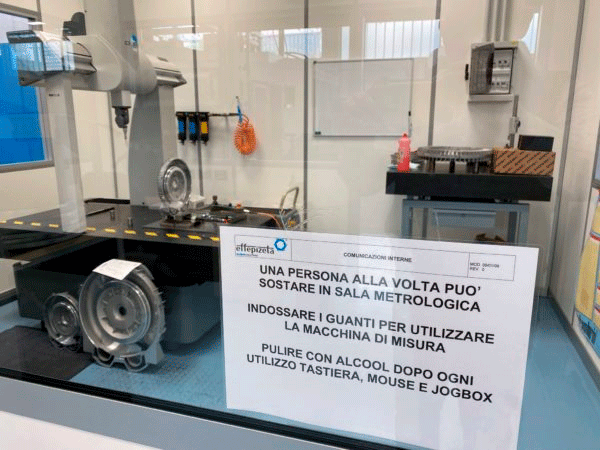
*See note at the end of the article.
SOME OF THE THINGS WE HAVE LEARNED
We would like to share with you some of the things we have learned over the last three weeks:
- The captain of the ship needs to be honest but positive, without underestimating the risk. In these difficult times, we need to look after our people's state of mind more than ever.
- Humans are social beings, and forcing them to internalize uncomfortable but necessary isolation measures has been difficult. This cannot be stressed enough.
- There is never too much information, even about the behaviors they should adopt when they come to work or go home (avoid public transport and carpooling, etc.).
- The message does not always reach everyone in the same way. Despite our best efforts, some colleagues continue to underestimate the threat of the virus.
- Whenever we involve our people in the decision-making process (for example, how to reorganize production shifts), we always see active participation and experience no resistance.
- In times of instability, the message conveyed to people has to be clear and impossible to misinterpret.
- Collaboration between departments and the office is crucial for helping one another in difficult times.
- We have always focused on learning, because only by sharing and collectively creating ideas can we achieve the personal growth of everyone involved.
We want FPZ's people to follow us of their own free will because they share our ideas and our vision — and not because they are afraid of not following. In uncertain times like these, people need to be given job security and safety at work, both of which are important for their well-being. They need to know that our actions are meant to help them, always; and we, the management team, need to understand that our legitimacy in leading them comes from our willingness to listen to their needs and from our ability to reassure them.
Lean management has allowed us to succeed as a business so far, regardless of the crises we have encountered. It has made us resilient and adaptable and allowed us to respond to the coronavirus emergency quickly and effectively. It may seem like the world is turning upside down, but things at FPZ remain the same — just with a little more foresight and some extra rules.
We believe that our company — and, indeed, our whole country — will emerge from this tragic chapter stronger than ever. As we Italians discover that the air we breathe is cleaner, as we fall in love with the newly rediscovered clear canals of Venice and as we admire the beauty of a smoke-free night sky, we are learning what is perhaps the most important lesson of all: that we all share a common destiny. We have been underestimating the importance of belonging (to a community, to a business, to a family), of speaking the same language, of eliminating conflict by thinking about the whole instead of only about ourselves.
*Note about the image. The poster in the image reads:
Only one person at a time may be in the metrology room.
Wear gloves to handle the measuring machine.
Clean your hands with alcohol after each use of the keyboard, mouse and jogbox.







