

Lean leadership: concepts, practices and applications at a Hospital in Foz do Iguaçu
More than any method or tool, the true competitive differentiator lies in the daily behavior of those who guide the teams. When leaders connect purpose, method and results, they create the conditions for everyone to see problems clearly, learn faster and deliver growing value to patients.
In the hospital environment, this means turning hours of waiting into minutes of care, preventing errors that cost lives and building a culture of respect that welcomes families at critical moments. Investing systematically in developing lean leaders stops being a cost and becomes the most powerful lever for the hospital's clinical, care and financial sustainability, since every improvement has a direct impact on the care experience and on the ability to innovate continuously.
In this context, the leader acts as an architect of improvement: they build invisible structures, such as culture, habits and trust, that sustain visible results – from more agile flows to better-served patients.
The seven practices that sustain lean leadership
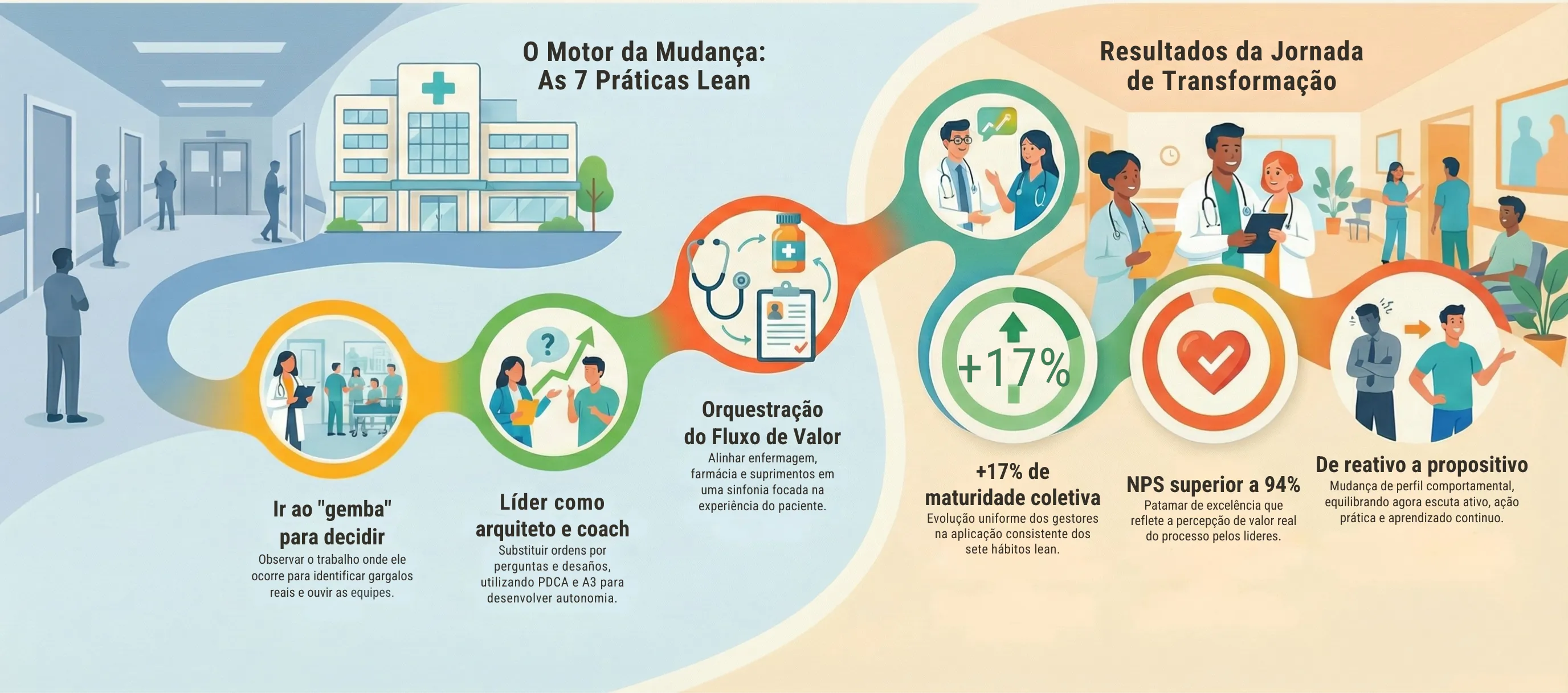
- Go see – carry out constant gemba walks to understand reality before deciding. In lean thinking, gemba is the Japanese word for “the place where the work happens”; in a hospital, it means being in the emergency room, the ICU or the clinical pharmacy, directly observing the flow and listening to those who do the work. Going to the gemba shows what really hinders the flow and reveals bottlenecks that are often absent from the reports.
- Challenge – set bold yet achievable goals that spur the team to overcome the status quo. The challenge works like a lighthouse on the high seas: it does not complete the crossing, but it gives direction, lights the way and keeps the organization from drifting.
- Listen and ask – replace unilateral orders with genuine dialogue. Each question works as a key that opens doors to new possibilities, widening the space for the team to discover its own solutions.
- Teach – act as a leader-coach, using the A3 Process and PDCA as instruments for reflection. Teaching is like planting trees: it does not bear fruit immediately, but it builds autonomous teams capable of facing complex challenges in the future.
- Support – remove barriers quickly, like a cultural andon. Supporting the team is like being a safety net: it provides the confidence to dare in improvement and innovation, even in the face of the risk of failure.
- Work as a team – align nursing, hospitality, pharmacy and supply around the value stream. It is like orchestrating different musicians so that they play in harmony, creating a patient-centered symphony.
- Learn – cultivate humility to revise hypotheses and learn from failures. Learning is like the cycle of the seasons: each phase brings new challenges and new harvests. What is a solution today may be a problem tomorrow – and vice versa.
These practices form a cycle of continuous learning in which leadership is not a hierarchical position but replicable and visible behavior in day-to-day work.
From theory to practice at Hospital Itamed
Located in Foz do Iguaçu (PR), Hospital Itamed is maintained by the Fundação de Saúde Itaiguapy and was founded in 1979 initially to serve workers at the Itaipu Power Plant. Over the decades, it has established itself as one of the largest hospital complexes in Western Paraná, and today it is a reference for the entire 9th Regional Health District.
With more than 26,000 m² of built area, the hospital brings together more than 40 medical specialties; 400 accredited physicians and about 1,400 employees; adult, neonatal, pediatric and coronary ICUs; 24-hour emergency care, a surgical center, oncology, a blood center and a clinical laboratory, among other high-complexity services.
Given this size and complexity, the hospital faces the typical challenges of high-complexity institutions: reconciling quality of care, financial sustainability and patient experience. It was in this scenario that Itamed , with the consulting and support of the specialists at Lean Institute Brasil, implemented a lean leader development program structured on three fronts.
1. Immersive workshops
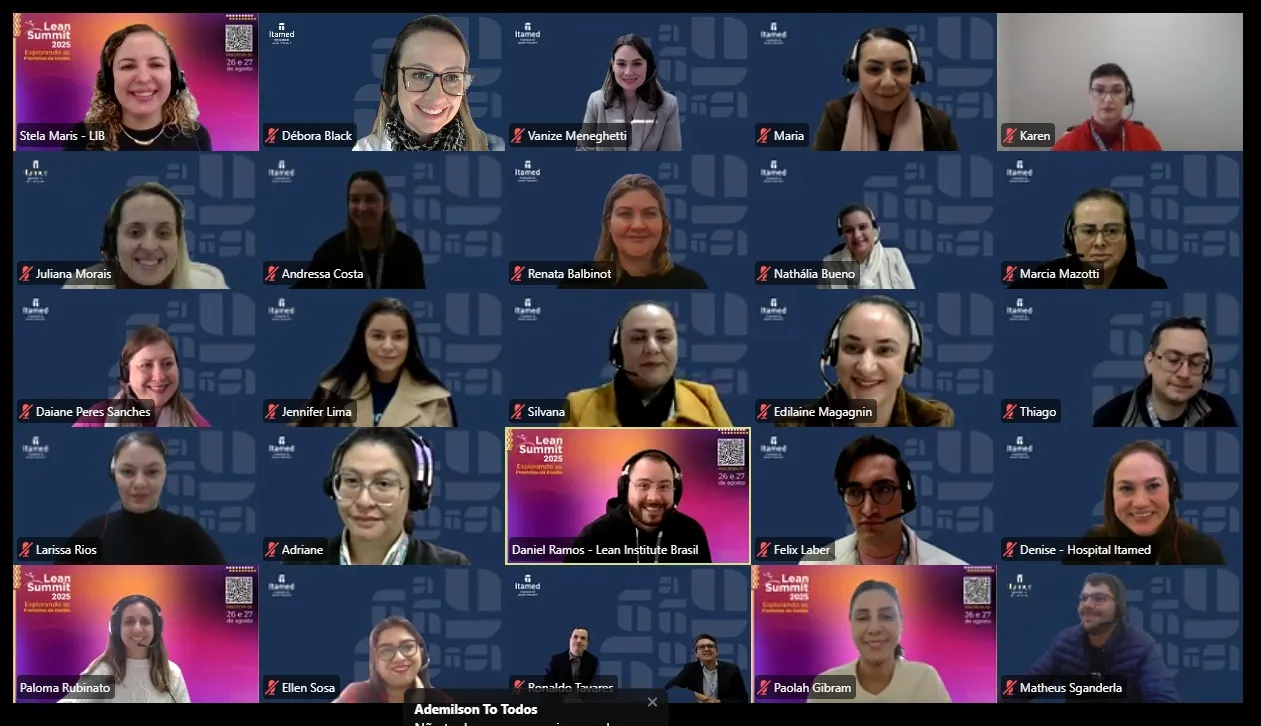
Hands-on workshops were conducted for 35 leaders – from the executive team to care coordinators – in which the seven practices were discussed, simulated and tested in the classroom.
2. Initial and final assessment
The initial diagnosis assessed the application of the seven practices. The result showed leaders who were strong in relational aspects but weak in “Go see” and “Challenge”, a sign of leadership that was still reactive. The second assessment, after the intervention, measured progress and confirmed significant advances.
3. Coaching in PDCA cycles
For four months, leaders were accompanied in coaching sessions in which they were challenged to choose a real problem, apply a new leadership practice, measure the impact and reflect. This cycle ensured that new habits were consolidated before old ones could prevail again.
Results that begin with behavior and reach the bedside
After the coaching cycle, the hospital observed visible changes:
- Behavioral progress – the previously critical dimensions, such as taking the lead in the gemba and encouraging people development, showed remarkable progress. The group demonstrated a change in profile: from a reactive and relational model to a more proactive and practical leadership, balancing listening, action and learning.
- Collective maturity – The average assessment score rose 17% — which, in practical terms, means that leaders began to apply the seven habits of lean leadership much more consistently in their daily work. In addition, the improvement was uniform among managers, a sign that this was not just individual progress but a leap in collective maturity.
- High engagement – the initiative's NPS (Net Promoter Score) was above 94%, a level considered excellent in any sector. This means that practically all participating leaders would recommend the experience to other colleagues, reflecting not only satisfaction but also the perception of real value of the process for their leadership practice.
These results show that developing lean leaders is not just training people, but transforming the way the organization learns and delivers value.
Lean leadership is not a project, it is a journey
Hospital Itamed's experience shows that building lean leaders sustains strategy and drives clinical and operational results. When practices such as Go see, Challenge, Teach and Work as a team stop being concepts and become everyday behaviors, strategy is not only executed but evolves with the hospital's collective intelligence.
In Itamed's case, this journey is already translating into leaders who are more present in the gemba, greater consistency in structured problem solving and collective gains in maturity.
Investing in this journey means ensuring that the hospital's next strategic objectives find leaders prepared to make them a reality sustainably — ensuring that every improvement is reflected directly in the patient experience and in the strengthening of the health system.







