

Misleading metrics
For me, costs exist to be lowered, not calculated"
Taiichi Ohno, in "Workplace Management"
Most performance indicators are tied to production volume and pace. Such indicators lose their meaning once the logic of mass production is abandoned. It is necessary to pay attention to the problem and communicate it carefully, because major advances may simply be abandoned due to an inappropriate interpretation of such metrics.
The logic of mass production is grounded in economies of scale. The charts below represent, in simplified form, the effect of economies of scale on the average unit cost of products.
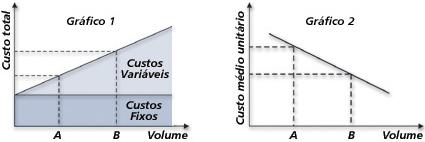
Chart 1 illustrates the relationship between total cost (the sum of fixed and variable costs) and production volume. Fixed costs are those that do not change when production volume rises or falls; variable costs, on the other hand, are those whose values are directly related to the quantity produced. Note that the ratio of fixed costs to total costs decreases as volume increases.
Chart 2, in turn, shows what happens to average unit cost (total cost divided by the quantity produced) as volume varies. For example: if the volume produced is A, total cost will be lower than if the volume were B. However, average unit cost will be higher, given the smaller "dilution" of fixed costs. If the volume produced is B, total cost will be higher, but unit cost will be lower.
Economies of scale have not ceased to be a reality; they continue to make complete economic sense. The problem is that the pursuit of maximizing them feeds "overproduction," one of the seven wastes identified by Taiichi Ohno and considered the most harmful, because so many others stem from it.
Overproduction is not a problem when demand exceeds supply or competition is weak: whatever is produced, sells. However, that is not the reality for most companies and economic sectors. That is why being lean means making only what is needed, when it is needed, at the customer's pace: whatever sells, gets produced.
Costs are perhaps the performance indicators most closely monitored by companies. The charts above, which represent the effect of economies of scale, treat costs as generic entities, classifying them as "fixed," "variable," "total" and "unit." In practice, companies adopt diverse and considerably more complex methods and approaches to estimate and classify them.
But regardless of the "costing system" used, the phenomenon of economies of scale remains the great backdrop: making more is still associated with costing less. Thus, the meaning of an "increase" in "unit" costs resulting from a drop in production volume can be misinterpreted and lead to mistaken and often anti-lean decisions.
Standard cost, for example, a management control tool used to measure the difference between costs actually incurred (actual) and planned costs (standard), is estimated on the basis of static assumptions about production volume, number and duration of setups, employee experience, etc.
To illustrate, let us imagine that:
- production volume begins to vary with actual demand;
- the number of setups increases and their times fall;
- employees begin to work in a new way, in cells for example, having to perform tasks they have never done before.
All of this would be seen as promising results of a lean transformation, but the variance reports - which show the degree to which actual costs diverged from standard - would be pointing to problems, because the fundamental assumptions would simply not have been confirmed.
Another kind of indicator that loses its meaning are those used as "efficiency" parameters.
The higher the efficiency, the better? Only if there are reasons for such an increase. What lean systems should seek is the necessary efficiency: the efficiency capable of meeting demand at the pace of actual consumption.
Bear in mind that the necessary efficiency may well fall short of the maximum efficiency allowed by equipment, facilities and people. In fact, if the necessary efficiency coincides with maximum efficiency for a long time, capacity may be at its limit and future revenues may be compromised.
Maximum efficiency cannot be an end in itself. What is the point of making maximum use of productive resources to turn raw materials into products that will not be sold? What lies behind "efficiency" indicators is, once again, the pursuit of economies of scale.
Another issue: isolated individual efficiencies do not mean adequate systemic efficiency. "Islands of efficiency" within a production system often mean excess investment and can also lead to overproduction.
Thus, when a system begins to operate according to pull logic, making only what is needed when it is needed, costs and other indicators may "worsen," because production volume will have to follow actual consumption: that is what we are after. Here is the trap. Well-conducted transformations with promising results may simply be abandoned because of the seemingly inexplicable behavior of some numbers that have lost their meaning.
A new reality requires new eyes to be seen. Therefore, it is necessary to communicate these issues properly to the different areas of the company, which understand the organization and its performance in different ways. The next step is to rethink the nature of indicators, the way they are generated and the use made of them. These are subjects we will leave for the next article.
If you know of examples of this kind of "conflict" between good lean practices and inappropriate indicators, please share them with us. We are particularly interested in the subject and your contribution will be very important.







