

Costs in Lean Production
Companies adopt lean manufacturing strategies in pursuit of improvements in productivity, quality, flexibility, fast delivery and costs (WOMACK and JONES, 1996).
These companies, however, report that lean practices can bring operational improvements that do not, however, translate into short-term financial benefits or reductions in product costs. This may come across as a lack of incentive to change the production system (MASKELL and BAGGALEY, 2004).
Similarly, a reduction in finished-goods inventories results in an increase in costs and, consequently, a reduction in profit. Womack and Jones (1996) present, in the example below, a comparison between the results of mass production and lean production in a fictitious company. In this example, when the company switches from mass production to lean production, the profit of $800,000 falls to a loss of $50,000.
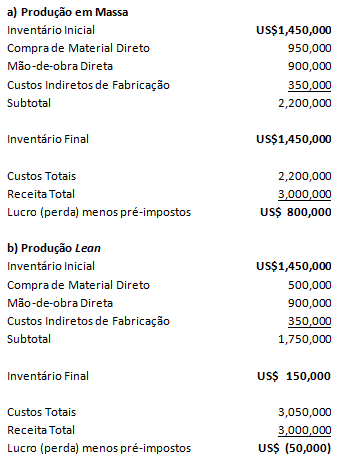
As can be seen, in lean production $1,300,000 of the initial inventory was used, with the conversion of only $500,000 in material instead of $900,000; production was reduced as a result of using part of the products found in inventory. The reduction in assets (inventories) led to an increase in product cost with a reduction in profit (and, in this case, a financial loss).
In addition, the lean company's customers notice that product delivery times (from order placement to formal delivery of the product) are also drastically reduced, and so they start placing their orders later than they used to and in smaller quantities. As a result, in the early stages of the lean implementation, sales revenues fall, which helps mask the results obtained with lean production.
The lean system is not a technique focused basically on cost reduction; its focus is the elimination of waste. Thus, the gains obtained by eliminating waste translate into gains in resources (labor and machines). The labor and machine resources freed up will be used in the future in new business, increasing the company's production capacity and generating profits in the future. Therefore, in the short term these gains do not show up in the company's results. Since this is a process of constant improvement, laying off employees made idle by lean would be culturally counterproductive during the process of implementing this new system.
Companies that have implemented lean manufacturing on a large scale conclude that the traditional management accounting system does not provide the information managers need to make decisions (HARMAN and PETERSON, 1990). It is not that traditional cost accounting is wrong. Traditional costing was created when companies operated in a stable environment and used mass production techniques such as large batch sizes. The most important cost was direct labor, and the other costs (other than material) were allocated as a percentage of direct labor cost. The principles of lean manufacturing are quite different, since they are oriented toward competition and changing environments, where suppliers need to adapt quickly to their customers, without costly inventories that could become obsolete and therefore unsellable, but instead using factory layouts such as single-piece flow. Furthermore, direct labor today represents a small percentage of total cost.
Overproduction and work in process were then considered a valuable asset, but the lean philosophy considers them waste (consumption of unnecessary resources). Traditional cost accounting and parameters such as machine utilization or productivity per worker lead to decisions contrary to the lean philosophy because, instead of achieving minimum cost, they endorse the idea that each section of a factory must produce as much as possible, in long production runs, thus maintaining all kinds of inventories. Lean manufacturing focuses on making only what customers actually want to buy, and tries to reduce inventories, reduce cycle time and eradicate operations that do not add value to products (Ward and Graves, 2004).
Since lean manufacturers do not cut costs but transform waste into available capacity, the financial impact comes from the decision on how to use that capacity (and the cash flow from reduced inventory). Lean Accounting uses specific tools to understand the financial impact of lean changes on companies.
Lean accounting is, then, a costing method that supports the creation of value for the customer by costing the value stream as a whole, not individual products or departments, thereby eliminating waste in the accounting process.
Accounting practices should closely follow changes in business operations. This, however, does not happen during the lean transformation. The fact is that traditional cost management may not work well in the lean environment. Changes in structure and procedural activities for lean manufacturing alter product costing and operational control.
In the lean environment, many of the indirect costs distributed to products using allocation drivers are now traced directly to the products, which produces accuracy in product costing.
When we speak of lean accounting, two aspects can be understood:
1. Application of lean Methods and Thinking to the Company's Accounting Processes.
2. Adapting Management Accounting to the lean Transformation.
In the first case, applying lean methods focused on eliminating waste/transactions leads to improvements in the following activities/processes:
Cost Accounting; Labor reporting; Production orders; Purchasing & Accounts payable; Inventory valuation & control; Simplification of accounting records; Month-end close;
In the second case, which is the main purpose of lean Accounting, the aim is to develop management accounting techniques that support the transformation of the traditional company into a lean company. Accordingly, the following aspects are addressed in this regard:
• Lean performance measurements - this is the primary lean control method for meeting customer needs and driving continuous improvement;
• Value stream costing - a simple, direct and accurate way of creating financial reports that uses few transactions;
• Box score report - steers the business toward customer value, not cost;
• Lean decision-making - manages the business by value streams, with accountability for growth, profitability and continuous improvement;
• Financial impact of lean improvement - understands the financial impact of lean improvement and creates a profitable strategy;
• Elimination of transactions - saves time, money and confusion through the radical elimination of wasteful transactions;
Harman and Peterson (1990) list some of the problems with traditional cost accounting techniques:
• Cost allocation policies are not always reasonable. For example, indirect costs are allocated based on direct labor costs, even though these costs nowadays represent a small percentage of production.
• Depreciation records are not compatible with the actual deterioration of assets, because it is an irregular process. Assets are not checked annually to determine their value.
• Efficiency metrics refer to internal actions that seek to keep people and machines busy. They do not measure customer-related aspects (on-time delivery, quality, etc.).
• The objective is to achieve standard cost, not process improvement.
• Inventory is an asset. The cost of holding inventory is not calculated. Traditional inventory control is not concerned with minimizing inventory cost. The priority focus is to avoid inventory shortages.
• The objective of cost accounting is to know the exact cost of a product, but changes in demand bring changes in the cost of production because of the averaging of fixed costs (fixed cost over the number of units produced).
• Managers claim that they use cost for decision-making on matters such as pricing, product profitability or outsourcing. Companies cannot always price a product based on cost. Increasingly, the price is set by the value created in the eyes of the customer, while still being subject to what the market establishes. Thus, it can be said that an approximate cost is sufficient. The analysis for deciding whether to outsource or make in-house can be misleading. When a company decides to outsource part of its process, many of the fixed costs do not disappear; certainly those fixed costs are included in the product's standard cost and may be the reason for deciding to outsource.
In contrast to mass production operations, a lean company emphasizes the elimination of waste, higher turnover and lower inventory levels. The focus is to achieve the shortest possible production cycle and to produce only to meet customer demand. The benefits are generally lower costs, high-quality products and shorter lead times. These principles require a company to move from a functional/departmental organization to a cell-based work organization in which the entire process needed to make a product or line takes place close together and in sequence. As soon as companies implement the lean approach in manufacturing, accountants begin to see the many traditional costing practices that no longer make sense. A growing number of businesses are implementing these accounting concepts to better capture the performance of their operations. Since traditional cost accounting does not work in a lean operation, a new way of looking at the numbers has been proposed. Instead of grouping costs by department, they are organized by value stream, which includes everything that creates value for the customer and that the company can reasonably associate with a product or product line. When switching to lean accounting, accountants may wish to supplement the company's standard financial statements with information that captures the resulting improvements. Most accountants will find the cost information they need to prepare lean financial reports already available in the company's accounting systems.
The value stream, then, consists of all the activities required to bring a group of products or services from its starting point (for example, a customer order, or the concept for a new product) to a finished product in the customer's hands. Value stream costing normally does not use ABC costing. It is a simple costing system in which allocations are minimal. Direct and indirect costs are charged to the value stream as if they were all direct. (MASKELL and BAGGALEY, 2004).
The need to review cost accounting arose in the 1980s and gave rise to several research studies (JOHNSON and KAPLAN, 1987). The problem is the lack of adaptation of cost systems to lean manufacturing up to the present day (WARD et al., 2004). In the early 21st century, the accounting method known as Lean Accounting (lean Accounting) gained prominence. This technique can be used by companies on their path to maturity toward lean manufacturing (MASKELL and BAGGALEY, 2004). Performance measurements can be controlled visually, and they provide useful and frequent information in order to improve processes.
Maskell (BMAInc, 2013) makes the following points on how the traditional way of calculating costs is harmful to lean companies.
• The traditional calculation of product costs is complex, time-consuming and creates thousands of transactions. And, for their part, lean manufacturers generally do not need to calculate product costs.
• The objective is to achieve standard cost, not process improvement.
• Variance analysis is supposed to provide the information to understand and improve the process. This, however, leads to time wasted explaining variances instead of improving the process. Lean shop-floor control leads to timely problem solving and improvement.
• Product costs are used to create information about product profit margins so that managers can optimize products across markets, regions, etc. These decisions are better made using contribution margin and incremental cost methods. Lean accounting uses these methods.
• Many think inventory is valued at standard cost - inventory needs to be valued at actual cost. This means finance staff need to analyze and apply cost variances in order to turn standard cost into actual cost. Lean accounting uses only actual cost throughout the entire cost accounting process.
• Traditionally, indirect costs are allocated to products based on labor time, machine time and other activity drivers. This always leads to incorrect calculations of product costs and to bad and harmful decisions.
• In lean flow, product cost is related to the flow rate, not to labor time or machine time. Many products have the same flow rate through the bottlenecks but different labor or machine times. Lean accounting does not use product cost for decision-making. If a product's cost is calculated, it is based on the rate of consumption in the flow, and this is more accurate.
• Traditional standard costing requires a great deal of work and thousands of transactions, motivates wrong decisions, leads to poor improvements and cannot value inventory directly. It is so complicated that only a few people can understand it, and it leads to the wrong cost.
• Traditional product costing is useless for companies that aspire to become lean organizations. There are, however, many lean actions that make it possible to serve these purposes.
In the traditional system, absorption costing encompasses all the costs considered: direct material, direct labor and indirect costs; the unit result x volume reflects the total.
In the lean system, resources in general do not vary with volume; the speed or hourly output at the bottleneck (constrained resource) is the determining factor of costs; and the objective is to maximize the value stream.
References
HARMAN Roy L., & PETERSON, Leroy D. Reinventing the Factory: Productivity Breakthroughs in Manufacturing Today. New York: The Free Press, 1990.
JOHNSON, Thomas H.; KAPLAN, Robert. Relevance LostThe Rise and Fall of Management Accounting. Boston: Harvard Business School Press,1987.
MASKELL, Brian; BAGGALEY, Bruce. Practical lean accounting: a proven system for measuring and managing the lean enterprise. New York: Productivity Press, 2004.
BMA INC.; 5 Reasons Why Product Cost Are Dangerous To lean Companies. Available at http://www.maskell.com/lean_accounting.html . Accessed on April 17, 2013.
WARD, Yvonne, CRUTE, V., TOMKINS, C., GRAVES, Andrew. Costing for Competitiveness: Cost Management and Accounting for lean Enterprises. Society of British Aerospace Companies Publication, 2004.
WOMACK, James P.; JONES, Daniel T. lean thinking: banish waste and create wealth in your corporation. New York: Simon & Schuster, 1996.
About the Author:
PhD in Production Engineering. Author of several books, the most recent being:
• CUSTOS E FORMAÇÃO DE PREÇOS Análise e prática (Atlas, 2013).
• GESTÃO PELOS NÚMEROS CERTOS Uma novela sobre a transformação da contabilidade gerencial para as empresas lean (Bookman, 2011).







