

Staff shortage is a critical issue in healthcare
Absenteeism is defined as the frequent physical absence of a professional from the workplace. It is one of the oldest problems in the world of work. Its origin goes back to the exodus of rural landowners, who left their lands to try for a better life in the cities, practicing so-called “absentism”. Later came the industrial revolution and the adaptation of the term to describe the absences of workers who worked in factories.
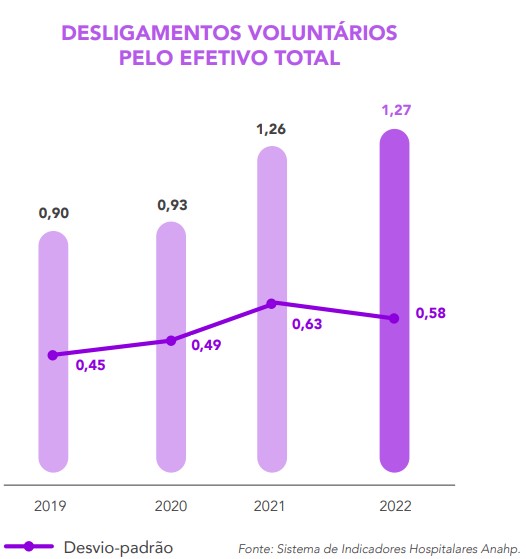
Even today, the phenomenon causes losses for institutions, for customers and for the employees themselves. In health care, we are living through a post-pandemic period with very high monthly absenteeism rates and employee leave rates, higher than those recorded in 2020 and 2021 and in previous years. According to the 2023 observatory of ANAHP (the Brazilian National Association of Private Hospitals), this is a point of attention for the sector and a worldwide concern regarding the health care workforce.
When we look at this problem through a magnifying glass, within institutions, we identify long times to fill vacancies, a Human Resources team overloaded with recruitment, growing overtime and a constant concern about how to maintain the quality and safety of care with fewer professionals.
But this is not an isolated issue faced only by Brazil; it must be analyzed considering the systemic scenario.
In the United States, a study published by Mark Linzer in JAMA Health Forum in November 2022 shows that the intention of physicians and clinicians to leave the institutions where they work increased from 24% in 2019 to more than 40% in 2021.
In addition, health professionals have been systematically reducing their working hours in European and North American countries, causing a dramatic reduction in the supply of services.
On the other hand, health organizations continue to struggle to contain resignations and to recruit people to fill vacancies, but a large share of health workers have been giving up on continuing in their professions, as we can see in the increase in the voluntary turnover rate.
Alison with Plant Manager Doug Wichmann
The causes:
Poor working conditions for the practice of care, a lack of human resources and work overload force workers to overexpose themselves and take on responsibilities in situations that end up causing great physical and psychological strain.
Leadership also plays a fundamental role in this scenario; it really determines how the organizational culture is felt by employees. In Mark's study, positive factors for keeping professionals at work are related to feeling valued, teamwork and values aligned with those of the leaders.
The effect of pandemic burnout is also an important cause that needs to be better studied and addressed.
Impacts:
Absenteeism has caused impacts for health institutions that are both financial and related to the quality of the service provided and to patient safety and experience.
It is necessary to take into account that, even when there is a decrease in the number of employees within the institution to provide the service, the number of patients to be cared for is the same, which means an insufficient number of staff to provide care to this population.
For all health professionals, commitment to quality and patient-centered care is among the main drivers of their likelihood of staying in their jobs.
Lean for analyzing and solving the problem:
The shortage of health professionals is one of the causes of inefficiency in health systems today; the problem is complex and cyclical and impacts the availability of resources, quality of care and the patient experience.
In the current Brazilian situation, we have not yet been able to see public strategies and mobilizations with a significant effect that establish effective changes; however, letting the problem happen without acting on the causes that are under the institution's responsibility cannot be an option. This is the ideal moment for us to review processes, equip people and co-create innovative ways of dealing with the situation.
Some concrete actions could be, for example, setting up a dedicated lean project team to evaluate the process for selecting and hiring people with the aim of reducing the time to fill vacancies and better matching profiles to the needs of the processes. Until recently, a period of 30 days to fill a vacancy could be considered efficient; today we need to be much more agile.
Another approach could be a structured leadership development program, so that managers begin to adopt new behaviors, such as listening more attentively, understanding problems in greater depth, and understanding the aspirations, desires and motivating factors that determine the existence of a truly engaged team. We need to be able to retain our talent and develop it, avoiding unnecessary turnover and, consequently, its undesirable impacts.







