

How to increase profitability and improve the work environment at the same time
When lean practitioners tackle a big problem, they use A3 problem solving to break it down into smaller, actionable components. That’s because lean thinkers have shown that significant business problems – including revenue or profit shortfalls, declining market share, an unreliable supply chain and the like – originate in the frontline value-creating work. And that’s why lean practitioners preach the mantra of “go to the gemba”.
Leaders and managers also know that A3 management — the work of overseeing A3 problem solving — is much more than simply solving work process problems. The practice triggers a change in mindset in everyone, transforming the manager from commander to coach, a new relationship that, in turn, reshapes the work environment, replacing conflict and blame with collaboration. As managers work with their teams to eliminate obstacles and frustrating tasks, both business results and the work environment improve.

The managers of an iconic restaurant learned these lessons when they used lean thinking and practices to close a profit gap of almost 8% while maintaining or improving their excellent service reputation. In nine months, the team, working with LEI coaches in a co-learning partnership, increased year-over-year profit by 2.2%, with almost half of that amount due to reduced labor and overtime costs (as happens in many lean transformations, the changes generated additional savings from the work process improvements – in this case, from reduced food waste).
In addition, during that time, leaders and employees learned that lean thinking and practice had transformed their old, conflict-ridden workplace into one that was more purposeful, less stressful and more productive.
Understanding the problem
To begin with, LEI and the restaurant’s director broke down the significant and vague problem of low profitability into more actionable components. They found that labor and food were driving additional costs mainly during the surge in demand in the summer. In addition, they documented how labor costs soared during that season as managers hired more cooks and staff to handle the seasonality. Management typically increased the number of cooks – going from 14 to 15 per shift in the low season to 19 to 20. Overtime also rose, as cooks arrived early (between 7 a.m. and 9 a.m.) to have enough time to prepare food and stock their workstations before lunch service began at 11:30 a.m. In addition, changing regulations meant higher minimum wages for staff and increased overtime for assistant managers. As a result, cost increases outpaced revenue growth, 6% to 3%.
The restaurant’s leaders were skeptical that they could adjust their replenishment system to reduce food waste and avoid the summer hiring frenzy. After all, the kitchen could barely keep up even after the hiring spree. Still, they agreed to keep investigating to discover the underlying (or root) causes of the problems. The LEI coaches began by challenging management with a simple question: What is the work?
The management team carried out a detailed analysis of the work, conducting a spaghetti-mapping exercise during a busy lunch service to help the management team learn to see work versus waste using LEI’s “work motion categories.” This exercise helped them identify how often cooks left their stations to do non-value-added work and how much time they spent not doing value-added work (cooking). Critically, they also identified why cooks left their stations: to replenish product, deliver finished dishes to expo, collect clean plates, among others.
The spaghetti-mapping exercise confirmed for management that the solution to their profitability problem was not that they needed more cooks – or even “better” or more efficient cooks. Instead, they needed to eliminate what was getting in the way of the cooks’ work and create a better work process that would let them focus on cooking.
The restaurant’s former executive chef explained the revelation: Before, “when a cook fell behind, we thought it was because he wasn’t good enough and we needed to replace him; that was naive,” he says. “When we started looking closely at the work and dividing it into value-added, non-value-added and waste, we realized that the jobs were hard to do successfully and frustrating for employees. It was really the process that was causing the failure, not the individual”.
Improving the process: a just-in-time kitchen
The management team and LEI started by making a change designed to keep the cooks cooking: setting up an on-demand prep station that would continuously replenish product for the entire kitchen and creating a new position – the runner – to deliver products to the cooks from the prep station.
In the previous process, every morning, 15 cooks arrived between 7 a.m. and 9 a.m. to prepare their stations for a day of service that would only begin at 11:30 a.m. Each cook was responsible for preparing their mise en place – a French culinary term meaning “everything in its place”. For example, the sauté cook would heat the water for the pasta, chop the garlic, grate the pecorino cheese, among countless other tasks. Cooks competed for scarce space, tools and products, leading to a chaotic environment. They spent a lot of time gathering ingredients, going up and down the elevator to get to the walk-in on the second floor, and bumping into each other as they prepared their stations.
In addition, cooks could not accurately predict demand, because they did not know what customers would order. For fear of running out of stock during service and “getting in the weeds” – falling behind in restaurant lingo –, cooks tended to over-prepare, especially products that took a long time to prepare.
The cooks’ fear of this situation is an example of the problems that lean thinking and practices systematically reveal and address. The dreaded scenario is a problem everyone is aware of but does not “see” or acknowledge and is therefore dealt with through workarounds by the person doing the task. Unfortunately, these improvised “solutions” often cause other problems in adjacent work processes, which also tend to be ignored or accepted as inevitable.
For example, when chefs prepare too many ingredients, some of which are thrown away if not used that day, or when they work at a station with excess inventory, grabbing more items than necessary, they are wasting time and increasing their physical effort unnecessarily.
Without a systematic plan to ensure that cooks never run out of ingredients during service hours, it is understandable that they overproduce to avoid falling behind – and being blamed for delays in serving customers. And, at the same time, it is also understandable that cooks might accept running short of some prepared ingredients or having to throw others away as a minor problem, because these problems do not affect their ability to deliver orders.
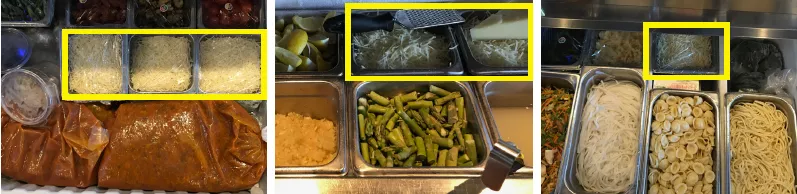
Before optimizing inventory, chefs overproduced and stored more product than necessary at their stations. The chefs saw overproduction as a strategy to avoid running out of stock during service hours, which would pull them away from their stations to prepare more, delaying the preparation of orders and hurting customer service. Instead, by basing station inventory on data – how much of each product is sold in a shift –, the team was able to reduce the quantities prepared and stored, while having enough to keep the cooks cooking and maintain the restaurant’s high level of customer service. The yellow squares show the pecorino cheese stored at the sauté station.
For example, to grate pecorino cheese, you have to set up a Robot Coupe, slice the cheese, shred it and store it. Doing this in the middle of a busy service would leave the cook desperately behind, so he would shred enough cheese for up to four days of service. Because the cheese took up precious space in the station’s refrigerated drawers, there was less room for other critical ingredients. For example, he might have only one pan of chopped asparagus, putting him at risk of running out. As a result, cooks often had too little of some ingredients and too much of others.
The management team addressed the chaotic prep process with the new on-demand prep system. With the new process, each station stores only two pans of prepared product for most ingredients: one pan designated as the “working pan” and the other as the “backup pan”. In addition, depending on a product’s sales velocity and prep time, they store more pans in a separate refrigerator.
For example, on average, the sauté station receives 36 orders requiring chopped clams on a busy day. Since each pan holds 15 portions, the station needs three pans to complete a day of service. The prep time for chopped clams was under a minute, since it was a matter of emptying a can into a pan. Consequently, they keep two pans at the sauté station and none in the refrigerator.
Another example is linguini, which takes eight minutes to cook. Since the sauté station typically sells 68 portions a day and each pan holds 10 portions, the station needs seven pans to complete a day of service. Because of the prep time, management decided to keep two working pans and one backup pan at the station, storing six in the separate refrigerator.
When a cook finishes a working pan, he places the empty pan in a blue tray at his station, signaling the need for replenishment, and then grabs the backup pan. Meanwhile, the runner collects the empty pan, places the product label on the prep cook’s board, takes a pan from the refrigerator and places it at the cook’s station as backup. The runner follows a fixed route through the kitchen every 10 minutes. This process ensures that the cook never leaves the station and can concentrate on cooking.
At the same time, he replenishes products as indicated by the labels accumulated on the prep board. This process ensures that the kitchen produces only what customers consume, eliminating the risk of spoilage and ensuring that cooks always have what they need to serve customers.

Reassigning current team members to the on-demand prep station and runner positions enabled just-in-time delivery of product to the cooks’ stations. This change reduced raw material inventory (ingredients) and work-in-process inventory (pre-prepared recipe components), which in turn reduced waste (spoiled food).
Testing the new process
The new system faced an unexpected test in mid-April, a typically slow time of year, when, on a warm, sunny Saturday, the restaurant unexpectedly had unusually high demand. Management had not yet hired its army of summer cooks, which meant a team of 15 people was challenged to meet peak summer demand on a day that would normally require 20. Not only was service successful, but the next morning the restaurant was calm. A busy day would normally deplete the restaurant’s products, requiring a heroic effort to restock all the stations between 7 a.m. and 11:30 a.m. the next morning. However, because prep took place continuously throughout the day, the stations remained stocked.
Critically, the impromptu test confirmed that the improvements they had made to the work process would allow them to handle the summer surge without the usual hiring spree. So they chose not to hire additional cooks for the summer, keeping a team of 15 cooks plus one runner and adjusting the cooks’ start times (which used to be between 7 a.m. and 9 a.m.) to 10:30 a.m., which reduced overtime expenses. The savings from these decisions showed up in the bottom line.
However, what surprised everyone most was discovering that not hiring additional cooks during the summer rush would not make the team work harder. In fact, the changes to the work process made the work easier and reduced the frustrations inherent in non-value-added work – the time wasted looking for the things they needed to do their value-creating work.
Recalling the day, the restaurant’s former kitchen manager admits: “Obviously, everyone was a little frantic and needed a bit of guidance, but we had a lot more time to do our work. So it was really good to see that, for sure”.
The test also demonstrated the effect that A3 management and problem solving have on the work environment and employee engagement. For example, the former kitchen manager notes that the day after the challenge of the unexpected rush, he saw a lot of buy-in from the team, adding that they were saying things like: “I can’t believe we just did that” or “what else can we do?” and “let’s keep going”. So he thought that was really cool.
Developing people and changing leader behavior
For the kitchen manager, learning from LEI how to work with the cooks to address issues the lean way was transformative, and he says he is beginning to introduce the practices in his new job. Once he experienced the lean approach – going to the gemba to see and understand the work, working with and coaching the cooks and other kitchen staff to solve problems –, he understood the value of building the team’s problem-solving capability.
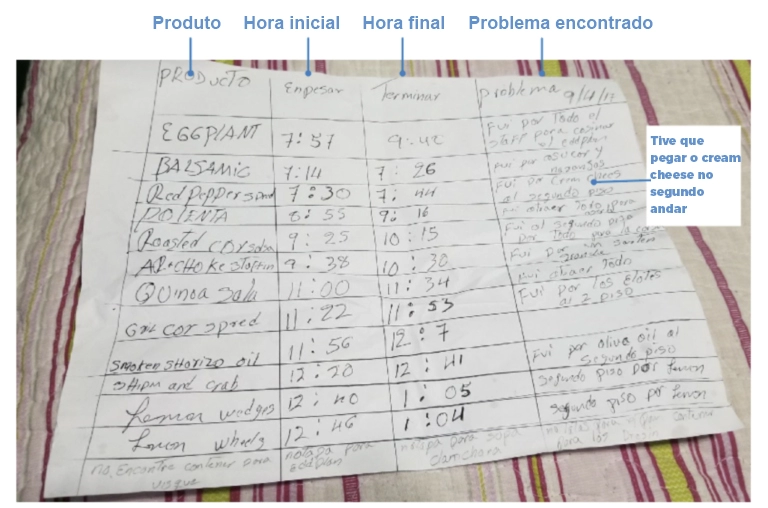
A simple tool the kitchen team used for kaizen was a problem identification sheet. For two weeks, the prep cook tracked start and finish times and the problems he faced when preparing each item. This data sparked ideas for improving the workflow of the cook and the management team. For example, the exercise revealed time-wasting trips to the second floor, leading the team to create a storage location near the prep area to increase productivity and spare the cook frustrating trips to the second floor.
When we run into a problem, “it’s so easy in our industry to just say: 'we need to change them'”, explains the kitchen manager. With lean thinking, however, you look at the processes and at how to fix them”. This shift in mindset is precisely what lean thinking teaches, according to LEI president Josh Howell. “Lean leaders frame problems in terms of the process, not the people. If a line cook falls behind, we don’t blame the cook”, he explains. “Instead, we observe and interrogate the process. What is getting in the way of this cook’s success? Then we try to improve”.
The lean approach to leadership is “very powerful,” the kitchen manager adds. “Because you’re not just earning respect and credibility for yourself; you’re also making their work and their morale much better along the way”.
For the executive chef, the change in mindset required of leaders and managers when adopting lean thinking and practices is fundamental. Before receiving lean coaching from LEI, “our culture was ‘management knows what’s wrong’. We just went at things without ever taking the time to understand the problems,” he says. “Over time, we learned to be humble and appreciate the cooks. We realized that by working together [with the value-creating team], we could really solve problems and improve the [work] environment”.







