

How the A3 saved Mr. Joe's life… and can save yours too

A3 thinking is a philosophy that applies to any environment and sphere of our lives. In fact, many people use its fundamentals without even realizing that they are, in a way, producing their own A3.
Let us meet and follow the story of Mr. Joe (on the left), who is going through health problems that put his life at risk. At the same time (on the right), we will follow how the care provided to him follows the structure and basic elements of an A3, with the purpose of giving Mr. Joe a long and enjoyable life, free from the suffering caused by his bad habits.
Let us meet and follow the story of Mr. Joe (text in black), who is going through health problems that put his life at risk. At the same time (text in blue), we will follow how the care provided to him follows the structure and basic elements of an A3, with the purpose of giving Mr. Joe a long and enjoyable life, free from the suffering caused by his bad habits.
In this way, we hope to see A3 thinking in our daily lives and learn that using the A3 can be of great value to each of us, whether in our working life or in our personal life. Learning to build an A3 in order to apply it in any situation is the goal of this article.
The clock read three in the afternoon when Mr. Joe arrived at the hospital in his town. Recently, Joe had been struggling to climb the stairs of his house and, along the way, he felt fatigue hitting his body. “Do you smoke?”, the doctor asked as she saw him. “A few packs a day”, he answered, short of breath. “Do you exercise?”, the doctor continued the questionnaire, observing his rather unathletic build. “Rarely”, answered Joe, probably resorting to a euphemism. Having seen many patients over the years, Dr. Cris, who was in charge of helping Mr. Joe, knew that we should always hope for the best, but prepare for the worst. Fortunately, this hospital has extensive experience using A3 thinking to save lives, and Mr. Joe hoped he could be one more of the hospital’s success stories. Decisively, Dr. Chris took a sheet from her notepad and a blue pen, wrote something and handed it to Mr. Joe:
Does your organization face problems or aim at a target condition? What is your need?
Whatever the needs, whether due to the effects of a crisis (current or prevention), the desire for your company to reach greater and better levels, or any kind of problem, the “A3 way of thinking” will lead you to your objectives and build consensus on the urgency of your purpose. The A3 also has communication power. It is a story told with a beginning, middle and end, whose construction is made up of the very investigation of the problems related to your purpose. All the fields of the A3 are related.
A practice pioneered by Toyota in which the problem, the analysis, the corrective actions and the action plan are written on a single sheet of paper (A3 size), usually using charts and pictures.
Extending Joe’s life
“Whatever problems we discover along the way, extending your life is our purpose and our concern”, the doctor told Mr. Joe.
Title:
What are you talking about and why?
The title refers to the purpose of the A3. It is like the cover of a book or the logo of a company. A single sentence should summarize the entire content of the A3.
Background:
Background: 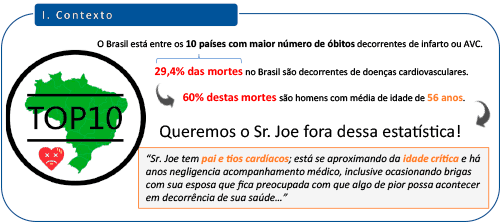
“Before we do any kind of test”, said the doctor, “I need to ask a few questions”. After a few minutes, the doctor found out that Mr. Joe is 46 years old and has a history of heart disease in his family, with his parents and uncles having suffered from various heart conditions. “Brazil is among the ten countries with the highest fatality rates from cardiovascular disease, with almost 30% of deaths in the country caused by this factor”, the doctor said. “Among the most affected are men with an average age of 56”. These data are all relevant since they connect to and give importance to the purpose of the concern for Joe’s life.
Background:
Background:
Why does your purpose matter?
The background should state the importance of your A3’s purpose. We fill in this part with the scenario and context surrounding the purpose, which steer and affect the decisions about it. As a rule, the background is filled in with elements we cannot change, such as history, competition, the need for innovation, end customers’ wishes or even strategic decisions and key indicators, such as the targets set by senior leadership (if you have no control over those decisions).
The background is what gives importance to the purpose.
Current State:
Current State: 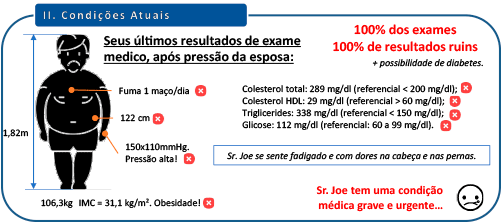
After the conversation, Mr. Joe was referred for a general diagnostic survey of his condition. The tests revealed some problems related to the fact that Mr. Joe smoked, was obese and had high blood pressure. Other tests also showed results outside the standard set by medicine. In addition, Dr. Chris noticed a high likelihood of developing diabetes. The picture was not good at all.
A view of the current state is of utmost importance for seeing the problems.Current State:
Current State:
Why define problems whose mitigation we cannot measure?
In this field we communicate the problems and pains related to the contextualized purpose. When reading the Current State, the reader should be armed with supporting facts and data provided by the author. The importance of data is paramount: seek to quantify your pains. As a rule: the Current State is filled in with elements that we can change.
The tools for surveying current conditions are situational and varied, ranging from VSM in processes to a visit to the doctor. Keep in mind to expose the problems with facts and data. If there are no facts and data, go get them.
Objectives:
Objectives: 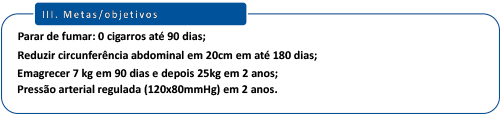
“Well”, Dr. Chris began the conversation with Mr. Joe while reading the test results, “we need to set some objectives for you. First of all, it is vital that you stop smoking, for the sake of your health”. Joe knew there would be no other alternative, so he agreed to try to overcome the addiction within 90 days. He also agreed to try to lose weight. “I believe we can set an objective in three stages”, said the doctor. “In 90 days, we will try to reduce your weight by 7 kg. In 180, reduce your waist circumference by 20 cm. In 2 years, our final objective will be for you to have lost 25 kg”. Joe nodded his head in agreement with the objectives set.
“As for reducing cholesterol, triglyceride and glucose levels”, the doctor continued, “I believe we will see positive results naturally, because they are already indirectly addressed in our objectives. Setting a target for these points would be redundant; they would not be mutually exclusive”.
Objectives:
Objectives:
What specific results does your purpose require?
Set quantified and time-bound objectives. All targets and objectives are an idealization of a future state. Targets should not be conservative. Targets are often necessary for the viability of the business and the survival of the organization. Targets should also provide a sense of challenge. Try to set objectives and targets independently – without one target interfering with another – so that you can control each one properly.
What specific results does your purpose require?
Analysis:
Analysis: 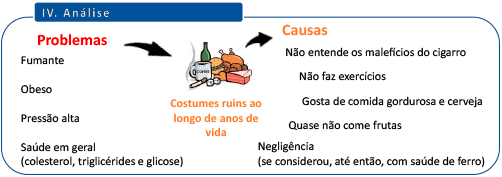
Why does Mr. Joe suffer from all the problems pointed out in his tests? After a few interview sessions with him and his wife, Dr. Chris realized that his eating habits were horrible. Another point that caught her attention was his sedentary lifestyle. In an interview, he said he played soccer, but after following up on and observing Mr. Joe’s routine, she noticed that for two weeks he barely climbed his stairs.
Analysis:
Analysis:
Why do the problems exist?
Root cause analysis closes the investigation of the problem. It is an important step that has the power to change the scope of the entire A3, if necessary. In this field, logically describe the cause-effect relationship of the problems. Use tools such as the Ishikawa diagram and the 5 whys, for example. This field shows that we have investigated the right problems in depth and with rigor.
Future State:
Future State: 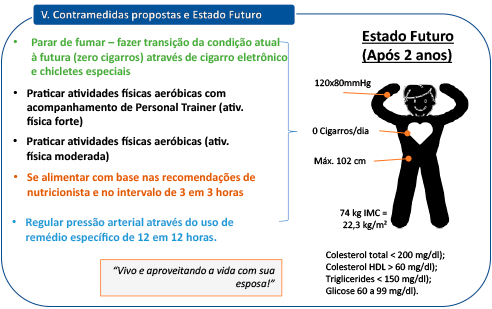
“Listen, Joe”, said the doctor, “I know it’s hard right now, but imagine how you will be 90 days from now. Imagine how you will be 180 days from now. And 2 years from now? If we want you to have a longer and healthier life, we need to act”. Joe imagined his life without cigarettes, in shape and in the best health of his life. He knew that it would not be easy to achieve this, but that was the state he wanted to be in. That was how Joe wanted to be in the future. Joe gave the doctor a firm handshake and committed to following her instructions to the letter to reach the scenario they had set.
Future State:
Future State:
Where do you want to get to?
We can design the Future State in two distinct but interconnected ways. This field is used to design the Future State that will be reached after the completion of all the objectives. However, it is also possible to use this field to help you set your objectives, that is, first envision where you want to get to – dream – and then deploy from this projection the targets needed to achieve it. Of course, don’t forget that this projection must be connected to the purpose, background, Current State and root cause analysis, in short, to the whole A3.
Countermeasures:
Countermeasures:
“Let’s be clear on the details”, the doctor went on, “you need to know exactly what you have to do to extend your life by several years. We need to communicate and align, so that it is clear what changes of course we are seeking”.
So Dr. Chris and Mr. Joe defined the countermeasures of quitting smoking, starting to do physical activity and following a disciplined diet. In addition, they also decided to regulate his blood pressure, which was vital to ensuring Joe’s health.
When they talked about blood pressure, the doctor felt unsure: “You know what, Joe? I think we made a mistake”, she said, “I think regulating blood pressure should be one of our objectives too. We didn’t think of it before, but now we can add it to our list of objectives to be achieved. Mr. Joe broke into a smile when he realized that his doctor was not afraid to admit mistakes and make changes as she saw the need. As a result, Joe became more confident, because he knew he was in good hands.
Countermeasures:
Countermeasures:
How do you want to get there?
In this field, describe your countermeasure hypotheses generated to mitigate the effects of each of the root causes identified in the analysis section. The quality of the countermeasures is directly linked to the quality of teamwork, so promote it. If you think the countermeasures are superficial, push your team to come up with at least 5 countermeasures for each root cause. This will make them think outside what they are used to thinking. Depending on the depth of the countermeasures raised, real projects may be deployed (in this case, describe the scope of each project in the A3), which may require building “child” A3s.
Don’t be afraid to change any point of your A3. It is a thinking process that, among other things, keeps us always connected to its purpose. It is common that, when defining one field of the A3, we have to think about changes to other fields already filled in earlier.
Plan:
Plan: 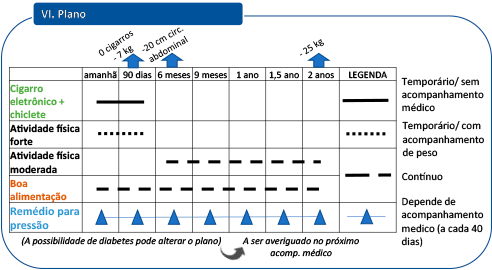
After agreeing on the plan, Mr. Joe and Dr. Chris began working on it. Dr. Chris wrote all the objectives on a whiteboard and told Joe they would rethink the countermeasures and their respective execution if those major milestones failed.
“I’ll put a footnote on our follow-up plan”, Dr. Chris explained to Joe, “so that we can change it whenever a course correction is needed”. In the footnote, Dr. Chris wrote “the possibility of a diabetes finding may change the plan”. “We will stay alert to that possibility, Joe”, said the doctor, while Joe looked at the board and thought about all the possibilities that could change his plans.
Plan:
Plan:
How do you ensure execution?
The plan for executing the countermeasures must be solid and its style situational.
It may comprise a standard schedule; a timeline with major milestones; or just a description of the countermeasures and their respective owners. There may be a kanban board for quick countermeasures, or else the targets to be achieved year by year. Plans delivering MVPs are also used. What matters is that there is traction in implementing the countermeasures and that they don’t die along the way, provided they are in fact leading your organization toward the stated purpose. On with the transformation!
Follow-up:
Follow-up: 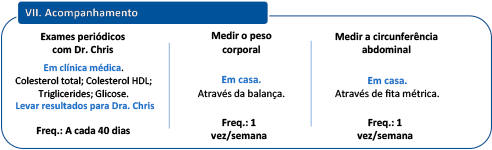
“For all this to work”, Dr. Chris went on, “we need to be clear about how you should track your progress. I need you to weigh yourself, measure your waist, write down how many cigarettes you smoked and measure your blood pressure every week. At our next appointment, bring all of this written down so we can follow up”.
There was a long journey ahead of him, but Joe knew that although the fight would be hard, his work would be worth it. He was starting the most important A3 of his life to secure what matters most: his health and well-being.
Follow-up:
Follow-up:
How do you ensure the target is achieved?
The follow-up section is where the effectiveness of the countermeasures is verified against the achievement of the objectives. It can also be used to look for future constraints in the projects that will follow or to sustain the improvements already made. Preferably with charts, in this field we check progress. It is a field that tells whether the proposed work is heading in the right direction. Once progress has been verified, share the learnings with other areas.
The A3 is the concrete visualization of a PDCA.
Mr. Joe’s story illustrates how A3 thinking helps us look for the deepest causes of our problems, whether in our professional or personal life, and develop effective countermeasures to resolve them. When we feel symptoms of illness (a fever, for example), we naturally head to a hospital. There, we undergo tests to find out the cause of these symptoms (in this case, it could be an illness, such as the flu) and take measures to fight it (the countermeasures; taking a medicine, for example). We would be outraged if, on arriving at the hospital with a fever, we were simply given a medicine to reduce the fever without any tests to understand what is causing it.
In the same way, it should be natural for us, when we find symptoms of problems in our organizations, to investigate the root causes of those symptoms (like the tests in hospitals, we can use structured methods – the five whys, for example – to discover the causes) and then develop effective countermeasures that fight not only the symptoms, but their underlying causes.
Often, in the rush of daily life, we treat the symptoms in our organizations as if they were the causes and fight our fever quickly and thoughtlessly, without investigating what caused it. A3 thinking offers a structured way for us to always focus on the real causes of symptoms, truly eliminating the problems we face every day, rather than just masking them and turning them into hidden waste.
Want to see what Mr. Joe’s A3 looked like? Click here to see two different versions of Mr. Joe’s A3.
Want to learn more about how to build an A3? Read the book “Managing to Learn”.







