

Executing strategy through Daily Management
Strategies often fail because they are not effectively communicated, deployed and monitored at every level of the organization. Without clear alignment and commitment across all layers and functions, even the best-crafted strategic plan struggles to deliver the expected results.
Daily Management (DM) helps close this gap by ensuring that everyone is aligned with the strategic objectives, that performance is tracked in real time and that corrective actions are taken accurately and quickly, in the shortest possible time, when deviations occur. DM sets the pace for execution and creates accountability and visibility regarding problems, which keeps everyone focused on what matters most.
As a key component of the management system, daily management is essential to the success of hoshin kanri, enabling the consistent execution of strategy by connecting long-term goals with daily operations.
What distinguishes a well-structured daily management approach that ensures strategic objectives are achieved?
- We need specific purpose definitions implemented in every area of the company.
The corporate vision is often too generic and somewhat disconnected from the gemba, where real value is created. The vision must be translated into meaningful purposes that engage every area of the company, especially the people who do the actual work.
- We need specific daily goals for each area, clearly linked to the hoshin kanri objectives.
Generic corporate goals must be broken down into specific daily goals. By understanding and defining the key success factors (key success factors - KSFs) that truly drive the expected performance, we ensure that hoshin kanri objectives are translated into concrete, meaningful daily actions for each area. These goals create alignment, maintain focus and allow progress to be tracked daily, connecting strategy with execution and ensuring that each team's actions support the overall objectives.
- We need to cultivate an environment that encourages daily learning and problem solving.
Daily management builds the strength and "muscles" needed for successful execution of hoshin kanri. Practicing it every day enables managers and leaders to become capable and skilled, just as a professional athlete practices every day to become a true champion.
- We need to provide the right circumstances to allow managers to focus on hoshin objectives.
Daily management frees up managers' time so they can focus on the main hoshin objectives and develop their teams, instead of constantly reacting to problems that can be solved directly at the gemba. It also allows for better identification and elimination of root causes, because the problem-solving process happens closer to the source, fostering a more robust, gemba-driven scientific approach.
- We need to build capabilities at every level so that people can also act bottom-up in hoshin kanri.
Daily management allows PDCA to be practiced at the operational level, in alignment with strategic objectives. Running it daily creates a stronger foundation for learning and for contributing to the definition and implementation of hoshin objectives, instead of relying on monthly or annual cycles, which often fail to produce timely conclusions.
- We need to avoid "too late" situations by addressing problems as they arise.
Daily management allows teams to identify and correct problems as they occur — or even before they happen —, preventing them from growing. Acting in real time helps contain performance deterioration and avoids the bigger complications that arise when small problems are left unresolved.
- We need to develop leaders and people through hands-on problem solving.
Daily management creates the conditions for leaders to grow, working side by side with their teams to solve problems at the gemba. This daily practice strengthens leadership capabilities, builds trust and fosters a culture of learning, accountability and continuous improvement throughout the organization. This leadership capability is essential to the success of hoshin kanri.
Framework for solid Daily Management
Our approach is built on three main blocks: commitment, control variables and problem solving.
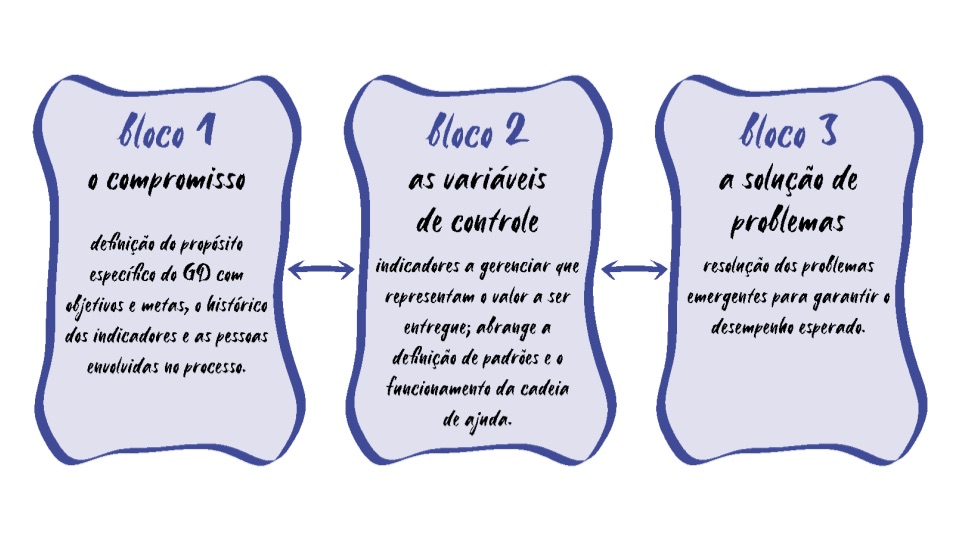
The first block, commitment, connects each area to the organization's strategic priorities. Here, the connection between daily management and strategy becomes clear and explicit. It is a true strategy deployment to each specific area. It defines each area's purpose, the key metrics and the corresponding performance targets. Commitment should also clarify the available resources, including the people involved and their respective responsibilities.
The control variables form the second block. Here, the team defines what should be measured and controlled based on daily objectives — the "heart" of the operation. These daily objectives represent the value to be delivered each day, as defined in the commitment block. During daily meetings, the team should compare planned targets with actual results. Any gap between them indicates a problem the team must solve.
The third block is entirely focused on problem solving. This is where the team visualizes the problems that are in the process of being solved, those with pending tasks or those that need to be escalated for additional support.
Problem solving is the engine that drives daily management. After defining the commitment in the first block and the control variables in the second block, it's time to ensure that the expected performance is achieved and that any obstacles are quickly removed.
Gaps between actual and expected results should be visible, transparently and visually, on a DM board. Whenever a result falls outside the defined standard, the help chain is activated, triggering immediate actions to contain the problem and restore the expected performance.
The presence of red indicators, which signal problems or gaps, does not represent a failure; it marks the starting point for the problem-solving process that turns the indicator green.
All of this comes to life through the interaction of a diverse team, working in a psychologically safe environment. This environment is not a matter of chance; it is intentionally built by the attitudes of leadership.
It is the leader's role to promote open dialogue, encourage initiative and build mutual trust, creating an environment where real problems can be exposed and tackled without fear of reprisal. This daily presence at the gemba replaces the command-and-control model with collaborative mentoring. When teams feel safe to speak up, take responsibility and solve problems together, cultural transformation becomes possible.
Conclusion
You can start or strengthen your daily management system in parallel with implementing hoshin kanri. Start small, experiment with the framework we propose and adapt it to your specific context.
Daily management encourages each person to connect their daily work to the hoshin objectives, not occasionally, but consistently. While hoshin kanri sets the direction for the whole organization, DM ensures that progress happens every day. It brings clarity about what a good day should look like and allows teams to see, in real time, whether they are winning or losing.
Ultimately, we need to make hoshin everyone's responsibility, every day. Daily management turns strategy into action and action into results, making every day a good day!
José Ferro and Robson Gouveia are co-authors of "Daily Management to Execute Strategy: Solving problems and developing people every day".







