

Transforming your business starts with transforming people
In the summer of 2018, Sølve Kiviranta was feeling the strain of the periodic firefighting he had faced since taking on the role of plant manager at Mowi in Eggesbønes. He was not the only one.
Sølve spent the summer tackling a series of challenges that kept arising at the fish plant, together with his management team. They were exhausted. Something had to change.
The plant, one of the largest in the world in its sector, is located in Eggesbønes, Fosnavåg, about an hour's drive from Ålesund, on the west coast of Norway. The plant had experienced a false start with lean after a consultancy-led attempt in 2012 was quickly discontinued. The tools were implemented, but without the kaizen spirit, little happened.
Despite this, Sølve knew that lean could be the right medicine, as long as it was administered correctly. His experience in previous jobs and the theory he had learned from books and lean leadership training shaped his belief that lean is all about people and that the transformation had to begin with himself.
Together with his management team and in close collaboration with veteran production manager Hans-Jakob, Sølve began to make some tough decisions. One of them was to bring in Marcin, who had experience in previous lean transformations but was becoming increasingly frustrated with the impasse he was facing at the company where he worked at the time. Another turning point was the realization that if Mowi Eggesbønes wanted to succeed with the automation and digitalization projects that lay ahead, problem-solving skills would have to be developed.
Sølve needed to build lean thinking capabilities in the organization quickly in order to make waste visible and reduce it. It made no sense to automate and digitalize unnecessary processes that did not work. A lean transformation is, first of all, a cognitive transformation: accepting, as leaders and operators, that we do not know what we do not know and that to change others, we first need to change ourselves.
Be the change you want to see
Mindaugas, Inger and the other middle managers at the plant saw early on that this change would be different. There would be no opportunity to hide, and they needed to rise to the occasion.
For Inger, this was a welcome change. Having started at the plant in 2004, she had seen several change programs start and stop. But she also saw the need for improvement, having grown tired of the constant firefighting and of coming to work not knowing what to expect. Sølve and Hans-Jakob knew they needed to involve and develop their middle managers to succeed, and Inger was ready to take up the challenge.
With more responsibility, but also more freedom, she worked with Marcin to train herself and her department in problem solving. Instead of starting with the tools, however, Marcin and Inger went looking for problems. Starting with those that simply did not seem to go away – the “we've had this for 5 years” kind of problems. Each problem presented an opportunity to learn different lean tools as countermeasures and as learning.
After a period of quality problems, Marcin and Inger decided to go and see (genchi genbutsu) to better understand why this was happening. By observing the employees in the fillet department and studying their work, they realized that the standards were not easy to understand, which meant that training operators in the value-adding work was not easy.
Inger realized she needed to train more than just the hands of her team members; she needed to change her management approach to unleash the creativity of operators and team leaders. Marcin suggested that they take a Job Instruction course to learn how to create good standards and to raise awareness in the department of the need for standards and training.
Although the training schedule was slightly disrupted by the Covid-19 pandemic, they managed to run a pilot with great success. The participants, experienced operators as well as team leaders and department managers, immediately understood that developing and training operators according to the standards would benefit everyone. Already in the first session, they experienced a different dynamic in the team, perhaps realizing that the process they work in requires excellent skills and attention to detail. Suddenly, all kinds of tips and tricks came to the surface. In fact, Job Instruction training was fundamental to achieving process stability.
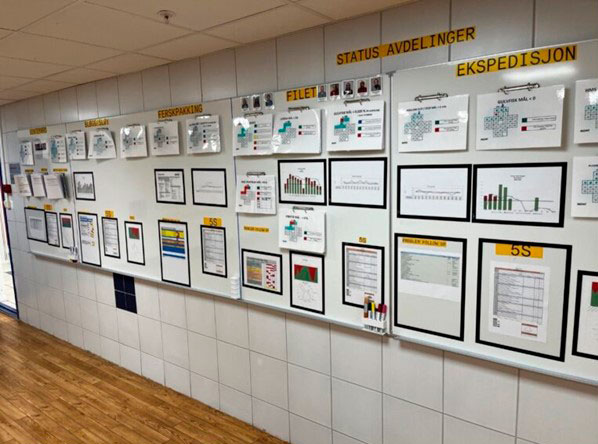
Over time, a kaizen culture developed at Mowi Eggesbønes. Sølve was creating a sense of urgency and a need for improvement, raising the level of the organization by challenging managers to look beyond established standards and structures. The mantra was: “Target, Challenge, Problem, Kaizen”. An obeya for daily management was created in one of the plant's main areas. There, each employee could see how the problem-solving and improvement work was contributing directly to the overarching business strategy. Without the knowledge and experience of the operators, there was no chance of the managers transforming their departments.
Cleaning, cleaning, cleaning
After a discussion with Sølve, Mindaugas challenged himself to become a better leader. He looked at himself and saw a leader who was controlling and commanding. This was not who he wanted to be. To succeed in turning his department into the best cleaning department at Mowi, he first needed to transform himself. His new mantra became: “If I take care of the people, the people will take care of the plant”.
He began to listen, discuss and reflect more with the employees in his area, involving the team in planning, in conversations about quality and in discussing what good work is. As this process continued, Mindaugas and his team realized that to be the best cleaning department, they would have to embrace the concept that the devil is in the details. They began to standardize and solve problems, while constantly raising the bar a little higher. Given the difficult conditions, especially on the night shifts, lean tools helped accelerate this ambitious department.
Over a three-year period, the team moved from reactive cleaning to systematic preventive cleaning. During this period, absenteeism fell from 20% to 2%, and they are now outperforming the industry's “best practice” KPI for cleaning by a factor of 10, covering four times as many square meters compared with other cleaning departments and pushing the limits of what is considered world-class in the industry. By transforming himself, Mindaugas transformed a team of 24 people.
Climbing the learning curve, one problem at a time
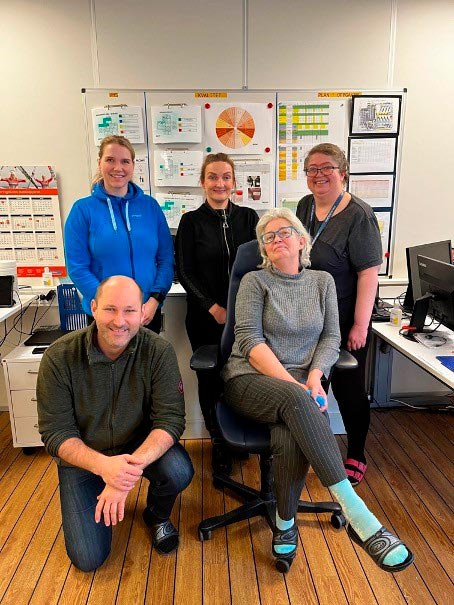
When the quality manager left the company, the rest of the quality department team was left with the difficult task of handling quality assurance and reporting. Like their production colleagues, they were asked to set up an annual plan of quality-related activities. Supported by Marcin, they managed to step out of their comfort zone and into the learning zone, dealing with internal and external audits while at the same time supporting the organization in quality assurance and quality control.
At the same time, Marcin was helping department leaders set up quality circles, forming teams and encouraging voluntary participation. Many joined, but once again Covid slowed down the initiative. Even so, this allowed more and more people to develop their knowledge and skills through problem solving, and the Eggesbønes plant gradually began to shift from a firefighting organization to an organization that looks to the future. As one of the managers said during our visit, “I don't get stressed coming to work, because I know we are dealing with problems earlier. We are working in a much more structured way with problem solving”.
The power of people in automation
In parallel with the transformation of people, the Eggesbønes plant was also a testing ground for new technologies at Mowi. One example was the integration of an AGV system in the distribution department. At first, people were skeptical and worried about their jobs, and they had legitimate concerns about the suitability of a more rigid automated system. However, with an open-door policy on information sharing and efforts to engage people, the operators began to contribute to the deployment of the AGV system – once again bringing valuable tacit knowledge and also systematically logging problems with the system.
At the same time, a great deal of time and effort was devoted to training and developing employees, giving them the competence and confidence to operate the new system. By actively using lean tools such as 5S, standardization and problem solving, the department was blending automation with people development.
Along with the deployment of the AGV system, a problem-solving culture emerged. They are now using standards to onboard new operators into the fillet team in a similar way, while everyone is voluntarily contributing ideas for improvements and corrections.
Developing the chain of trainers
Meeting at a regular cadence, the Eggesbønes staff can now discuss daily production figures and problems in daily management, while the leadership team can focus on strategic improvements, which are followed up in the weekly management meeting, and on following up their main activities, against the annual plans, once a month.
Cooperation between departments is improving, as is the ability to carry out root cause analyses. Discussions are also changing, always looking forward rather than back. A natural consequence of Sølve and Hans-Jakob giving more responsibility to department managers is that they, in turn, need to give more responsibility to their team leaders – mirroring the challenging and supportive relationship with their team leaders and aligning people development with business development.
And the business?
If you visit Mowi Eggesbønes today without knowing anything about its history, you might think that all the lean tools and methods were implemented and that they “simply worked”. But this is not the case. As each department and each manager progressed along their learning curve, understanding and application of the tools went hand in hand. Today, the plant is outperforming both itself, compared with a few years ago, and its peers on all KPIs. At the same time, Sølve, Hans-Jakob and the rest of the leadership team have completely stopped stressing about firefighting activities. Instead, they can turn their attention to strategic problems and to improving the complete value stream, bringing the highest-quality seafood products to consumers' tables around the world.
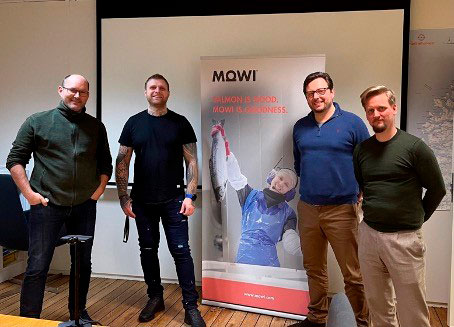
Sølve, Mindaugas, Marcin and Eivind during the visit for the article







