

Observing Covid-19 vaccination at the gemba
I recently visited a local general practice here in Wales to observe the Covid-19 vaccination process. After so many months of isolation, it was wonderful to be at the gemba again. There I met fantastic people and came away with many questions, but with enough information to write this account.
On the day I visited, the practice – which had just received 400 doses of the Oxford AstraZeneca vaccine – had booked 100 appointments for its patients over 80.
Each vial of the Oxford-AstraZeneca vaccine contains 10 doses (with a possible extra eleventh dose). Once a vial is opened, it must be used within six hours: as long as everyone attends their appointment, there will be no waste. It was agreed that patients would arrive at two-minute intervals. They would be greeted at reception and asked to go through to one of the clinic's four rooms. Three of the rooms had a clinician who administered the vaccine and an administrator who entered the patient's information into the database on a computer. In the fourth room, one clinician carried out both the clinical part and the administrative tasks.
Local preparation
All the preparation tasks were “external” to the vaccination activity. The setup included discussions about patient flow, stocking the necessary items, rearranging the furniture in the rooms and logging into the IT system, which had all the appointments preloaded with patient information. All of this had to be done before the patient received the vaccine. They had planned to start the process at 8:30 a.m. so that they would be ready for the first patient at 9 a.m. And so they did.
The first patient was greeted and asked to walk through the waiting room, following a one-way system, to the rooms used for vaccination. This was the start of the morning flow. I watched how the team did their work carefully, conscientiously and with consideration for others. Lean thinkers learned from Toyota that work can be documented so that anyone can see whether it is being carried out as planned, making improvement activities more structured. Now I needed to see what I was looking at, even though the work itself was not the result of standardization in the way we lean people do it.
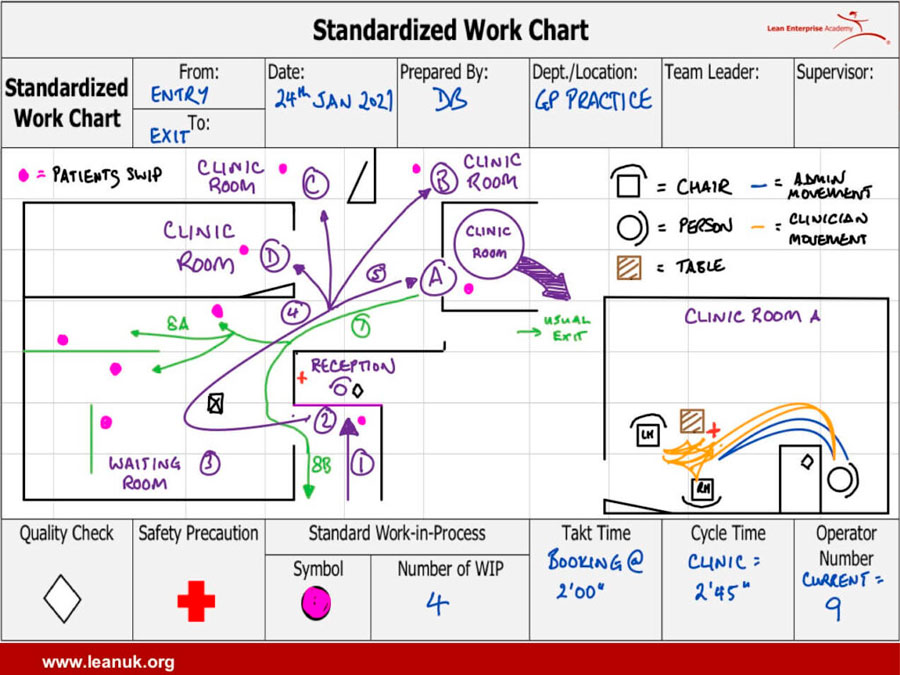
This is how I was able to see the work. Patients arrived at reception, were attended to and gave their names, and the system was updated. They were invited to sanitize their hands, received an information sheet and were directed to the waiting room. They were then directed through the door to the next available vaccination room. I noted down the steps, documented them and timed 10 successive patients to better understand the current condition. What was happening? Did it happen every time? Did all patients follow the same steps? Is there variation in the time each vaccination takes? I documented what I saw on the Process Study Sheet.
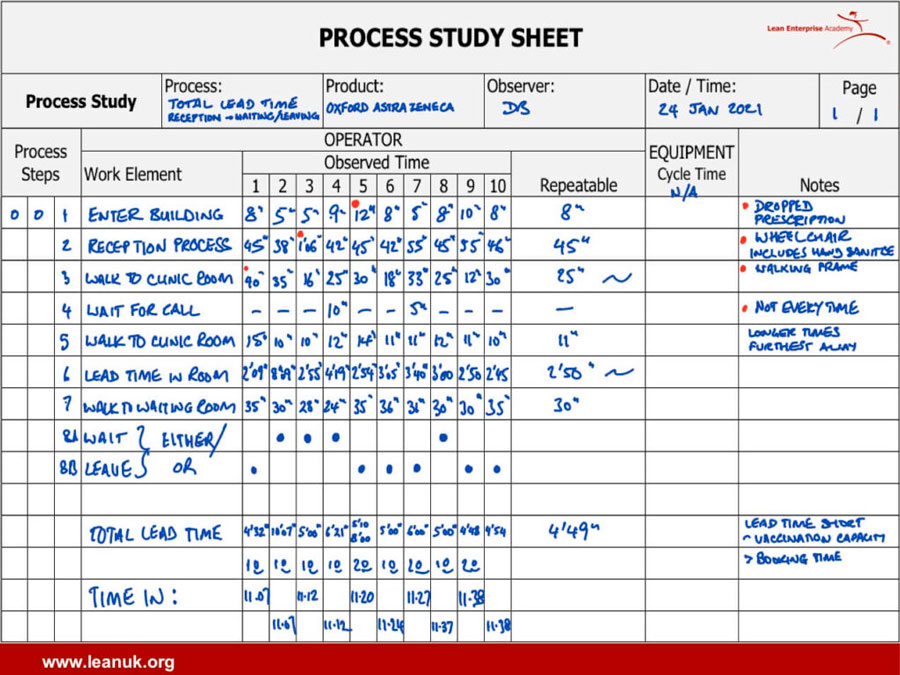
After just over 2 minutes, the first patient came out of a room vaccinated. They then either waited 15 minutes in the socially distanced waiting room or left immediately.
What is the actual work?
I had already been observing for 45 minutes, but I had not yet seen the value-creating process. Observation normally starts at the last process in the system – in this case, the waiting area – and works backward. But here the customer is part of the process, which starts at reception. Because reception sets the pace of arrivals, there was no problem in starting my observation there.
After reception, I went to observe the detailed steps required to administer the vaccine. I sat, socially distanced, in the corner as a lady entered one of the vaccination rooms. She was greeted by the doctor and asked to give her name and date of birth to the administrator, who found her on the computer and confirmed her details. This built-in quality check started a sequence of entering information into the database. The clinician then took control of the process, explaining that the vaccine needed to be injected into her arm and asking whether she was right- or left-handed and in which arm she would prefer the injection to be given. The lady was asked to sit down, and the clinician explained what the vaccine was, checked that there were no contraindications for the patient being vaccinated and asked for consent to administer it. He picked up a syringe and explained that the patient would hardly feel anything. The vaccine was injected. The syringe and the swab were disposed of, and an explanation was given of how the patient might feel over the next few days. The administrator gave the patient a vaccination card, a side-effects leaflet and details of how she would be contacted for the second dose. The patient was asked to get dressed again and it was explained that she should not drive for 15 minutes. She was invited to sit in the waiting room. When the patient left the room, the doctor wiped down the chairs and sanitized the area for the next patient.
I noted down the work elements, the steps required to complete one cycle. Each element is the smallest increment of work that can be transferred to another person. For example, “pick up syringe and inject patient” is a work element, while “pick up syringe” would not be. It is important to break the work down into elements, because this helps us identify and eliminate waste (activities that do not create value) hidden in the work.
With the work elements defined, the next step is to time each work element.
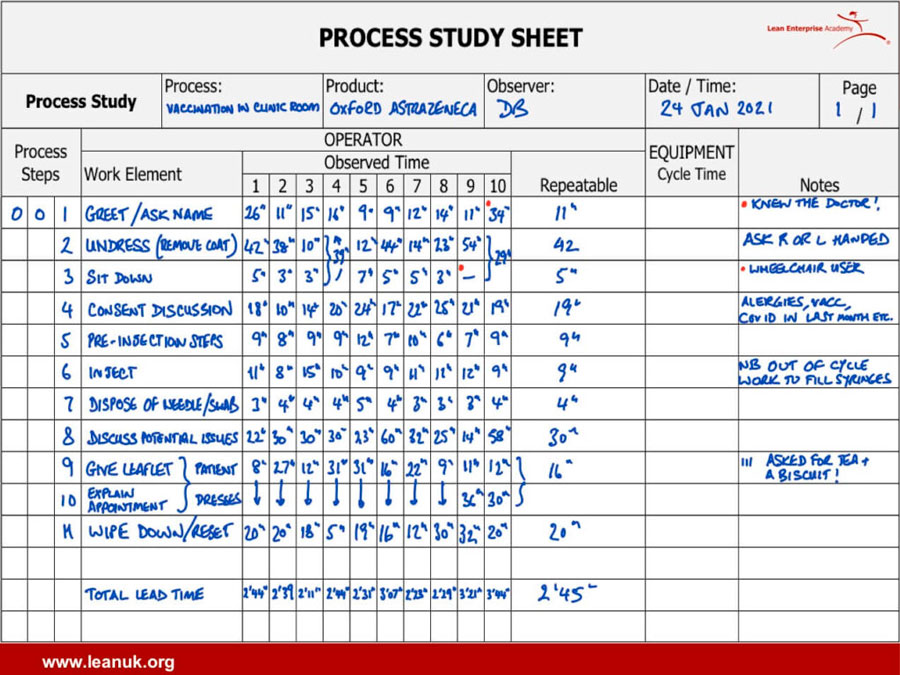
The process study shows which of the steps appear to be repeatable with consistently similar times and which have more variation. Work is rarely done the same way every time, but non-repeatable processes cause a big problem because they make it very difficult to plan and almost impossible to flow.
During the observation, it became apparent that some work elements are entirely repeatable, while others are harder to repeat. For example, cleaning up after seeing a patient is something that can be repeated, but discussing possible problems after vaccination is harder to repeat, because questions may arise.
Observing the duration of the process steps also generates more questions. The way we question whether a process is carried out by the most effective means can be seen in the image below:
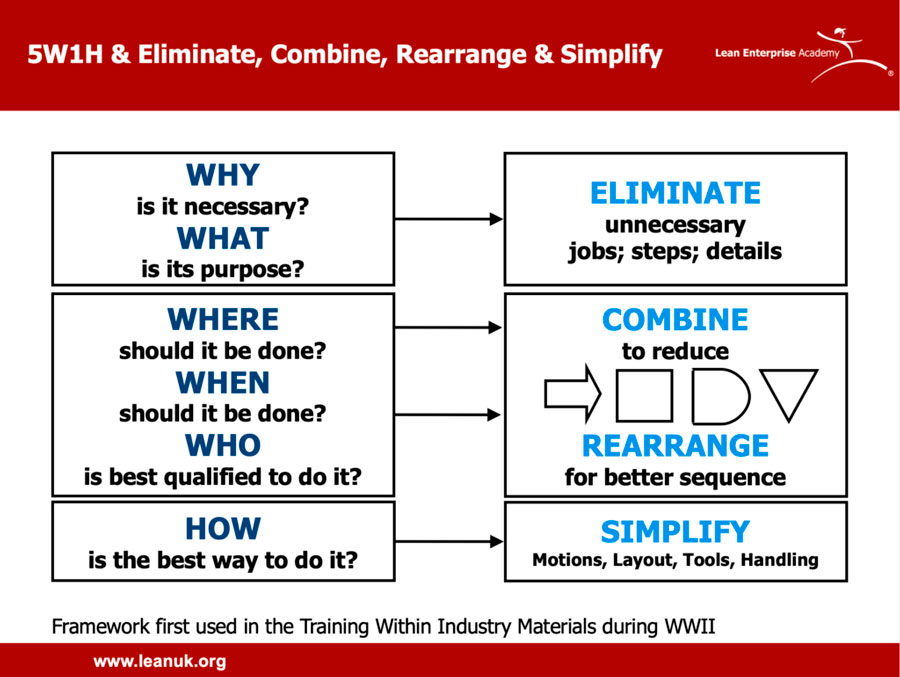
By asking these questions, we can see whether a step creates value or not, and whether it should be combined with other steps, rearranged or simplified. These are really the four things you can do to improve the safety, quality, delivery or cost of a process. A great example, looking at the Process Study Sheet, is the “undressing” step. It is the longest time element. As it was cold on the day of my visit, patients were well wrapped up, but three in ten were very well prepared. They had taken off their coats before entering the vaccination room and were wearing short sleeves, as requested during the initial booking process (another three had also done so, but undressed in the room) – hence the difference in time.
Although time and purpose meant that we did not rebuild the Process Study Sheet to eliminate, combine, rearrange or simplify the steps, this is really the moment to look at the work in great detail. The right way to do this is to give frontline staff the ability to examine their own work, so that they are able to propose far more appropriate countermeasures than any central team, improvement specialist or outsider ever could.
Capacity and pull
I was interested in the capacity of the system. To understand this, I made a rough calculation of the “lowest repeatable time” for each work element (not the fastest time, but the time in which a team member could safely repeat the work). I found that the lowest repeatable time to administer a vaccine is 2 minutes and 45 seconds in its current form.
Patients are due to arrive at two-minute intervals. Without improvements, using this time to plan how many rooms are needed, only two rooms with a vaccinator and an administrator would be required (instead of 4). The calculation here is the total work content divided by the takt, which equals the number of people (or, in this case, rooms, each operated by two people). The point here is that anyone can throw people at problems, but understanding the total system is what is needed to optimize flow.
Going forward, there will be two separate activities: the first dose and the second dose. Many of the activities required for the first dose will not be needed for the second. What will the work be? How will it be designed? How many rooms will be needed? Using these analytical tools, the answers to these questions become much easier to develop.
The need for a cleaner supply
Our biggest problem is probably not the vaccination process, but obtaining supplies. In Wales, doctors do not know the delivery dates or the quantities of vaccine they will receive. This means they can only plan after they receive the vaccine, which increases waiting time. However, knowing the cycle time is the key to designing the supply chain. By understanding the work, it is possible to calculate the number of rooms needed, work out how many centers are needed and then design the delivery system.
For Covid-19 vaccines to become part of everyday life, we will not be able to rely on the goodwill of volunteers, nor will we add such an effort to the ever-growing list of activities we require health professionals to do. Resources are already exhausted; therefore, thinking about the work to be done and the design of the supply chain will be essential for the future.
In addition to Covid-19 vaccines, other supplies are currently delivered weekly to surgeries in Wales from the national health system – a system that is not very responsive. To provide exactly what the customer wants, when they want it, in the quantities they want, organizations must reduce order lead time and deliver small quantities regularly, just in time. This removes the peaks and troughs from the supply chain, reduces the amount of inventory needed and dramatically increases the speed of product delivery.
To implement this economically, healthcare supply providers need to map the extended value stream. This needs to be done now to avoid supply problems in the ongoing process. Without these exercises, the opportunity to develop insights will be lost. I am sure the front line will deliver, but it will do so with a great deal of overburden. We will get through the current crisis, but we will not have questioned the underlying thinking about how we are organized to vaccinate at scale.
We must get ahead of the problems we have encountered during the pandemic. The problem to solve is how to increase the speed of the total process and vaccinate as quickly as possible to save lives, and then to set up processes so that this can be done safely, in the shortest possible time, in the future.







