

Planning a turnaround with purpose
These days, many companies that would be doing fine if not for the pandemic are closing their doors every day. In the United States, in the restaurant industry alone, more than 110,000 have closed since March 2020. That is more than 350 a day! Some have avoided that outcome, at least for now, by changing owners. That does not make the challenges go away, however. On the contrary, the new people in charge must confront these difficult situations as soon as they take the helm.
I recently saw an example of this at a company close to where I live: Legal Sea Foods. Witnessing the situation, I began to ask myself how lean thinking could be used to increase the likelihood of a successful turnaround at these companies.
A new course for Legal Sea Foods
In December, Bostonians learned that a local family institution, Legal Sea Foods, had been bought by PPX Hospitality Group. For those who don't know it, the Legal Sea Foods website describes it as “a fish company in the restaurant business”. Over 70 years, according to an article in The Boston Globe, the Berkowitz family grew the business to 33 restaurants, most of them located along the East Coast of the United States, employing 3,500 people and generating more than US$200 million in annual revenue. It is a very popular destination in the region.
Then the pandemic arrived. Like all “non-essential” businesses, the lockdown that took place in the spring in the United States forced all Legal Sea Foods restaurants to close. After its sale was announced in December, 18 locations had reopened, but only partially, 9 were hoping to reopen soon, and 6 locations had closed for good. For Legal Sea Foods customers, this is just one of the many inconveniences experienced at the start of the year. For the company's employees, however, it is tragic.
For customers, it is just an inconvenience. For employees, it is tragic.
As a regular customer and someone who knows many people who work for the company, I hope PPX can successfully turn the business around (Legal Sea Foods was an LEI learning partner for several years in the 2010s. I supported the company as a lean coach, discovering a great deal about how lean thinking applies to the restaurant business. Currently, however, there is no business relationship between the two organizations).
The questions that remain are: how will PPX approach the challenges facing the business and the industry in general? Do they have new (dare I say fresh) ideas for the business? After all, the company's motto is “if it isn't fresh, it isn't Legal”. Assuming PPX has enough capital to help Legal Sea Foods survive the pandemic, what will they do to make the company as strong as before, if not stronger?
Where to start?
Lean thinking always starts with the customer, defining the needs, wants and problems to be solved. I imagine PPX is getting to know its customers: who are they? How do they behave at Legal Sea Foods and elsewhere? Why?
Simple questions, but hard to answer. Especially now, given the changes brought about by the pandemic and the ongoing state of flux and uncertainty. Although vaccines are already being administered in the United States, it will take many months, probably most of 2021, for the country to reach “full immunity”, when (normal enough) behaviors can safely return.
Just think of the customer I am most familiar with: myself. The way I act as a retail consumer has changed considerably and, in some respects, keeps changing. Overall, I am spending less. More than that, I now consume a very different mix of businesses than before.
I used to spend a lot of money out and about, but today businesses such as gas stations, airlines and coffee shops get almost no money from me. On the other hand, I still need household goods (probably more than before), clothing (you know how it is during the pandemic: I need looser pants), sustenance (food and drinks – a large serving, please!) and information. I am reading more than ever. I buy virtually all of these products online for home delivery. Books are the exception. I used Amazon at the start of the pandemic, but in recent months I have been going to two local bookstores (my thanks here to “The Book Rack”, in Arlington, MA, and to “Book Ends”, in the neighboring town of Winchester).
Why have these behaviors changed? To begin with, obviously, I don't go anywhere anymore. The last time I boarded a plane was in 2019. A few years ago, I was flying, on average, more than once a week! As for personal and household needs, shopping in a store takes too long and involves too many interactions. Personally, I find it too risky. When it comes to prepared meals, I also have to take the consumption process into account.
Books are different. Buying from a local bookseller lets me get my hands on a book almost immediately (assuming it is in stock, which can also be a risk, but one I am usually willing to take).
Buying from local bookstores also means I am supporting the local economy, which benefits my “neighbors”. Besides, when I pick up my book, I can spend a few minutes exploring the store's “favorite” books and looking for a handwritten card with trusted recommendations from the store staff. In other words, I can have a safe (that is, quick), pleasant and perhaps even serendipitous experience that connects me to the community and provides a small dose of normalcy.
According to the shopkeepers at “The Book Rack” and “Book Ends”, business is growing. If these two businesses are a fair representation, the growth trend for independent bookstores (more than 50% over the next decade, according to the American Booksellers Association) has not slowed with the pandemic. Professor Ryan Raffaelli of Harvard Business School, who has a paper titled “Reinventing Retail: The Novel Resurgence of Independent Bookstores”, attributes this trend to the three Cs: convenience, curation and community.
Consider the 3Cs framework
As PPX gets to know Legal Sea Foods' customers and their contexts, I think viewing the 3Cs framework as a way to develop and/or define the retail experience may be useful. Let's see…
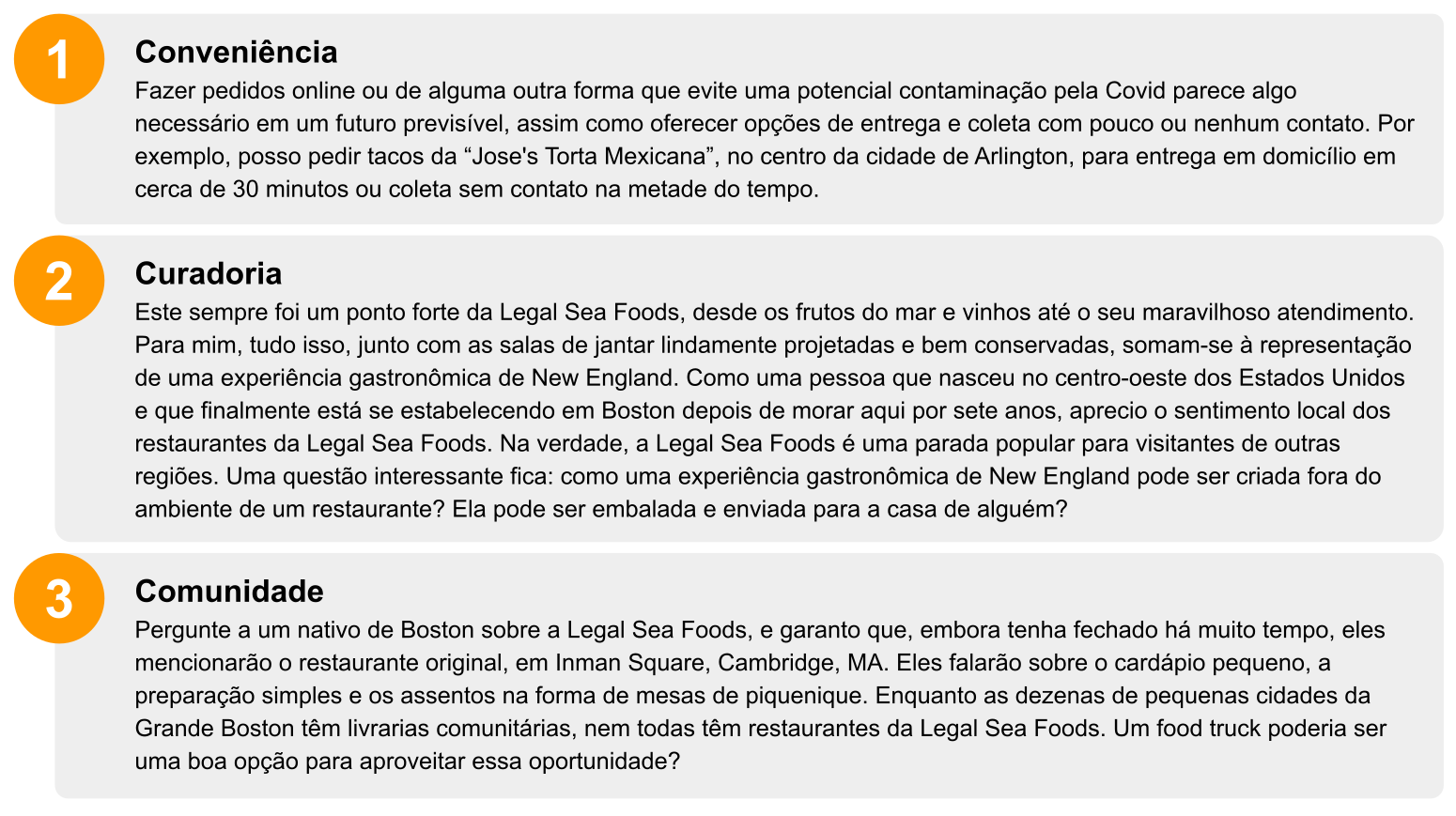
I would add a fourth C: consistency. As a Legal Sea Foods customer, I am always impressed by the execution and its attention to detail. The restaurant comes alive when you walk through the front door and are cheerfully greeted by a host. When you are taken to your table, its presentation is immaculately conceived. Throughout the experience, food, drinks and dinnerware flow to and from the table flawlessly. As for the food and drinks, the presentation and flavor rarely fail to impress. The experience is remarkable, every time. I wonder: is this same detailed execution being achieved across the pickup, delivery and home-consumption processes?
The ability to repurpose and then redesign and retool is extremely important. For companies and industries in which demand has become uncertain, the four Cs alone may not be enough. In those cases, you need a fifth C – capital! For the companies that are suffering from the pandemic (possibly, probably, yours), I hope they have enough capital and the built-in capability to learn what is needed for a successful turnaround.
Along the way, if you like, please get in touch. I would love to hear how you are using lean thinking to improve your odds.







