
Critical equipment suffers unexpected stoppages, breaking the continuous production flow and causing cascading delivery delays.
Maintenance management (Total Productive Maintenance – TPM)
Raise the reliability and availability of operating assets by connecting operations, specialized maintenance and rigorous standards. With data analysis and scientific problem solving in the gemba, build a system that eliminates unplanned downtime and ensures equipment runs at peak efficiency whenever the value stream needs it.
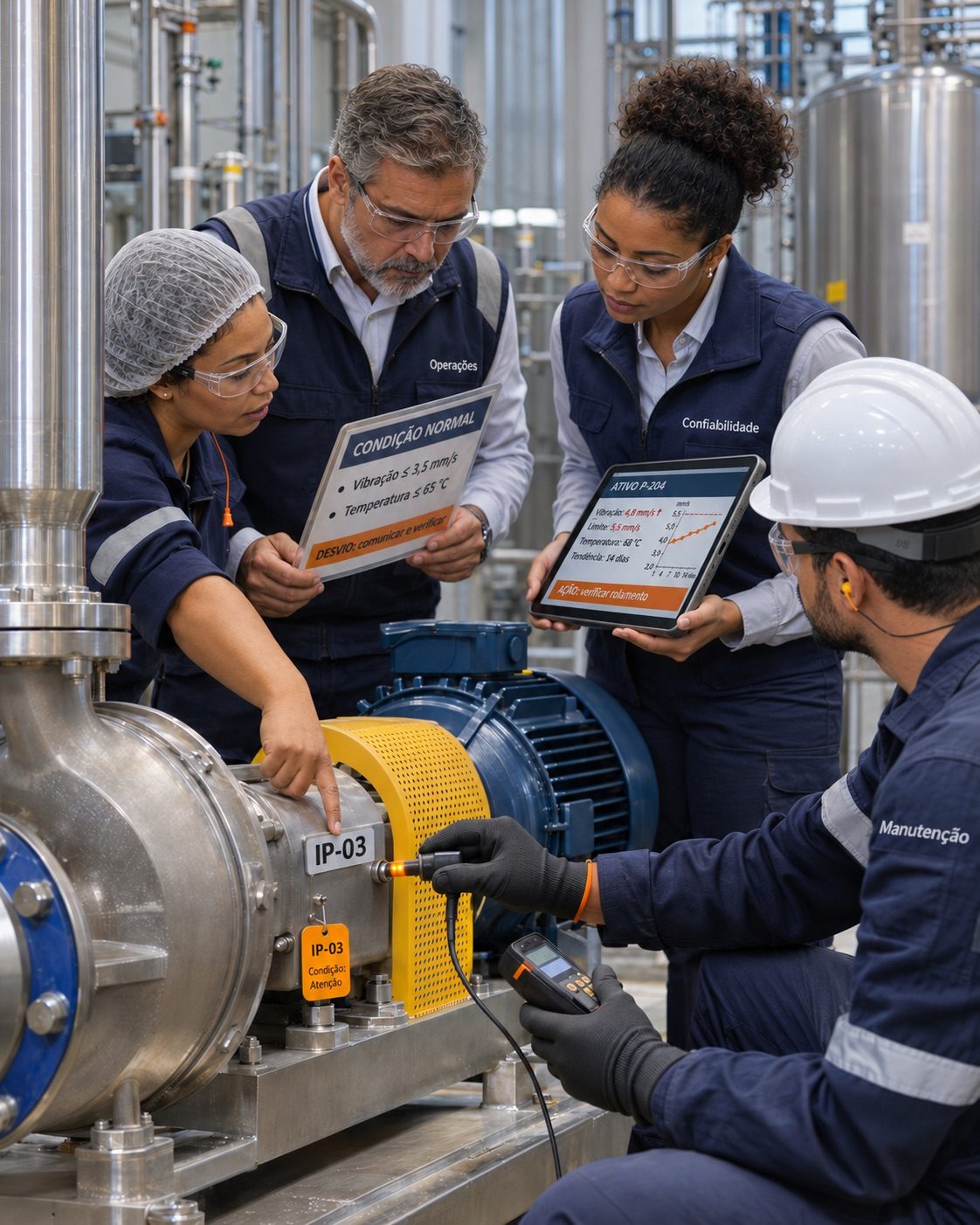
Joint inspectionOperations + maintenance
OPMTRELD+1
Deviation spotted earlyVibration P-204 · 4.8 mm/s
Before breakdown · maintenance
Critical partBearing · in stock
Challenges
The challenge of
keeping assets running
without firefighting
In many organizations, the maintenance routine is dictated by the unexpected. A breakdown interrupts the flow, teams are reassigned, parts have to be found quickly and previously planned priorities are dropped to restore operations. When urgency becomes routine, much of maintenance capacity is spent reacting to the past.
The problem lies in the difficulty of understanding which assets are critical, which signals precede breakdowns, which basic conditions must be maintained and how operations and maintenance should work together to preserve stability.
In the lean approach, equipment care is treated as a shared, preventive responsibility aimed at the real goal of zero breakdowns and zero accidents.
Operators have neither the autonomy nor the training to carry out basic care checks, and report deviations only once the machine has already stopped working.
Preventive work orders pile up in the system without being carried out on time, repeatedly postponed by everyday corrective emergencies.
The unavailability of critical spare parts extends the mean time to repair (MTTR), while slow-moving parts tie up working capital unnecessarily.
Interventions focus on swapping the broken part to get running again quickly, without ever investigating and blocking the fundamental root cause of the wear.
Excessive spending on technical staff overtime and air freight for replacement components, and early loss of the residual value of machinery and facilities.
Transformation
What is maintenance management in lean thinking (TPM)?
It is a systemic management model that brings together line operators, specialized technicians, engineers and leadership in continuously maximizing the operational performance of assets (Overall Equipment Effectiveness – OEE). The method goes beyond mere mechanical intervention: it restores the basic conditions of machines, eliminates forced deterioration, standardizes cleaning-and-inspection routines and uses scientific problem solving to anticipate failures before they cause stoppages.
The approach integrates planned maintenance, routine activities carried out by operations, management of abnormalities, criticality, data, spare parts and problem solving. The goal is to carry out the maintenance that is needed, at the right time and with enough learning to reduce the recurrence of failures.
The transformation happens when the system starts identifying abnormal conditions early, understanding failure mechanisms and acting before the interruption occurs.
What transformation do we aim to create?
By structuring maintenance management on lean fundamentals, the company builds a stable, predictable operating ecosystem with the full capacity to meet customer demand.
-
For the business
Greater asset availability, less impact of stoppages on flow and delivery, fewer losses caused by failures, better use of investments and more predictable capacity.
-
For management
Clear criticality criteria, maintenance priorities connected to the business, greater visibility of losses, more reliable planning, structured spare parts management and more consistent use of data for decision-making.
-
For people
Clearer roles between operations and maintenance, less pressure from recurring emergencies, a stronger ability to notice abnormalities and greater participation in preventing and solving problems.
How do we structure this transformation?
Approach
Methods and practices Capabilities developed
-
Autonomous maintenance
Operators take responsibility for simple, routine checks, early identification of abnormalities and basic equipment care. This brings the condition of the asset closer to everyday work.
-
Planned maintenance and reliability
Interventions are structured according to the criticality, history, condition and behavior of the asset, balancing preventive maintenance, condition-based maintenance and other suitable strategies.
-
Management of critical parts and materials
Sizing minimum and maximum stocks of critical spare parts through a pull system and visual management, ensuring the right part is available without inflating inventory.
-
Analysis and elimination of failure causes
Failures are investigated in a structured way after any unplanned stoppage. The goal is to understand deterioration mechanisms and develop countermeasures that reduce the likelihood of recurrence.
-
OEE maximization and visual management
Visual breakdown of the 6 Big Losses in operations (breakdowns, changeover/setup, minor stops, reduced speed, process defects and startup losses).
Journey
How does LIB guide this journey?
-
1
Understand the relationship between assets, flow and criticality
Identify which equipment, systems and facilities are critical to delivery and analyze how their failures affect safety, quality, capacity and the customer. Based on the history of breakdowns, stoppages and downtime, define where to focus attention and effort.
-
2
Assess and restore the basic conditions of priority assets
Evaluate the current condition of critical equipment and act on deterioration, abnormalities, cleaning, lubrication, adjustments, hard-to-reach areas and other basic conditions that make it hard to quickly tell normal from abnormal.
-
3
Structure responsibilities between operations and maintenance
Define routine inspection, upkeep and abnormality-detection activities, bringing operators and technicians closer together and creating simple visual standards for asset care and rapid communication of deviations.
-
4
Organize planned maintenance, spare parts and data
Review maintenance plans and frequencies according to the criticality, condition and behavior of assets, improve spare parts management and upgrade records so that failure, stoppage and intervention data support more consistent decisions.
-
5
Investigate recurring failures and eliminate causes
Select significant losses, understand the mechanisms that produce failures and develop countermeasures to reduce their recurrence, connecting problem solving and local improvements to the reliability strategy.
-
6
Build reliability into the management routine and scale up
Connect abnormalities, availability and priorities to Daily Management cycles, track how asset condition evolves and consolidate learning to progressively extend the practices to other equipment families, areas or sites.
Integrated practices
Integrated practices to
sustain safety,
stability and quality
The workplace produces better results when its organization is connected to the way work is carried out, monitored and improved.
Problem Solving (A3 Method)
Structures the technical investigation of complex mechanical failures, ensuring that countermeasures permanently eliminate the root cause of the breakdown.
Daily Management
Tracks equipment anomalies and adherence to maintenance plans in the first hour of every shift, calling for quick help when deviations occur.
Localized improvements
Helps transform specific points of the work, reorganizing layout, sequence and working conditions based on direct observation.
Evidence
When maintenance happens at the right time
Company:
Aera Energy
Industry:
Energy
-
Situation:
The company operated thousands of oil wells and faced equipment failures that reduced availability and output. Worn pumps could fail without warning, requiring corrective repairs and undermining operating performance.
-
Approach:
Preventive maintenance was structured with vibration monitoring on the pumps, root cause analysis of failures and information recorded in a well database. The company also standardized the repair flow, prepared tools, equipment and materials in advance, and established daily routines for planning, tracking and reviewing the work.
-
Result:
Teams began identifying pumps at risk of failure in advance and performing preventive maintenance before they stopped. The well repair flow, once measured in days, came to be completed in an average of hours. The company also strengthened integration between operations, maintenance and suppliers through daily routines and standardized work.
Source: Leveraging lean to clean up oil — Lean Institute Brasil.
Resources
Expert knowledge to go deeper


Frequently asked questions
Zero breakdowns is not a utopian slogan; it is a management mindset. Breakdowns happen because small anomalies (dust, vibration, lack of lubrication, loose bolts) are ignored until the mechanism collapses. By eliminating forced deterioration and restoring the equipment's original conditions, the vast majority of sudden failures stop happening.
The operator does not replace the technician who specializes in complex repairs. They act as the machine's “first-line caretaker”: they carry out technical cleaning, check fluid levels, retighten connections and, because they live with the equipment every day, detect unusual noises, odors or vibrations early on, opening preventive work requests before a stoppage.
OEE measures real efficiency by multiplying Availability (productive time vs. scheduled time), Performance (actual speed vs. rated speed) and Quality (good parts vs. total produced). TPM systematically tackles the six big causes of loss that drag this index down day to day.
By working together in the gemba. When technicians and operators jointly carry out the initial cleaning and the anomaly mapping of the pilot machine, mutual respect develops. The technician comes to see the operator as a partner who preserves the equipment, and the operator sees the technician as a mentor who improves their working conditions.
Not necessarily. Software is just a recording tool. The success of TPM depends on reorganizing human and operational processes: clear standards, physical inspection routines, visual management of anomalies and disciplined root cause analysis. If the company already has a CMMS, we integrate it into the new lean routine.
Yes. The approach is widely used in logistics and transportation fleets, hospitals (maintenance of biomedical equipment and surgical facilities), data centers, hotels, mining and service companies that depend heavily on physical infrastructure.
On the selected pilot line or machine, restoring basic conditions and training the team deliver significant gains in reliability and availability within the first 60 to 90 days of hands-on work in the gemba.
By applying lean supply chain principles to the maintenance storeroom: classifying parts by machine criticality and replenishment time (supplier lead time), creating Kanban supermarkets for high-turnover items and setting up consignment or scheduled-delivery agreements for strategic parts.
Assessment
Which asset or
maintenance bottleneck
does your organization
need to transform?
Tell us about the challenges of unexpected breakdowns, line stoppages, high costs or spare parts shortages your company faces today. Share the operating context, your most critical equipment and the results you want to achieve. Our experts are ready to design the ideal high-performance architecture for your business.

