


Related term
A3
A practice pioneered by Toyota in which the problem, the analysis, the corrective actions and the action plan are…
View termA management process that aligns a company's functions and activities, both vertically and horizontally, with its strategic objectives.


A management process that aligns a company's functions and activities, both vertically and horizontally, with its strategic objectives. A specific plan is developed, usually annually, with precise objectives, actions, deadlines, responsibilities and metrics.
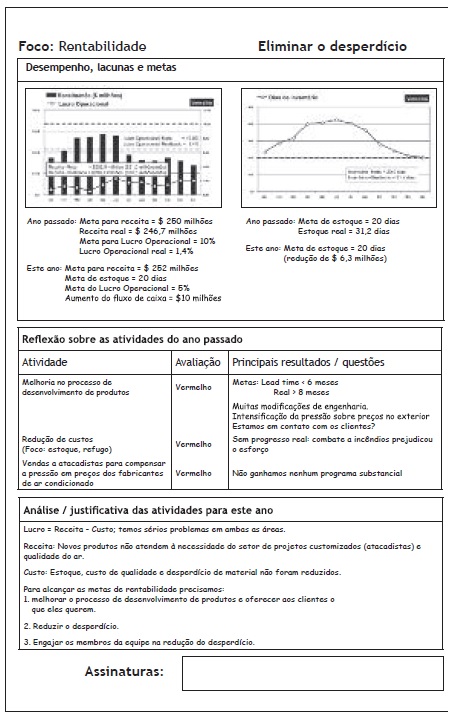
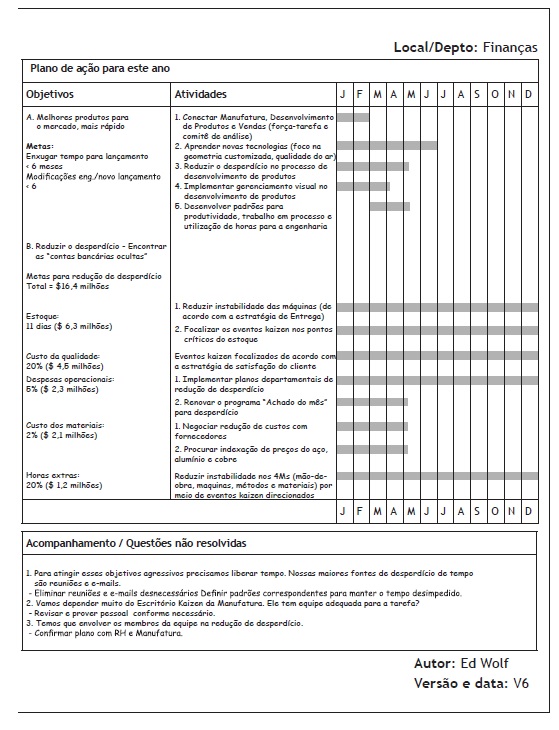
The A3 example (below) shows a finance department director's strategy for returning the company to profitability (Dennis, 2007). The development box at the upper left shows that the company missed its revenue target and its EBTI target last year. It also shows inventory levels, because the director believes inventory is the biggest waste and a serious drag on cash flow. The "V", a red rating, in the Reflection box shows that the major improvement efforts did not work last year. The Analysis, below the Reflection, shows the most important actions to be taken to achieve this year's strategic objectives for profitability. The Action Plan on the right sets out the "who," "what," "when" and "how" of the strategy. The Follow-up box shows ongoing concerns and how the director will check progress.
Strategy deployment, also known as hoshin kanri, may begin as a top-down process when a company is first moving to lean. However, once the main objectives are set, it should become a process that is not only top-down but also bottom-up, involving a dialogue between senior management and project teams about the time and resources available and needed to achieve the objectives. This dialogue is often called catchball (or nemawashi), as ideas are tossed back and forth.
The goal is to match available resources with desired projects, so that only necessary, important and achievable projects are approved. This is meant to prevent the practice of organizations launching many improvement initiatives that are popular in only parts of the organization, and not across the whole, for lack of cross-functional agreement and resources.
As a company progresses in its lean transformation and gains experience with strategy deployment, the process should become much more bottom-up than top-down, with every area of the organization proposing actions to senior management. A mature lean organization such as Toyota may call this process strategy management or policy deployment.
Explore related terms and go deeper with real-world analyses by our industry leads.
A practice pioneered by Toyota in which the problem, the analysis, the corrective actions and the action plan are…
View term
See how this concept and management mindset were applied in practice to deliver real business results.
Read the full article
Build leadership and problem-solving skills at the gemba with support from our specialists.
See the training
