

HOSHIN KANRI - Deploying Strategy in Your Organization
Policy Deployment, Zielentfaltungs process, Hoshin Kanri, Strategy Deployment or Goal Deployment, what do these terms have in common?
Although they are written in such different ways and mean the same thing in their respective cultures, they share something else: the difficulty of putting them into practice in a systemic and consistent way.
There is no doubt that in more disciplined cultures, especially those that value consistent planning, execution that meets agreed deadlines, systemic control and the standardization of good practices as a management approach, successful application of the concepts of Hoshin Kanri is more frequent.
But after all, what does the Japanese symbolism hide behind these two words: Ho –direction, shin – needle, Kan – control, ri – logic/reason. Despite this simple meaning, few organizations have their true north, the Hoshin, clearly defined, communicated and known within the organization, serving as a guide for each of the company's strategic actions. In addition, what is sometimes missing is a systematic way to control strategy deployment, as well as the logic for tracking results.
A fatal mistake made by many organizations is to deploy the strategy before the so-called “Hoshin house” has been built in a consistent and logical way. How can you deploy the strategy if the company does not know where it is going?
Thus, some prerequisites are fundamental to ensure the success of the strategy deployment process, and they guarantee the solidity of the Hoshin house:
The structure of the Hoshin house
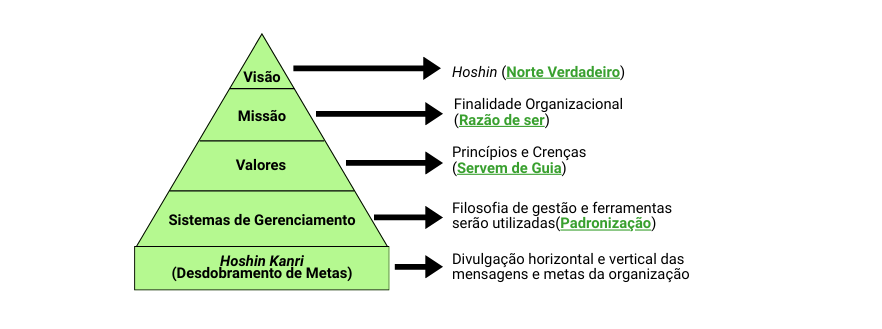
- What is our Hoshin or Vision – it will be the guide for the organization. For each action, one should ask whether it is aligned with the organization's vision of the future. It represents the true north of the compass.
- What is our Mission – it is the company's reason for being. It should make clear to everyone the objectives related to results, employees, the community, customers and associates.
- What are our values – they will guide each action. It is not enough to describe them and hang them on the wall; it is essential that they are truly practiced at all levels of the organization.
- How will we manage our processes – which management systems will be practiced. Will we have the concepts of Lean as the basis of our management system?
These four points will provide the support for applying a structured strategy deployment process with greater chances of success.
However, this is only the beginning of a systemic Hoshin Kanri process. Other points must be taken into consideration so that the process can be carried out and be sustainable.
All processes in organizations are managed by people, and not infrequently we forget to ask whether the profile of the employees is the most appropriate. The role of leadership is a fundamental element in the strategy deployment process and in the pursuit of results through goals aligned with true north.
Thus, leaders who are mature for the role, opinion makers, focused on results, who work as a team and who enjoy being in the gemba are the ones we should choose. In other words, we must seek out and develop so-called lean managers.
Stay ahead: explore the new frontiers of management at the Lean Summit. Sign up now!
These managers are those who are open to seeing through other people's eyes, who know how to ask questions and who, therefore, choose to ask their employees what they think about a problem, instead of simply saying “do it this way.”
The Hoshin Kanri process is, in principle, democratic. It makes information common to all, from top management down to the gemba, and everyone without exception must understand the message as well as how they can contribute to achieving the defined goals.
Interested in the topic? See our training on Hoshin Kanri
For information to be communicated and managed, an appropriate visual management system must be defined and implemented. Using appropriate language, it will carry the messages, the goals and the results achieved to each level of the organization; it will be the tool that allows results to be tracked in the gemba, in addition to enabling teamwork always based on real, up-to-date information.
The visual management process must take into account some basic characteristics: language appropriate to each level of the organization, standardized display, in an easily accessible location and in a format that is pleasant to read. Visual management should include only the most important information, always updated on the agreed dates, and it should be managed with a standard methodology for problem analysis and solving.
To guarantee this standard method, use PDCA and the A3 methodology as working tools. Avoid the lack of discipline characteristic of several cultures, where PDCA consists of a small P, a D that is too fast, a C tending toward zero and an A that neither communicates nor establishes good practices as the new standard. Many well-structured Hoshin Kanri processes die for lack of consistent, focused actions that attack the true root causes of problems.
In addition to an effective PDCA, using the A3 methodology for the most important projects will ensure that focus is not lost, that the path between the current and future situation is known to everyone, and that the main actions are discussed and appropriate metrics are tracked to check the direction.
Finally, we must not forget that the goal deployment system is a dynamic process, subject not only to variables that are under our control, but also to many that are partially or totally beyond our command. Therefore, we should view it as a large PDCA with steps to be carried out logically, and thus it is a process of continuous improvement.
Once the prerequisites presented above have been met, we can suggest a disciplined logic as an alternative for a consistent strategy deployment process:
- Strategic input – ensure that the strategic goals are discussed by top management and cascade down to the rest of the organization after exhaustive and democratic discussions.
- Harmonize the strategic goals – before the next steps, ensure that major conflicts of interest have been resolved.
- Deploy vertically – through a democratic process in which top management must be open to suggestions and changes coming from the gemba, deploy the goals vertically within the company.
- Deploy horizontally – in this process, which is more complicated than the vertical one since conflicts between areas come to the surface, make sure management is prepared to handle and resolve them.
- Coordinate and synchronize – steps three and four will require an overall review to be carried out to ensure that true north is being followed.
- Ensure the quality of the goals – they must be SMART (specific, measurable, attainable, realistic and tangible)
- Operationalize and monitor – through an appropriate visual management system and the use of PDCA and the A3 methodology, monitor the actions aimed at achieving the negotiated goals.
- Visualize – keep information always up to date and available. Walk the management boards in the gemba frequently, ask questions, give praise and share good practices.
- Hold management reviews – top management should review the main processes at a frequency agreed in advance.
- Reflect on the process – again, I remind you that this is a dynamic process. Continuous improvement should always be remembered as an instrument that launches new challenges.
- Coordination of changes – be alert to internal and external changes in the scenario. Rediscuss goals and objectives, adjusting them to new situations.
Final reflection
The Hoshin Kanri process is, in essence, a simple methodology that is easy to understand. However, many company managers lack the discipline needed for the implementation and execution “ritual” to be carried out in its entirety.
Our tendency to skip steps, to sacrifice planning in favor of execution, weak discipline in control, the lack of a standard methodology for problem analysis and solving, and the “comfort” of some managers in monitoring the process from their offices instead of going to the gemba, have brought discredit to the goal deployment system.
The success of Hoshin Kanri depends basically on never forgetting the importance of being true Lean Managers.
How about strengthening the skills of your company's leaders? With the Lean Leadership corporate program, you transform your leadership in a practical and efficient way. Talk to a specialist and find out more!
Would you like to know more? Read Michal Ballé's article on the Difference between Hoshin Kanri and Strategic Planning







