

Lean culture: learn what it is and what its purpose is
The pursuit of efficiency, quality and customer value is a constant in companies that want to grow sustainably. In this scenario, lean culture emerges as a management philosophy that transforms the way organizations think, operate and evolve.
More than a methodology, it is a way of thinking and acting based on eliminating waste, respect for people and continuous improvement. In this article, you will understand what lean culture is, its pillars, the benefits it generates and how to implement it in practice in your company.
Keep reading to learn more!
What is lean culture?
Lean culture is the internalization of the principles of lean thinking at every level of the organization. It goes beyond applying tools – it defines the way the company works, decides and learns.
Inspired by the Toyota Production System, this culture was popularized worldwide by the book The Machine That Changed the World, by James Womack and Daniel Jones. Since then, lean has expanded from manufacturing to sectors such as healthcare, services, logistics, construction and information technology.
What is the origin of lean culture?
The origin of lean culture dates back to post-World War II Japan. At that time Toyota was facing scarce resources, so it developed an approach that sought to eliminate any waste (or “muda”) and deliver value to the customer at the lowest possible cost.
From this philosophy emerged tools such as Just in Time, Kanban and Kaizen, which not only optimize processes but created a new management model focused on learning, improving and engaging.
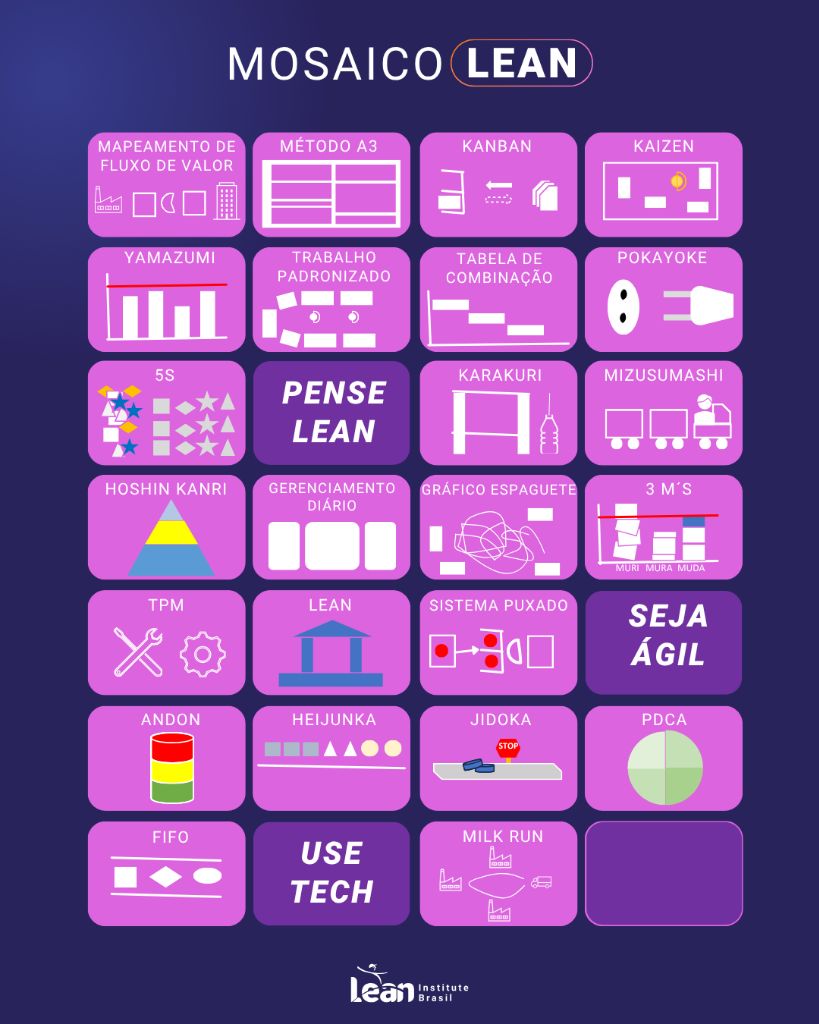
What is the purpose of lean culture?
The main objective of lean culture is to deliver more value to the customer with fewer resources, through the elimination of waste and the continuous improvement of processes.
But this purpose goes beyond operational gains: it also involves creating a work environment that is safer, more participative and learning-oriented.
In lean companies, everyone – from leadership to the front line – is responsible for improving the system every day.
What are the pillars of lean culture?
For lean culture to stay alive and generate consistent results over time, its actions must be anchored in solid foundations, that is, its pillars. These pillars guide team behavior, leadership decisions and the way processes are designed and carried out.
They therefore represent the core values that sustain a truly lean organization — more than techniques, they are principles that shape the culture.
Below are the main pillars of lean culture:
- Focus on customer value: lean begins with a clear definition of what value is from the customer's point of view. Anything that does not contribute directly to it is potentially waste.
- Continuous improvement (Kaizen): everyone should look, every day, for ways to improve processes, eliminate losses and innovate. Kaizen is the basis of continuous organizational evolution.
- Respect for people: lean companies trust, listen to and develop their employees. This appreciation creates an environment of high engagement and learning.
- Continuous flow and pull system: work should flow without interruption and be triggered by real customer demand, reducing inventories and waiting times.
- Visual management: visual tools are used to make performance visible to everyone, facilitate decisions and promote transparency in processes.
What are the advantages of lean culture for your company?
By adopting lean culture in a structured and continuous way, companies begin to operate with more clarity, agility and focus on value. This not only improves process performance but also transforms the work environment and the customer experience.
These advantages become visible both in day-to-day operations and in the organization's ability to innovate, adapt and grow sustainably.
Here are the main benefits generated by implementing lean culture:
- Reduced operating costs, with less rework, movement and inventory.
- Improved quality, by preventing errors at the source and acting quickly on problems.
- Increased productivity, through optimized processes and greater efficiency.
- Team engagement, with safer, more participative environments that leave room to learn and propose improvements.
- Greater agility and innovation, by eliminating bureaucracy and encouraging experimentation.
- Customer satisfaction and loyalty, with faster deliveries, better products and more agile responses to market needs.
Read also: Want to implement lean in your company? Talk to our specialists
How to implement lean culture in your company?
Implementing lean culture does not happen overnight — it is a progressive journey that requires strategic alignment, leadership commitment and the involvement of the entire organization.
More than applying isolated tools, it is necessary to cultivate a mindset of learning, experimentation and continuous improvement. This means transforming habits, systems and ways of making decisions.
Below is an initial roadmap for starting this journey in a structured and effective way:
- Leadership commitment: top management needs to understand, believe in and practice lean. The culture is only sustained by leaders who set the example.
- Diagnosis and Value Stream Mapping (VSM): before proposing changes, it is essential to understand how value flows in the company today. VSM (Value Stream Mapping) helps visualize waste and set priorities.
- Setting goals and KPIs: establish clear, visible and shared indicators, such as lead time, rework rate, productivity or customer satisfaction.
- Training and development: build capabilities at every level with hands-on training. Well-trained teams are more confident in solving problems and proposing improvements.
- Gradual application of the tools: start with simple, high-impact initiatives, such as 5S, PDCA and Kanban. Move on to tools such as Jidoka, TPM and Heijunka as maturity grows.
- Monitoring and continuous learning: use PDCA cycles to evaluate results, adjust course and consolidate learning. The lean journey has no end – it is a continuous process of evolution.
What are the main lean tools?
Lean culture is not sustained by good intentions alone — it translates into concrete practices that guide teams' routines. In this sense, lean tools are instruments that put lean principles into action, making it possible to identify waste, improve processes and promote continuous learning.
Each tool has a specific purpose, but together they build a solid foundation for transforming the way work is done. Below are some of the most widely used in the day-to-day of lean companies:
| Tool | Objective |
|---|---|
| 5S | Organization, standardization and discipline in the workplace |
| Kaizen | Continuous improvement focused on everyone's participation |
| Kanban | Visual management of tasks and pull production system |
| PDCA | Structured cycle of improvement and problem solving |
| VSM | Value stream mapping and identification of waste |
| Jidoka | Automatic stop when defects are identified – quality at the source |
| Poka-Yoke | Devices that prevent or signal human errors |
| Just-in-Time | Producing only what is needed, when it is needed |
| Andon | Visual signaling of problems in real time |
| TPM | Preventive maintenance with operator involvement |
| SMED | Reduction of machine setup time |
| Heijunka | Leveling production over time |
| Gemba Walk | Direct observation of the work to understand and improve it |
These tools are not ends in themselves, but means to sustain the culture and the results. Their use should always be connected to the organization's strategic objectives.
How to measure the results of implementing lean culture?
Lean culture is only sustained when there is clarity about the results being achieved. That is why measuring progress is essential, not only to validate advances but also to identify new opportunities for improvement and keep the focus aligned with strategic objectives.
Well-defined indicators help turn perceptions into concrete data, supporting more assertive decisions and evidence-based actions.
Here are some of the main indicators used to track the results of the lean transformation:
- Lead Time (total time between order and delivery).
- Defect or rework rate.
- Overall equipment effectiveness (OEE).
- Employee engagement level.
- Customer satisfaction (NPS, CSAT).
- Average problem resolution time.
Reviewing this data visually and periodically helps keep the focus on the goals and ensures that improvements are sustained.
What types of sectors can benefit from lean culture?
Lean culture was born in industry, but its essence — eliminating waste, improving continuously and focusing on value — is universal. That is why lean principles have proven effective in very different environments, regardless of size or segment.
Each sector faces its own challenges of complexity, variability and waste, which makes lean a powerful approach for transforming the way people work in virtually any context.
Although it emerged in the automotive industry, lean culture is already applied successfully in many sectors, such as:
- Healthcare (Lean Healthcare): improved patient care, shorter queues and optimized hospital flows.
- Services: less rework, greater agility and closer alignment with the customer.
- Information Technology (Lean IT): faster deliveries, more value added for the user and less waste in projects.
- Logistics: reduced inventories, efficient routing and shorter cycle times.
- Education, Retail, Construction, Agribusiness and the Public Sector: all can benefit from the principles of flow, value and continuous improvement.
The logic is simple: where there are processes, there is waste – and where there is waste, there is an opportunity to apply lean.
Conclusion

Figure 2 — Team collaborating in a continuous improvement meeting, in an organized environment focused on developing a lean culture.
Lean culture is not just a set of techniques – it is a way of thinking and leading. It requires commitment, learning and daily action.
When implemented genuinely, it profoundly transforms the company's performance, the work environment and the customer experience.
More than “doing lean,” it is about “being lean”: building an organization that continuously learns, improves and delivers value.
👉 Want to know how to start applying lean culture in your company? Talk to our specialists.


