

What is Lean Thinking? See the challenges and learn how to integrate it into your company
Lean Thinking is a way of managing and improving processes that puts the customer at the center and eliminates waste throughout the workflow.
More than a set of tools, it is a way of thinking that connects strategy, culture and execution to transform day-to-day work — from the shop floor to the back office.
Applied with method, it shortens lead times, increases quality and frees up capacity to grow at lower cost.
Keep reading to understand where to apply it, see practical examples, the 5 principles, the benefits and how to get started in your company.
What is Lean Thinking?
Lean Thinking is a management and continuous improvement methodology that guides the entire organization to deliver more value to the customer by eliminating waste.
In practice, it combines principles (value, value stream, continuous flow, pull and perfection) with management routines (gemba, PDCA/A3, standardization, visual management) and the smart use of Lean tools to make work more predictable, faster and of higher quality.
More than a set of tools, Lean is a strategy for leveraging the business: by reducing variability and losses, the company shortens delivery times, improves quality, frees up cash and increases customer satisfaction — all with alignment through Hoshin Kanri and continuous learning, boosted by digital learning in Lean.
Because it focuses on flow and rapid learning, it works in industry, services, healthcare, technology and the public sector, with solid foundations in Lean Manufacturing.
In short: Lean Thinking = customer value first, waste last, learning always — an approach that connects strategy, culture and execution to scale results sustainably, supported by Lean leadership and a solid foundation of Lean culture.
Where can lean thinking be applied?
In any company, of any size and sector. Size and industry do not prevent the application of Lean Thinking.
Wherever there is a process with customers, activities and waiting, Lean helps increase quality, shorten lead times and cut costs by eliminating waste and through management routines. In practice, this translates into context-specific gains, as in the examples below:
- Industry and operations: Lean Manufacturing practices stabilize flow, reduce variability and shorten lead time.
- Services, back office, healthcare and technology: standardization, visual management and continuous improvement work equally well; to get started safely, check out the main Lean tools.

Figure 1 — Collage showing the application of Lean Thinking in different areas: healthcare, logistics, construction, transportation and services
See practical examples of Lean Thinking
Below is a quick overview of how the principles translate into day-to-day work in different contexts. Use it as a reference to identify opportunities in your own flow — adapt it to the goals and constraints of your process.
- Manufacturing: organize the line into production cells with continuous flow, apply 5S and kanban to reduce inventory, and SMED to cut setup time.
- Healthcare: lean triage and standardized medical records; “one stop, one care” to reduce transfers; visual bed management to reduce waiting time.
- Construction: planning pulled by work fronts, construction takt per floor, standard checklists per activity and short daily meetings to remove obstacles.
- Retail: replenishment pulled by consumption, store layout designed around customer flow, and gemba routines to quickly fix stockouts.
- Logistics/Warehouse: routing by delivery windows, smart slotting, small-batch picking and andon for shipping deviations.
- Services/Back office: standardize repetitive tasks, limit WIP in service queues, visible SLAs and daily tracking boards.
- Technology/Software: small deployment batches, CIs with fast feedback, WIP limits on boards and A3 post-mortems for learning.
- Customer service/Contact center: standard scripts with room for kaizen, demand-pulled queues and quality andon for critical cases.
Tip: in any sector, start by mapping the value stream, choose a visible bottleneck and run a quick PDCA to validate improvements with data.
What are the 5 principles of the Lean Thinking methodology?
Applied together, they reinforce one another: they align efforts with what matters to the customer, reduce variation and waste, increase predictability and quality, and create a continuous learning cycle.
Let's look below at the five principles and how to put each one into practice.
Value
Define value from the customer's point of view (the problem they want to solve) and align goals and initiatives with that purpose. To keep the organization focused and aligned, use strategy deployment through Hoshin Kanri.
Practical example: if the customer wants “fast, error-free delivery”, set OTIF (On Time In Full — delivered on time and complete) ≥ 95% and zero first-pass defects, connecting projects and routines to these goals.
Value stream
Map end to end and identify bottlenecks and losses. Start by eliminating the main types of waste (waiting, rework, transportation, inventory, etc.) and prioritize where the impact on the customer is greatest.
Practical example: map from order to delivery, recording cycle/waiting times; the map reveals that 60% of the lead time is stuck in manual approval and in data entry with rework; countermeasures: an automatic rule to approve orders up to R$ X, a data-entry checklist at the source and a single queue with a WIP limit; expected result: lead time −40% and rework −70%.
Continuous flow
Make work flow with small batches, balancing and WIP limits (Work in Process/Progress — work in progress; items under way in the queue). In production environments, build on Lean Manufacturing principles (takt, leveling, quick setup/SMED).
Practical example: a process that released batches of 200 items moves to batches of 20, with a maximum WIP of 5 per step; the team balances tasks to meet a takt of 2 min and applies SMED to reduce setup from 30 to 8 min; expected result: near-zero queue, lead time −50% and quality at the source (problems become visible with each micro-batch).
Pull
Produce according to actual demand, avoiding producing ahead and unnecessary inventory. To sustain the routine, apply the main Lean tools (kanban, visual management, standardization).
Practical example: calculate the reorder point based on actual consumption (ROP = daily demand × lead time + safety stock); implement a 2-card kanban for each item (e.g., consumption 40/day, lead time 1 day, SS 20 → ROP = 60); create a supermarket with a visual limit and prohibit producing ahead — replenish only when a card is released; expected result: inventory −30–50%, near-zero stockouts and more predictable flow.
Perfection
Improve continuously with PDCA/A3 cycles, learning fast and standardizing what works. Accelerate capability building and the sharing of lessons with digital learning in Lean, and strengthen the role of Lean leadership to sustain the culture day to day.
Practical example: choose a recurring problem (e.g., first-pass defects = 12%), run an A3 with PDCA: (P) define the gap and map causes; (D) test two countermeasures in a 2-week pilot; (C) compare results (defects ↓ to 5%, rework ↓ 60%); (A) standardize the new method, train the team, update the checklist and create a lessons-learned log; repeat the cycle monthly aiming for defects < 3%.
Why is applying lean thinking in the company essential in times of uncertainty?
In volatile scenarios, Lean creates operational resilience by encouraging rapid experimentation, data-driven decisions and the systematic elimination of waste.
The result is more predictability, shorter lead time, first-pass quality and more efficient use of cash — benefits we will detail in the next topic.
Adoption picks up speed when we combine continuous capability building (boosted by digital learning in Lean) with leadership present at the gemba, able to align priorities and sustain routines (see Lean Leadership — the link between strategy, execution and culture).
What are the benefits of Lean Thinking?
Here are the main gains organizations usually see when they adopt Lean consistently — from the shop floor to the back office — with practical effects on cost, quality, lead time and people engagement:
Less waste and lower unit cost.
Systematic removal of the main types of waste (waiting, rework, inventory, transportation, etc.).
Higher first-pass quality.
Clear standards, quality at the source and fast feedback, sustained by the main Lean tools.
Deadlines met and a consistent customer experience.
Stabilized flow, shorter lead time and visibility of work in progress.
More flexibility for demand variations.
Smaller batches, leveling and pull reduce queues and inventory.
Better communication and collaboration.
Visual management, short rituals and problem solving at the gemba increase alignment between areas.
A motivated and autonomous team.
Lean leadership coaching and continuous learning (accelerated by digital learning in Lean) build capabilities and raise engagement, including with the support of digital learning in Lean
Practical result: a more predictable, faster and more economical operation, with a direct impact on margin, customer satisfaction and sustainable growth.
Want to accelerate your team's capability building? A practical Lean training program and how to choose management courses can help.
What are the challenges of integrating Lean Thinking into the organizational culture?
Integrating Lean into the culture takes more than training on tools: it requires habits, symbols and routines that sustain the right behavior every day. These are the main obstacles that tend to appear — and how to tackle them:
- Resistance to change and “it has always been this way”. Changing habits requires clarity of purpose and practices that reinforce Lean culture day to day.
- Cadence of improvement routines. Sustaining quick meetings, visual management, A3/PDCA and standards reviews requires discipline and process indicators, not just result indicators.
- Tension between the short and long term. Quarterly targets can conflict with flow stability; deployment and prioritization need to protect the work system.
- Leadership that “outsources” Lean. Without example at the gemba and coaching, Lean becomes a project. Strengthen the leader's role as a developer of people and guardian of the flow: Lean Leadership — the link between strategy, execution and culture.
How to mitigate: align purpose and expected behavior, define minimum rituals (daily/weekly/monthly), measure the process and learn fast with A3 — with leaders present, teaching and removing obstacles.
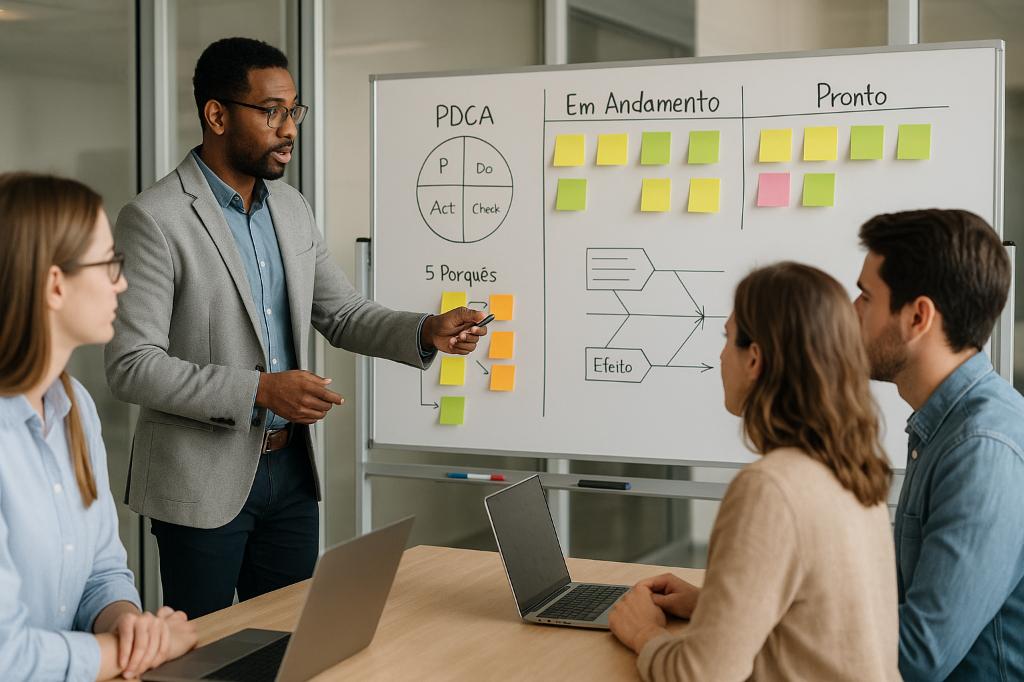
Figure 2 — Leader guiding a team at a visual board, representing Lean management and the application of Lean Thinking in companies
How to apply lean thinking in the organization's day-to-day work?
Before moving on to the practices, use this roadmap across five fronts — mapping, stabilization, root-cause solving, cadence and development — to turn purpose into daily routine and measurable results.
- Map the flow and define customer goals
Before improving, see the whole: understand how value flows from order to delivery and where work stops — this guides goals and prioritizes what hurts the customer.
- Objective: understand where value is created and where there are losses.
- How to do it: draw the end-to-end flow (from order to delivery), mark cycle/waiting times and bottlenecks. Prioritize the customer's “biggest pain point”.
- Metric: total lead time, % of on-time deliveries (OTD), rework rate.
- Artifacts: current/future Value Stream Map (VSM) and 1 A3 with the quarter's goal.
Practical example: the VSM shows 7 days of lead time, 4 of which are spent waiting for manual approval; applying an automatic rule for orders up to R$ X and a data-entry checklist reduces lead time to 4 days and rework by 60%.
- Stabilize with standards and visual management
Once you see the flow, stabilize the work: standards reduce variation and visual management makes problems explicit, allowing quick correction day to day.
- Objective: reduce variability and make deviations obvious.
- How to do it: create simple standards (checklists, work instructions), limit WIP (Work in Process/Progress — work in progress; items under way in the queue) and put up boards/andon for real-time status.
- Metric: adherence to standard, average WIP per step, cycle time.
- Artifacts: checklists, SOPs, kanban/andon board with explicit policies.
Practical example: standardize the check in 5 steps, limit WIP to 4 per step and flag deviations on the andon; in two weeks, cycle time −30% and errors −50%.
- Solve at the root cause with PDCA/A3
Replace “firefighting” with method: investigate the problem, test small solutions and standardize what actually worked — creating learning that lasts.
- Objective: improve with method, not “guesswork”.
- How to do it: for each priority problem, run an A3: define the problem (gap), analyze the root cause (5 Whys/fishbone), test countermeasures on a small scale (PDC), standardize what worked (A).
- Metric: reduction in the defect/delay at the targeted point, % of effective countermeasures standardized.
- Artifacts: living A3, list of experiments, lessons learned.
Practical example: first-pass defects at 12%; the A3 identifies the cause as ambiguous instructions → test of a revised standard + 5-step checklist for 2 weeks; result: defects 12% → 5%, rework −60%; new standard published and training completed.
- Ritualize improvement (cadence)
Without routine, improvement disappears into the day's urgencies. Create short, frequent rituals to keep the focus on flow, make problems visible and ensure continuous learning.
- Objective: maintain daily focus on flow and goals.
- How to do it:
- Daily (10–15 min): meeting at the gemba with the team for status, obstacles and the day's actions.
- Weekly (30–45 min): review of process indicators, A3s and capacity.
- Monthly (60 min): hansei (reflection), review of goals and next experiments.
- Metric: % of rituals held, average time to remove obstacles, flow health (WIP/lead time).
- Artifacts: visual agenda, process metrics dashboard (not just results).
Practical example: with a 12-min “daily”, a 40-min weekly review and a monthly hansei, the team reduced obstacles open for > 48h by 65% and lead time by 25% in two months.
- Develop people (learning by doing)
Without prepared people, the system cannot be sustained: develop skills in real work, with close guidance and responsible autonomy to decide and improve.
- Objective: autonomy with responsibility to sustain the system.
- How to do it: on-the-job training (TWI/Job Instruction), leadership coaching at the gemba, quick feedback, planned task rotation. Give authority to stop the process when there is a critical deviation.
- Metric: multiskilling per cell, ramp-up time, engagement, no. of improvements suggested/implemented per person.
- Artifacts: skills matrix, training standards, development paths.
Practical example: with 3-step TWI and weekly coaching, the team raised average multiskilling from 1.6→2.4, cut ramp-up by 35% and doubled improvements implemented per person in 60 days.
Tip for getting started in 30 days: choose a pilot flow, publish 3–5 process metrics, limit WIP, run 2 small A3s and institutionalize the daily routine. Then scale to adjacent flows while keeping the same cadence and governance.
Want to implement Lean Thinking in your company? Talk to our specialists by sending an e-mail describing your main challenge in 3 lines. We will get in touch soon.
Remember: Lean Thinking is not a one-off project, but a daily discipline of delivering value, developing people and improving processes. With clear principles, consistent routines and leadership present at the gemba, results appear and are sustained.
Count on us to put it into practice in your company.


