

Sell One, Buy One, Make One: transforming conventional distribution into lean distribution
Portuguese translation by Diogo Kosaka.
Large inventories. Long lead times. Infrequent deliveries. Large inventories to cover fluctuations in demand. These are not characteristics normally attributed to Toyota's lean model, but they once accurately described the automaker's parts distribution system.
"We used to send one large order to our dealers", said Bob Gallagher, manager of Toyota's parts distribution center in Mansfield, Massachusetts. In turn, Gallagher's parts distribution center received one large weekly shipment of North American parts from a supplier in Kentucky and one large weekly shipment of Japanese parts stored in a warehouse in California. Like any other conventional distribution system with low frequency and large replenishment batches per cycle, this system generated a great deal of waste.
Toyota Parts Distribution Center in Boston
- Opened in 1980
- 1847.400 square feet
- two shifts
- 36 warehouse employees, 5 administrative and support employees, 1 manager and 7 leaders (operations, logistics, customer service)
For example, since dealers cannot accurately forecast which parts customers will need next week, they keep high inventories to ensure a consistent supply between weekly deliveries. In turn, the automaker's distribution network of 11 centers needed enormous inventories to supply the dealers.
The system also hurt productivity at the parts center, because dealers placed daily orders for "critical" parts – parts that had run out – along with their weekly stock orders. "Basically what we did in any warehouse in the country was go through the distribution center once to pick the order items and come back later in the day to pick the critical items", explained Bob Gallagher. “We were making twice as many movements in the warehouse for each dealer." The volume of critical orders grew until it reached 45% of daily order volume. The trick was to decrease the number of critical orders and increase regular orders, because the big gain in productivity comes from processing orders for standard replenishment parts such as spark plugs, filters, hoods, bumpers, etc.
The traditional system was also inefficient for dealers. A large dealer in El Monte, CA, needed two 48-foot containers to deliver its weekly order. The dealer needed labor and space to unload and store the huge shipments. And the parts distribution center needed dock space equivalent to two containers for the shipment. That was space the distribution center could have used to speed up the unloading of parts arriving from California and Kentucky.
As Toyota sold more cars and models in the US, the problems would get worse – and more expensive – if dealers and distribution centers had to knock down walls and add workers to handle the growing pile of new parts. That is money that could be better invested in marketing new models or adding showroom space. Applying the principles pioneered in the factory, such as one-piece flow, kaizen and leveling, Toyota began a transition from conventional distribution to a just-in-time system
One part at a time
Toyota built the new system based on frequent orders and deliveries to replenish minimum inventory levels covering actual demand. So, when a dealer in Vermont replaced the hood on a customer's Camry, it ordered a new part from the manager of the Mansfield distribution center, Bob Gallagher, who delivered a new hood, not a full pallet, the next day. Gallagher requested a new hood from the Kentucky warehouse, which delivered a new hood, not a loaded pallet, the next day, and then placed an order with the supplier plant. Toyota called this “sell one, buy one, make one”.
Starting in the mid-1990s, Toyota launched the new system on the West Coast and gradually expanded it throughout the country. “A lot of training took place before it happened”, reported the Mansfield manager. Eventually, dealers began placing daily orders with the distribution center. Parts ordered by 4 p.m. at the latest were delivered at 7 a.m. the next day (dealers could place critical parts orders until 6 p.m.). This allowed dealers to lower inventory levels and place critical orders only for what was truly absolutely necessary.
“We basically took the weekly order and said: ‘we will send a daily order; so order only what you need to replenish your shelves’”, explained Bob Gallagher. "A very astute dealer can tell what kind of inventory is needed for spark plugs, filters and other maintenance items. An alternator for a 1978 Corolla is different. Any dealer that needed one of those parts could place a critical order today, and it would be in the shop at 7 a.m. tomorrow. But critical shipments are strictly for customers whose vehicle is broken down and the dealer does not have the needed part", he illustrated.
Initially, some dealers were apprehensive about the change and relied on huge buffers. But some, convinced that they could receive what they needed the next day, quickly got rid of hundreds of thousands of dollars in inventory, which they devoted to advertising, facility improvements and other benefits. "Over time, everyone came to believe in the system”, said the manager.
Most orders happen automatically now. Dealers set a minimum inventory quantity in their computers to cover the daily demand history. For example, a dealer keeps two hoods in stock. When it sells one, its internal system automatically places an order for one more with the regional parts distribution center. The system replenishes maintenance items such as spark plugs and brake pads in quantities of 15 or fewer instead of completely full boxes. Orders go from the dealers to Toyota Motor Sales in Torrance, CA, which checks key quality points, such as having the correct part numbers (“part numbers”) so that incorrect orders are not sent to the distribution centers. Torrance also looks at the database of the regional parts distribution centers to make sure they have the necessary items. For the new system to work consistently, actual customer demand must also be separated from demand created by sales. "If there is a promotion, sales will let us know and our purchasing department will do some manual manipulation in the ordering system to make sure we have the parts." In the few weeks leading up to the sales, inventory increases.
Kaizen
To convert the parts distribution centers to a just-in-time distribution system, Toyota's experts conduct jishuken (intensive kaizen training sessions) to improve key processes. Typically, it was one of these that improved parts-picking productivity while Bob Gallagher was manager of the Chicago parts distribution center.
The distribution center's main floor held most of the parts, but a mezzanine area concentrated all the low-frequency orders. "Every order had at least one part on the mezzanine, so the worker had to go up to pick the parts and then come back down again", illustrated the Mansfield manager. After making observations and analyses of the work at the workplaces themselves, the improvement team redesigned the parts-picking process to reduce the number of trips up and down. Workers picked all the necessary parts on the main floor, and then one or two people, depending on the order volume, went up to the mezzanine to pick all the low-frequency parts.
"So, instead of 12 people going up there every hour, one person went up and sent us everything we needed", Bob Gallagher continued. "That kept 11 people from having to go up and down". The improvement saved several minutes per hour. That did not seem like much to the managers of a conventional system, "but you are saving that on the first and second shifts, he noted. "Then they extended the savings over a week. That is where you really start to get your gains – a few seconds here, a few there, soon you are saving minutes and then hours".
Another change was grouping the dealers supplied by the Chicago center into larger routes. Distribution center workers picked orders by route. So creating large groups meant fewer trips inside the warehouses, saving time and greatly improving productivity. Ideas (kaizen) from various warehouses are shared on a website. Each distribution center has an annual goal for kaizen projects. Once complete, the kaizen is documented on an A3 form. The kaizens are sent to headquarters, which posts them on a website accessible to any warehouse. We get ideas from other warehouses too.
Leveling
Probably the biggest benefit of the new system was the leveling, or smoothing, of work at the parts distribution centers, noted Bob Gallagher. In a conventional distribution center, managers typically give workers a list with eight hours of parts to pick from the shelves. "If you finish everything in four hours, you find a place to hide for the other four hours", said the distribution manager. Based on a work analysis that includes time studies, Mansfield implemented repetitive 12-minute parts-picking cycles to smooth the workflow and create a more regular work pace.
"We can use cycles of 12 or 15 minutes because both divide evenly into 60 minutes", explained the Mansfield manager. There are advantages and disadvantages to each. Using a 15-minute picking cycle means that workers make one fewer trip per hour back to the scheduling board where they receive their next task. However, they pull larger and heavier carts, since they carry more parts in 15 minutes. "We found that 12 minutes was the best number for us here", said Bob Gallagher.
The scheduling board (heijunka box) is a simple open board with rows and columns of small cubbyholes (similar to an old-fashioned mail sorter). Despite its modest appearance, the board's impact on maintaining the flow and pace of work is significant. Over Mansfield's two shifts, demand was leveled into a regular and stable pace. Here's how:
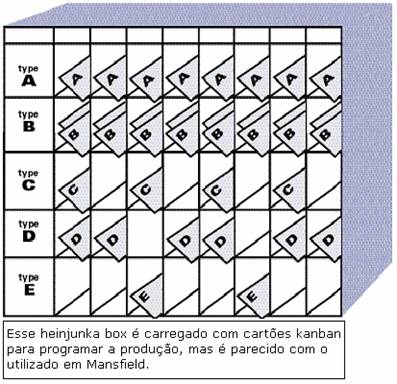
Each row on the board represents a truck route. (Mansfield supplies 112 dealers on 18 routes). Each column represents a 12-minute interval. A computer and a printer in an office next to the board print cards resembling kanban four times a day, at regular intervals. Each card is an order, such as a hood or, in the case of maintenance parts, a box of 10 spark plugs. A person in the office groups the cards into packets of 32 for small parts and of 19 for larger items, and loads each group into each slot on the scheduling board. (Observation and time studies showed that employees can pick 32 small and 19 large parts in 12 minutes).
"With 12-minute cycles for large and small parts, each employee can pick five batches in an hour. That is how we monitor productivity", reported the manager of the Mansfield distribution center, Bob Gallagher.
Employees take the tasks from left to right. Using carts, they pull the quantities of parts from inventory according to what is written on each card. To pick most items, workers use carts with totes (dividers). Each tote represents a dealer on the route. Employees who pick the bulkier parts use larger carts. The warehouse layout is designed to optimize efficiency and safety. The bulkiest and heaviest parts are near the shipping dock, as are the parts with the highest movement frequency. Every 12 minutes, they bring the carts full of order items to the shipping lanes near the waiting trailer assigned to the route they are working on. Then they take another packet of cards.
A yellow card accompanying the packet signals to the employee that this is the last batch for the route. He or she has an extra 12-minute cycle to finish the work and load it into a wheeled container that other employees will take into the trailer. The completed cards are placed in a box in the container. The first truck loaded is bound for Maine, the most distant route. The drivers have keys to the dealerships so they can make deliveries to secure areas. A contracted company delivers to the most remote locations. An internal transportation operation balances the routes.
Leveling combined with historical data gives Bob Gallagher a very good idea of what volume of orders the dealers will send in a day. "We can predict with greater accuracy on a Monday what our heaviest day of the week will be, and that we will ship 10,500 to 11,000 orders. You can almost bet on it", he said. On a recent Monday, Mansfield shipped 10,984 orders.
This data, used with software developed in-house, helps the plant's managers plan the labor needed. A few days ago, the software showed that 9.25 employees were needed to fill the orders for routes one through four. Ten people were assigned initially, but one would be reassigned later to work on other routes because of the fraction. If managers know how many people are needed to pick the orders, other employees can be moved to unload the six trailers that arrive daily from the two supplying warehouses, instead of everyone picking or everyone unloading, which goes against the leveling pattern.
Labor planning usually falls apart when dealers are open on a holiday. The next day, Mansfield would be flooded with orders from the dealers”. As a countermeasure, Mansfield's holiday calendar is synchronized with that of the dealers.
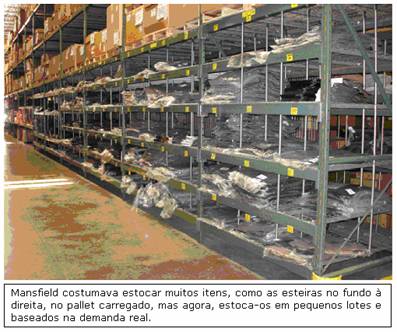
Small-batch, high-frequency deliveries, combined with careful analysis of actual demand, allowed Mansfield to free up parts storage space for new models. If sales information shows that the distribution center sold one hood per week, two were stocked in the main stock located at floor level and two kept in safety stock on the rack above the primary stock. When one is sold, another is requested from the Kentucky warehouse. With much smaller batches kept in stock, “we can use the storage area, which used to be only for shock absorbers, for six types of parts”, explained Gallagher.
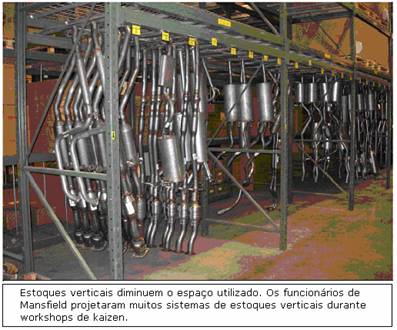
Mansfield is gaining additional space through kaizen events to improve the way parts are stored. For example, storing parts vertically takes up less space and causes less damage than storing them horizontally.
Toyota uses the following guide for storing items:
1-Group similar parts together (raw material, small box, large box, exhaust systems, loose parts in boxes, hoods, doors, shock absorbers, etc.).
2- Store vertically.
3- Store in locations easily accessible to employees.
4- Store heavy parts in an ergonomically safe way.
5- Set aside a location for each part.
6- Predetermined stock location space to identify oversupply.
7- Store based on movement (items with the most movement at the front of the warehouse).
If parts are moved from safety stock to main stock, the forklift operator writes down on a piece of paper the date and how many were moved. At the end of the month, managers review the information to see whether many parts are being moved too often. If there is a lot of movement of a part out of safety stock, they will keep more parts in main stock.
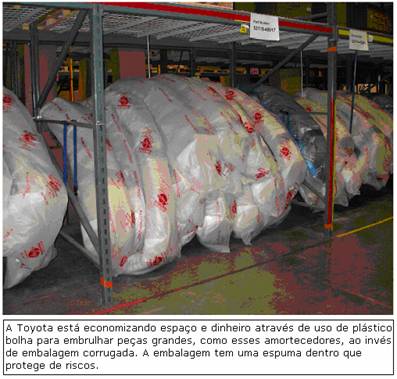
“The goal is never to touch the safety stock”, said Gallagher. “Having forklifts replenishing from those stocks is a waste of time and hurts productivity. If your calculations for main stock are correct, you will never need to touch your safety stock”. The calculations are based on sales history, and the replenishment time is obtained from the California and Kentucky warehouses. Safety stocks serve as a buffer in case a delivery truck breaks down or bad weather causes an increase in accidents and the resulting increase in repairs at dealers. “We keep our eyes on safety stock and try to reduce it all the time”, said Bob Gallagher. “Safety stock is not meant to turn over, except for batteries and a few items with an expiration date”, he added.
Small batches and minimal safety stocks have worked wonders, said Gallagher. “This will allow us to stay in this building much longer, because it gave us more space by condensing the amount of area needed for a part. When you have less inventory, there is better visual control of what you have. What's more, it allowed us to greatly reduce the inventory in our supply chain”.
To keep inventory to a minimum, it is vital that the six trailers with replacement parts arriving from California and Kentucky be unloaded within 24 hours. Mansfield used to delay unloading if Monday was a very busy day with orders received over the weekend. But that always resulted in working on Saturday and some freight delayed by up to five days. Now, employees will work an hour or two longer if necessary to unload all the trailers on the day they arrive. "Before we go home, all the trailers we received that day are unloaded", said Gallagher.
Next steps
Incoming parts come with labels indicating their location in the distribution center. An employee scans the label to update on the computer what is in inventory. "It is a somewhat old-fashioned way to do it, but it is really simple and it works", the manager added.
A new supply system under development will replace the paper labels with radio frequency identification tags that will update inventory data when the truck arrives at the receiving dock. The system will equip the receiving carts with receivers and small computer screens that will show the employee the best sequence for organizing the parts that have just arrived. The changes reduce unloading days, a key indicator of how long it takes to unload freight, and will take Mansfield to the next step, toward the main objective described by Gallagher as “satisfying the customer and shrinking the supply chain by reducing inventory”.
| ||
Productivity | +3% annually |
|
Time to unload and store parts | < 22 hours per container |
|
Inventory | 32.2 days |
|
Errors per thousand orders | 64 errors |
|
| 1981 | 2006 |
Percentage of critical orders/ | 45%- 55% | 5%-95% |
Toyota models sold in the US | 7 | 17 |
Warehouse size | 187,400 square feet | 187,400 square feet |
For more information on some of the terms used in this article, such as kaizen, just in time, heijunka and jishuken, see the Lean Lexicon.
* Portuguese translation by Lean Institute Brasil.
** Source: Lean Enterprise Institute





