

Toyota's new material handling system shows the flexibility of TPS
Portuguese translation by Diogo Kosaka.
Toyota has introduced a new kit-based material handling system to reduce complexity and improve quality in the areas in the assembly areas.
The new method has been introduced in Japan and China, according to Art Smalley, author of the workbook “Creating Level Pull” published by Lean Institute Brasil. Smalley saw the new system in action on an engine assembly line during a recent tour of Toyota facilities in Japan. He was one of the first Americans to work at Toyota in Japan in the 1980s and helped transfer Toyota's equipment concepts and manufacturing methods beyond Japan.
A Toyota Motor North America employee said the kit system was being introduced on more and more lines at the Georgetown plant in Kentucky and at other North American plants. He said it was not a total change in the parts supply system and was not applicable to all production areas.
Smalley said the system, called the “set pallet system” (SPS) in Japan, worked better on automated lines than in cells. The new approach removed the inventory racks alongside the lines, often called “flow racks”, so that operators no longer walked from their workstations to pick up parts. Instead, electronic signals tell material handlers which part to pick from bins set apart from the line. They pick the parts and place them on pallets that travel along with the engines being assembled (see the diagrams below).
“Visually there is a big difference, because the racks have disappeared”, Smalley said. “I was surprised. The area was much more open and clean than the traditional environment with all those materials alongside the line, which blocked the view. The line is much more open”.
More value-added work
At Georgetown, the correct parts for a specific Camry or Avalon are laid out on a tray that was placed inside the car and traveled with it down the line. Because parts selection is done upstream, assembly line workers can “focus on the quality of the assembly”, according to a Toyota employee. Variety and the resulting complexity have proliferated as more and more options have been offered to customers. For example, before the new system was introduced for the current generations of the Camry and Avalon, assemblers had to choose among dozens of varieties of a given item.
The change means that operators now focus 100% of their time on value-adding work, which is installing parts, because they no longer have to perform non-value-adding activities such as walking to pick up parts from the racks, Smalley notes. “The operators stay in a very small area, adding value almost 100% of the time”.
The switch also eliminated searching for, fetching and reaching for parts by assembly line operators. The new arrangement also made training operators and material handlers easier because responsibilities became more narrowly defined.
The new system concentrates material selection and the walking to fetch it in the hands of material handlers, who are positioned at seven out of every 10 stations along the engine assembly line, Smalley said. Although the new system increased the number of material handlers, he commented that, on average, Toyota estimated that the change in total productivity was neutral due to the greater efficiency in the use of direct labor. One small problem with this new approach was that it became harder to add or remove handlers as the takt changed.
Advantages and Disadvantages
The great advantage of the new material handling system is simplicity and improved quality by not allowing errors. Smalley explained that Toyota in Japan had roughly 5% temporary workers when he was there in the 1980s. “Now it reaches 40% in some plants” he said. “And the workforce is also younger than it was twenty years ago, and labor law has changed to allow more women to work on the assembly line”.
All these trends created a workforce less experienced with factory work and less familiar with automotive components than in the past. Combined with the proliferation of component variety, parts selection errors were occurring, and small quality problems, such as assembly errors and bolts not tightened enough, were flowing downstream. “I think they couldn't put poka-yokes everywhere, and the logical step was to simplify even further”, he said.
The new system was introduced at a vehicle assembly plant in China co-owned by Toyota that had little space to store materials at the end of the assembly line, Smalley said. A kaizen effort created the SPS approach. “Other managers saw and loved the effect it had in clearing the area around the line” he said. “The line became less cluttered, easier to see, easier to walk around, and they simply felt they had more room to work. One by one, the plants changed over to the system over a year or two, and now the engine assembly line is doing the same”.
Although the system is considered new, Smalley pointed out that a similar version was used on line number 14 at Toyota's Kamigo Engine Plant 20 years ago. The line supplies approximately 100 different types of engines and thousands of small variations at the level of “part numbers” used in engines around the world. Other lines do not suffer from the same complexity issues, and so the system was never spread. Smalley noted that adopting the SPS material handling system today shows that the flexibility of TPS adapts to the needs of the situation instead of forcing a solution in order to maintain standardization.
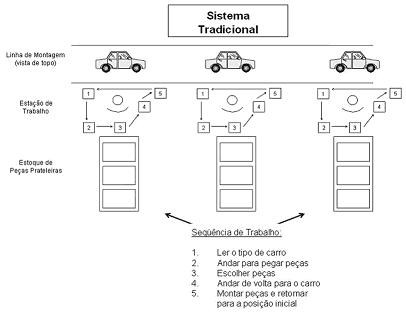
Toyota operators on the traditional assembly line lost a lot of time in non-value-adding activities by walking to the racks (“flow racks”) to pick parts.
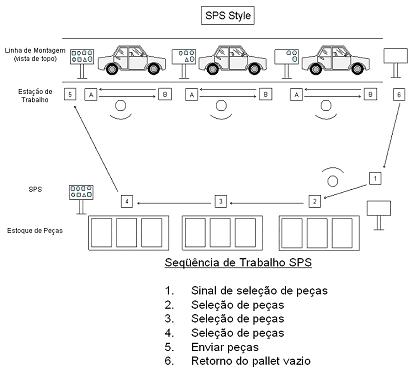
Operator movement is drastically reduced and parts selection is eliminated with the new system, also known as the “set pallet system” (SPS). Material movement and selection are concentrated in the material handlers, leaving assembly line operators free to concentrate on assembly. In the diagram, operators walk from position A to B during assembly, and then back to position A. After receiving an electronic signal indicating which parts to pick, material handlers take the parts from bins positioned in line and place them on pallets or trays that travel with the car or engine being assembled. Material handlers bring the empty trays back to the racks for replenishment at the end of their workstations.
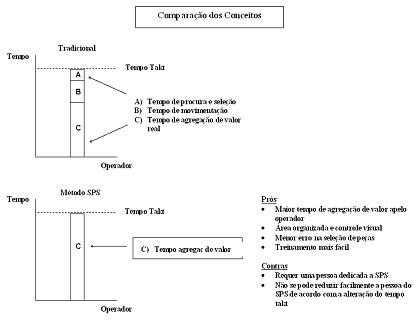
This representative analysis shows overall how the operator's value-added time increases dramatically with the new system.





