

Lean Logistics: basic concepts
Supply chain management covers the planning and management of all logistics activities. It also includes coordination and collaboration with partners in the chain, such as suppliers, distributors and customers.
These activities contain countless wastes, for example:
• Safety and buffer stocks due to inefficiency, unreliable processes, and erratic and artificial demand variation;
• Long-distance transportation due to a lack of route planning, underutilized equipment in the plant due to the absence of proper process engineering, late-delivery fees paid because scheduled delivery windows are not used;
• Unnecessary inventory areas, investment in expensive storage systems due to high inventory levels;
• Waiting, with underutilized labor and equipment, and idle materials;
• Packaging requested beyond what is needed, or simply transporting “air”, as well as waste from damaged packaging.
• Rework, among others.
1. Lean Logistics
To manage the supply chain in a lean way, with less waste, you need lean logistics, which is based on 3 fundamental concepts:
1. Reduce the lot size
2. Increase delivery frequency
3. Level the delivery flow
This means implementing a pull system with leveled and frequent replenishment in small lots, defined between plants along the supply chain value stream, in order to work as closely synchronized as possible with actual consumption.
It is common to see companies supplied by their suppliers through deliveries in large and inconsistent lots, based on sales forecasts.
Sudden changes in orders, in both volume and mix, often cause disruption for everyone involved, generating various types of waste and increased costs.
When lean logistics is adopted, as products are consumed by the customer, a pull signal is created in the companies indicating the exact quantity of products to be replenished by their suppliers, who in turn will send a pull signal to their sub-suppliers indicating the same consumed quantity to be replenished, and so on along the chain.
Lean logistics requires some basic elements, such as:
• A pull signal mechanism, such as kanban systems, signaling devices that authorize and give instructions for the production or withdrawal of items in a pull system. Kanban cards are the best-known and most widely used examples.
• A leveling device, such as a heijunka box at each step of the value stream between plants, leveling demand in small time increments (every hour or every shift, day or week) and also by mix, ensuring that all products are produced and replenished at a constant pace, in small lots.
• Planning of routes and frequent deliveries in small lots using the milk run, a method of accelerating the flow of materials between plants in which vehicles follow a route to make multiple pickups and deliveries at several plants, instead of waiting to accumulate materials for a direct full-truckload shipment. In this way it is possible to reduce inventories and reaction time along a value stream. It is similar to the concept of material handling routes within plants.
• Often the cross-dock system is also used to consolidate loads, that is, a facility that sorts and recombines a variety of items arriving from several suppliers to be shipped to various customers (other plants, distributors, resellers, etc.). It is not a warehouse, since its function is not to store materials. Products are simply unloaded from incoming vehicles and moved to the vehicles that will carry them to other locations. If these departures are frequent, it is possible to empty the cross-dock every 24 hours.
2. Obstacles to implementation
But why are there so many barriers to applying these concepts? What are the prerequisites for implementing lean logistics? What paradigms need to be broken?
First, no lean logistics will work without a certain stability in supply chain demand. Trying to apply these concepts while dealing with quarterly, monthly or weekly demand peaks will force you to keep additional buffer stock to cover these variations, and it will not be possible to make leveled and constant deliveries. Analyze demand behavior together with the Sales area and the Commercial team, identifying the peaks and above all their causes, and generating countermeasures to avoid or minimize them.
Second, an effort is needed to reduce setup times in order to decrease lot sizes (monthly lots to weekly, weekly to daily, daily to hourly). This alone will help with leveling and with increasing delivery frequency, contributing to maintaining basic stability in the production system and in transportation.
Third, operating cost is heavily questioned by Logistics regarding the implementation of the milk run, transporting less volume more frequently. There is a perception of increased logistics operating cost, which is in fact true. As an example, I cite the case of a company in which logistics operating costs represent 75.5% of total logistics cost and the remaining 24.5% represent the costs of holding finished goods inventory; by reducing inventory cost by 50% (the result of implementing lean logistics concepts), there is a 5.1% increase in operating cost, equivalent to 4.3% of total logistics cost. However, total logistics cost is reduced by 9%. Therefore, it is important to analyze the benefits brought to the system as a whole and not just the cost increase in one department or another.
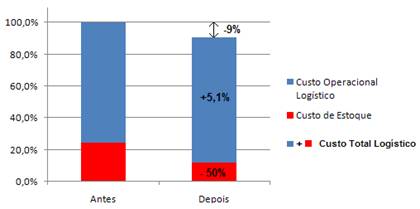
Chart 1 – Reduction of total logistics cost
3. Suggestions for implementation
Before implementing lean logistics across your entire production chain, apply lean concepts in production, and then expand to the whole system as needed.
Start a pilot with the products that have the smallest demand variations. An ABC curve by demand variation, where A products are those with variation below 20% (and not those with the highest volume), B products with variation between 20% and 100%, and C products above 100%, will provide a better view for choosing the items for the pilot.
Select the A products and create flow in your production. Size the pull system, extend it to the flow beyond your plant's door-to-door, and design the delivery routes and frequencies by applying the three concepts of lean logistics: reducing lot size, increasing delivery frequency and leveling the delivery flow.
Monitor the performance indicators and, as always, do kaizen to bring benefits to the management of your supply chain.





