

Down with batches

SulAmérica decided long ago to focus on the SME (small and medium-sized enterprises) market as a business strategy in the health insurance segment. This proved to be a good move, with SME insurance becoming a best seller in the industry's portfolio. This is the commercial side of health insurance, serving small business owners and giving them access to our network of hospitals and services.
The policy issuance process, however, was not as successful as the product. We needed days – usually around two weeks – to complete it. Concerned with controlling this process, we installed a complicated verification system that consisted of entering every proposal we received from the sales department into an Excel spreadsheet. This, added to the batch work system we used, meant that we received three large blocks of proposals a day from the dispatch area.
Until the entire batch had been processed, and all the information transferred to the Excel spreadsheet, the next step in the value stream could not begin its work – and that is how the delays happened. Before a policy could be issued, we had to make sure all the documents were there, enter the information into the systems, verify the authenticity of the customer's signature, make sure the customer did not have any pre-existing condition, occasionally request a medical review (when submitting a proposal, the customer had to include the Personal Health Statement; in the presence of pre-existing conditions, SulAmérica needs to determine whether we can take on the risk) and, finally, carry out a quality check.
The delays in the process also meant that people on the sales team called us all the time to find out when a proposal would be issued (only after that did the brokers earn their commission, so you can imagine their hurry). Of course, customers can only start enjoying their health or dental policy after the number has been issued.
I was the person responsible for all the transitions between steps. Each of them was recorded in an Excel spreadsheet – which meant I was constantly saving and backing up on a USB stick that hung around my neck all day. My colleagues joked that I slept with it for fear of losing it.
At first, the team could not see the problem with batches. They knew there were problems in the process, but they could not see the biggest one. One day, during our first attempt at a hoshin exercise, our coach Flávio Battaglia, of Lean Institute Brasil, ran an exercise using a signing process in batches and in flow, and we then understood that it reflected our current process. It was clear that it made no sense to work in batches.
THE EXPERIMENTS BEGIN
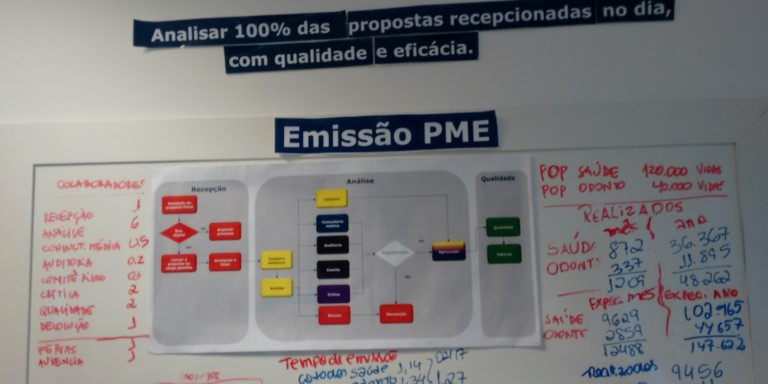
One of the first measures we took was to remove the checks between steps – our biggest bottleneck – keeping only one at the beginning and one at the end of the process. As a result, we saw a drastic reduction in our lead time. Eventually, the controls were removed entirely, because correct and complete proposals could be processed on the same day. The only ones that could not be completed in a day were those missing information that had to be sent back to the broker and those that had to be sent for medical review. Processing a proposal on the same day is a competitive advantage for us, obviously.
To move away from batches – previously, we received three deliveries a day of almost 100 proposals each –, we introduced a new three-step system, called House 1, House 2 and House 3. Despite the clear layout challenges (one of the Houses was in a different room), the system now had three clearly defined steps. An undesired effect was that different teams began to compete with each other and frequently went to the dispatch area to get more proposals to work on. Houses 2 and 3 had to wait for House 1 to finish its work and therefore started to complain. So, although it improved the situation, the House system also created some problems.
When we moved to a new facility, we were able to put all the steps in a line, one next to the other. It was a very logical work arrangement that allowed us to move away from the House system. By taking steps to understand each task in depth and how long it took to complete, we were able to allocate our resources more effectively. So, for example, we assigned two people to dispatch and seven to the analysis step (the main step in the process, in which all the information is entered into the system and the team checks whether all the documentation has been submitted; if anything is missing, the proposal is sent to another team, whose task is to obtain the missing information). After that, we implemented standardized work for each of the tasks, to bring consistency to the way they are performed and to prevent errors. As a result, the team was able to reach a point at which it processes one policy at a time – one-piece flow, as we lean practitioners call it.
A major contribution to achieving this goal came from the use of visual tools and the introduction of daily management meetings. First, we placed boxes next to each step of the process to make possible bottlenecks clearly visible.
To organize our day and allocate resources in the best possible way, we began using daily management boards. These boards show how many people are present on a given day and help us assign tasks. Today, everyone on the team understands the board, and we are able to rotate leadership weekly. To make it easier for everyone to help with problems and to speed up the whole process, we also placed great emphasis on multi-skilling: we created a “skills autonomy index” to see who could do what in each team and to identify opportunities for further capability development, which became a major responsibility for the leadership team. It was great to see how, over time, people became more proactive and began to pay more attention to the goals they set for themselves and to how those goals impacted all of SulAmérica.
The proof is in the pudding, they say. The proof that our system works lies in the fact that the department can handle demand peaks (whenever we run a campaign or before we adjust our prices, for example) much more quickly and efficiently than ever before.
BRINGING LEAN TO OTHER AREAS
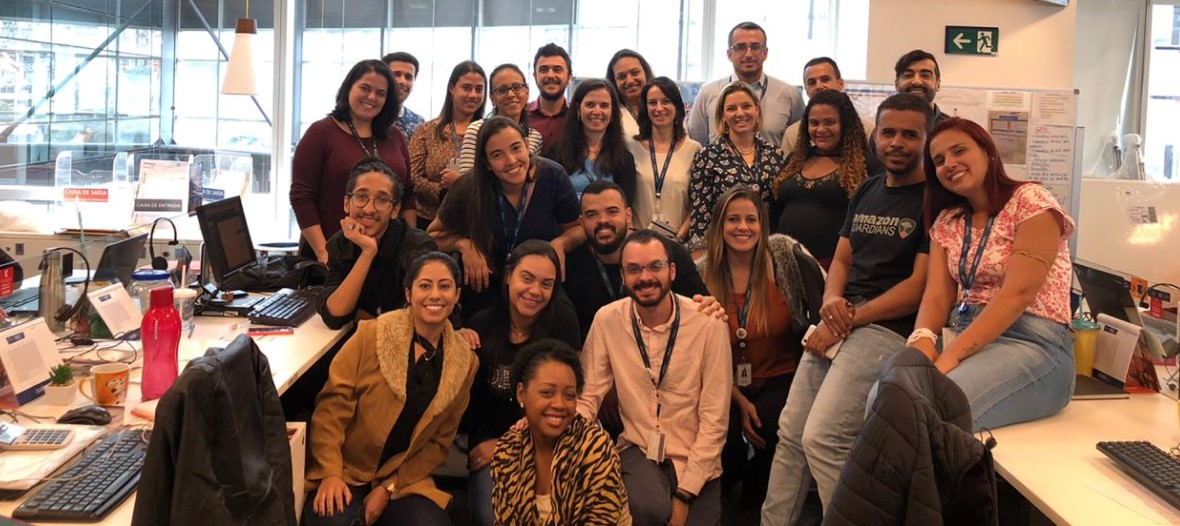
The success of the SME department continues to inspire other people at SulAmérica to adopt similar measures and approaches. In the area where I work now (which handles customer complaints and changes to policy records, as well as insurance products for professional associations or unions), for example, we are focused on daily management. However, I ran into a common pitfall of lean implementations here: the dreaded copy-and-paste approach, with managers simply adopting good practices they had already seen elsewhere and putting them into their processes.
We quickly realized that we needed to involve the teams in daily management. To engage them in this practice, we turned it into a game: tasks became missions, with different teams receiving a superhero costume they could wear while tracking the progress of their activities. Our goal is to handle today 97% of the requests that arrived the day before. To do that, we need to reduce delays as much as possible, which means understanding our capacity and our workload – daily management is a powerful tool in this respect. By using it, we ensure that help reaches the people who need it and that the right number of people is assigned to each step of the process.







