

Why lean marketing is the future
Covid-19 has brought the global economy closer to the VUCA scenario (volatility, uncertainty, complexity, ambiguity) than it had been in decades. In today's market, change is continuous and competition is fierce. We are experiencing, albeit in different circumstances, the same dynamics Japan went through after World War II. That crisis in Japan was one of the elements that led to the development of Toyota's unique approach to management, which in turn led to lean thinking. Indeed, crises have always been fertile ground for change and innovation. With this in mind, it is hard to imagine a lean organization that is not interested in deepening its transformation in the current scenario of uncertainty and unsustainable costs.
In just a few weeks, companies were faced with a choice – to be the predator or the prey. The direction a business takes depends on two elements: 1) management's ability to change and adapt the business strategy, revolutionize methods and processes and keep to the company's True North, and 2) resilience and the effort to create new market opportunities quickly and cheaply.
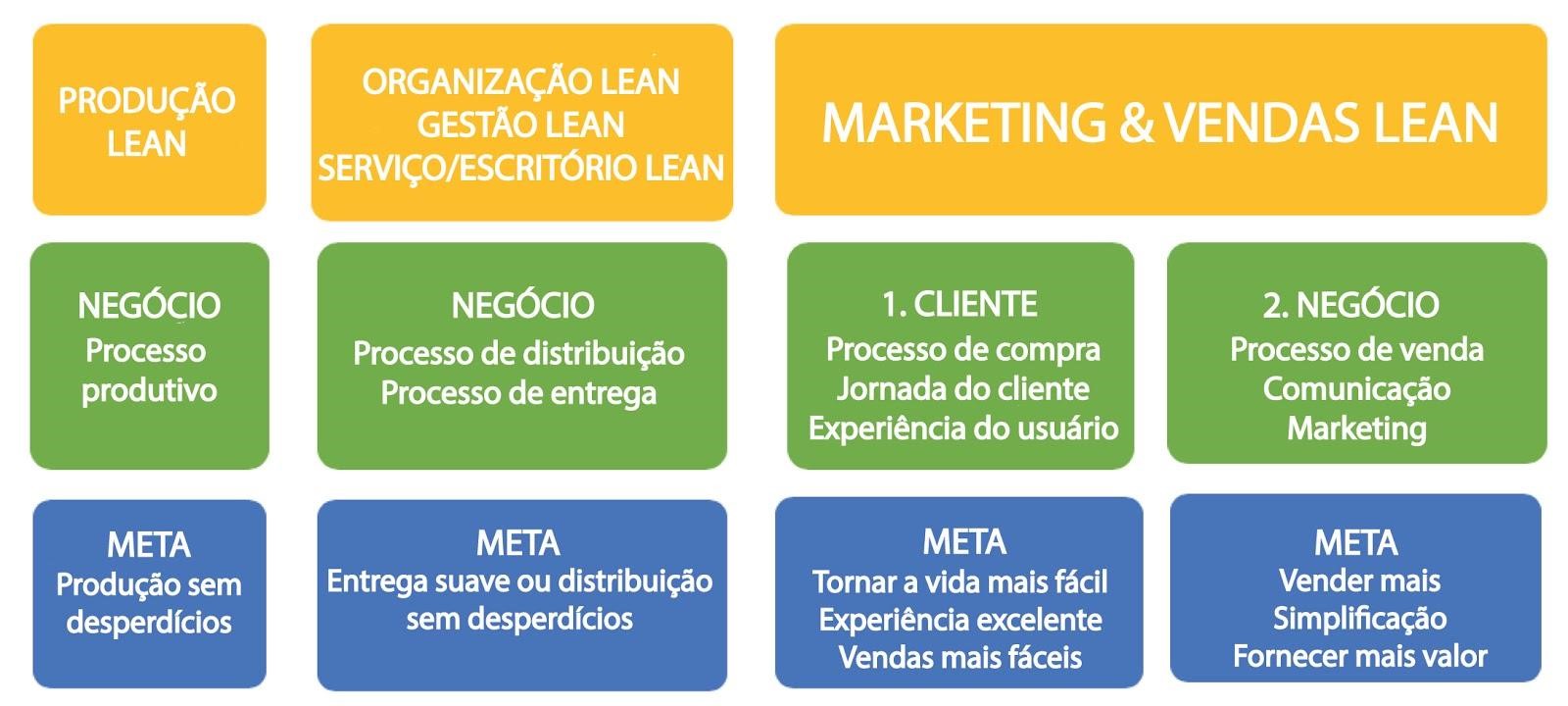
The role of marketing is to help organizations adapt their decisions and actions to the constant changes taking place in the market. However, marketing needs a redefinition of its own to truly help companies grow stronger and thrive in situations of extreme instability. A lean approach to sales and marketing allows organizations to shake up the competitive landscape, reinventing themselves in a very short time and taking full advantage of the opportunities offered to them by digital technology. Lean represents a revolution in marketing, its very own “new deal”.
BEYOND MODERN MARKETING
Lean marketing represents the next step in the evolution of modern marketing, pursuing excellence at low cost – “doing more with less”. Applying it means drastically reducing time and cost, optimizing the use of resources and eliminating waste in all its forms, focusing on increasing the company's ability to respond quickly to market developments and on creating value for customers all the time.
John Wanamaker, considered a pioneer in marketing, once said: “Half the money I spend on advertising is wasted; the trouble is I don't know which half”. This is no longer true (at least not necessarily): innovative digital tools now allow companies to use their resources much more efficiently and effectively than before – no wonder these tactics, capable of targeting specific demographics, are called “precision marketing”. However, waste is still enormous in marketing.
In the context of strategic marketing (which ends up contributing to a company's positioning in its industry), rather than just operational marketing, waste can refer to a number of issues or inadequate practices:
- Long, fruitless communication campaigns.
- Ineffective, poorly planned marketing strategies.
- Lack of specific, appropriate KPIs.
- Delays in responding to customer inquiries.
- Prices that are not aligned with the market.
- Lack of understanding of the customer journey.
- A sales takt time that is not aligned with demand.
- Dissatisfied customers.
- Incorrect allocation of marketing resources and budget.
- Frequent communication errors.
- Incorrect positioning of a product in the market.
- Sales strategies that were planned long before they were executed.
- A terrible customer experience before and after the sale.
Lean marketing helps us identify and solve these shortcomings, thereby increasing a company's performance. A lean marketing model maximizes value for customers while using the smallest possible amount of resources, anticipating and trying to meet price and quality expectations, improving sales and, most importantly, putting people at the center of the work.
This approach involves analyzing and optimizing marketing processes and workflow, first analyzing two main elements: the customer journey and the customer experience (CX, or user experience, UX). From operational marketing to new product development, from lead generation to customer inquiries, from information management to order management, lean marketing encourages us to rethink our entire modus operandi with the goal of offering customers what they want as quickly as possible, at the right price and involving all stakeholders in the value chain. A better customer experience contributes to loyal customers, reducing retention costs and eliminating churn. This, in turn, encourages positive conversations about the brand and turns customers into ambassadors. Ultimately, it improves KPIs.
The beauty of lean marketing is that it is completely adaptable to any context, from private companies to public settings (such as government agencies or healthcare services). In that case, the citizen or the patient becomes the customer.
CUSTOMER FOCUS
The focus of lean marketing is not on internal processes (which remain important for providing customers with the product or service they want, at the cost and when they want it), but on external processes – such as delivery, sales, communication and after-sales. In lean marketing, we start with an analysis of how the customer buys and consumes the product (looking at the customer journey, the user experience and the waste present in them). Only then do we figure out the best way to enable the best customer experience in our internal processes and start thinking about digitizing and further innovating that experience. At every “touchpoint” there is an exchange of information, data and sensations, and it is important to analyze them always keeping value for the customer in mind (this may mean offering specific training to salespeople or analyzing customer behavior through observation in the store, in person or online, using the main maps).
It is important to point out, however, that seeing waste, problems and inefficiency in marketing is harder than, for example, in a factory. They are intangible, unlike a defective part. Despite this clear difference, however, the use of lean in marketing is remarkably similar to its use in a factory: it starts with an initial check-up and the drawing of a sales value stream map (the customer journey), followed by the identification of KPIs (orders, sales, improvement ideas, kaizens, financial results, etc.) and the work to improve them. Finally, the results are sustained and improved by diligently tracking the indicators and applying PDCA.
Here is an example of inefficiency in the world of marketing: imagine a customer contacting a company through one of its distribution channels (store, online store, event, etc.). The products and services are displayed to allow her to make her choice – all value-added activities that make the customer aware of the company's offering. Now imagine the customer requesting a quote and waiting a week to receive it. After that, the customer will evaluate the offer for a few more days before finally placing the order – which will take another week to be processed. From that moment on, another week is needed for the product to be delivered to the customer. In this way, almost a month has passed from the moment the customer made contact to the moment she received her product. Waiting is a source of stress for customers, and nowadays most people do not tolerate such a long and complicated process. But why did it take so long? Because of the waste hidden in the company's marketing and sales processes. This is the kind of thing we need to solve with our lean marketing efforts.
THE 5Ps OF LEAN MARKETING
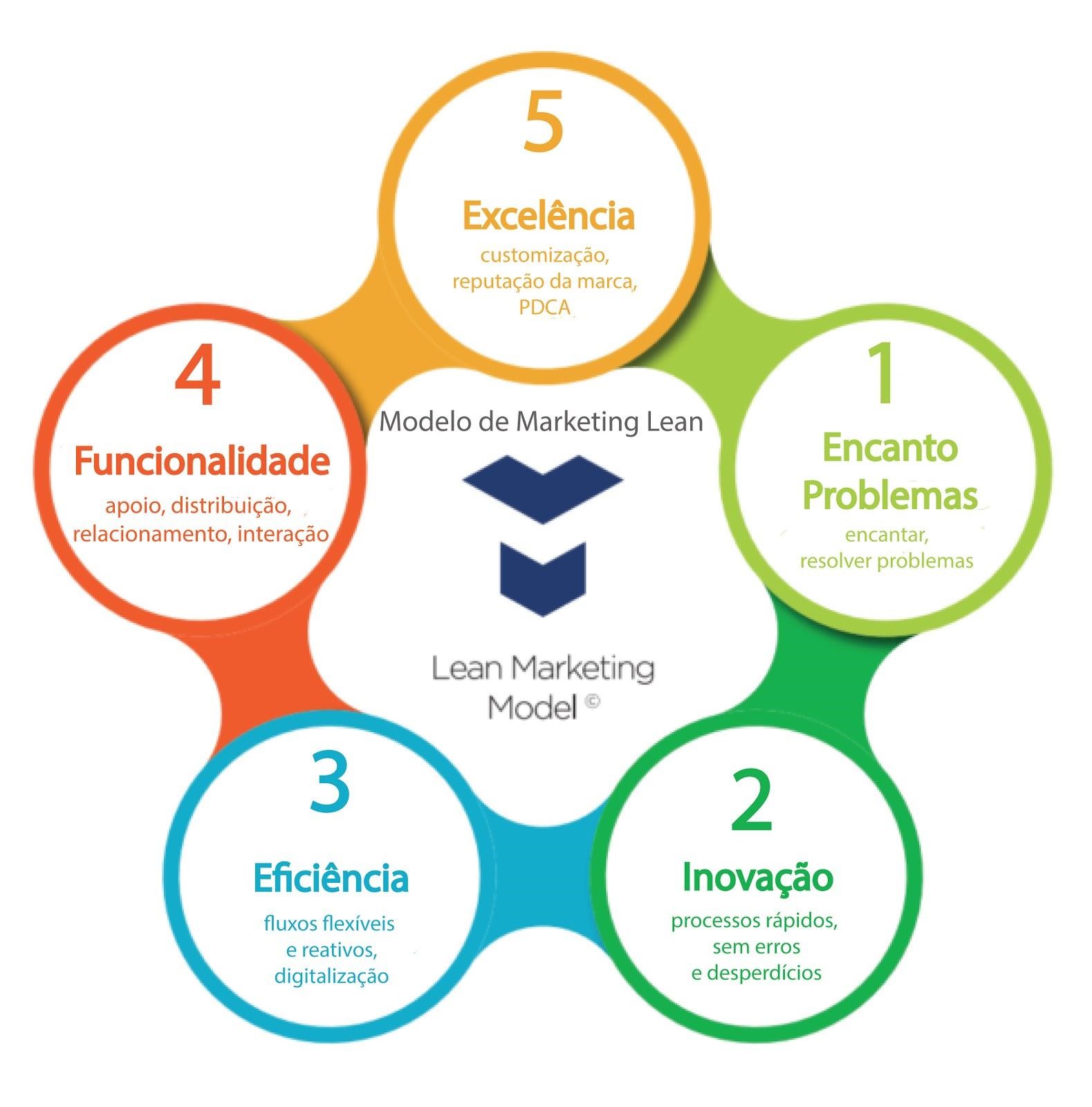
Lean marketing goes beyond the 4Ps of Kotler's marketing model, adding a fifth P – which stands for Problem. I believe this is lean's great contribution to marketing.
The 5Ps correspond to the five objectives that all innovative companies (or global disruptors) need to achieve.
- Problem. This is a strategic P that aims to add value by solving a customer's problem or meeting their needs.
- Process and price. This P encourages us to look at our internal processes from the customer's point of view, which also means actively listening when defining the product's price.
- Promotion and distribution. In this phase, we focus on ensuring that the product (or value) flows uninterruptedly and quickly to the customer, where and when they want it.
- Product augmented, which facilitates interaction between the business and the customer after the sale, giving the company control over the product thanks to digital tools (such as the updates sent to smartphones).
Personalization. This means transforming the most complex and potentially frustrating customer experiences into pleasant moments, bringing the company one step closer to excellence.
| 5P – LEAN MARKETING | ADVANTAGES | LEAN THINKING | GLOBAL DISRUPTOR |
|---|---|---|---|
| 1. PROBLEM/ DELIGHT | Create value and usefulness and delight customers by solving their problems. | 1. Value – Creating value is solving problems. | Be useful Demonstrate the product's real usefulness, beyond promotions and “what sells.” |
| 2. PROCESS/ PRICE | Don't waste the customer's time. Reduce errors and waste at lower cost. | 2. Mapping – Visually represent the flow, reducing errors and waste. | Simplify Identify and eliminate the weak points of the customer journey. |
| 3. PROMOTION/ DISTRIBUTION | Deliver the essentials digitally and faster at a fair price. | 3. Flow – Let value flow without interruptions. | Save the customer's time Provide service when and where people need it; show respect for their time. |
| 4. AUGMENTED PRODUCT | Distribute value and products where and when customers want them. | 4. Pull – Internal processes triggered by the customer's order. | Empower people Give customers more control, even if that means deviating from industry standards. |
| 5. PERSONALIZATION / EXCELLENCE | Unique, personal and memorable experiences that enhance the brand's reputation. Promotion. | 5. Perfection – PDCA. | Reimagine experiences Transform customers' worst experiences into experiences |
In addition, it is important to remember that a lean marketing strategy is based on two main elements: reducing waste and adding value for the customer. To help you build your marketing strategy quickly and easily, in an A3 format, I created a tool called the “Lean Marketing Canvas”. I will say more about it in a future article.







