

Standardized work in construction: bringing in contractors and getting results with lean
In the highly competitive construction industry, making management improvements that can generate significant productivity gains can become a major differentiator in the market.
These concerns have always been present in the daily life of Construtora Habiarte, a company that has been active in the real estate market for 35 years, developing high-end projects in Ribeirão Preto (SP).
In this context, the company adopted several lean practices, among them a fundamental element of this system, standardized work (SW), as a way to increase productivity on its job sites.
Standardized work is a fundamental element of lean that goes far beyond technical procedures. It is a lean practice that aims to define precise procedures for the work that must take place in a given production process. In the original concept, it is based on three elements: the “takt time”, which is the rate at which products and services must be delivered to meet customer demand; the work sequence in which an operator performs his or her tasks within the takt time; and the “standard inventory”, including the items in the machines, required to keep the process running smoothly.
In the context of construction, standardized work defines the best sequence of worker movements, the most suitable logistics, and the positioning of inventory and equipment at the work location to ensure the previously defined pace. This can bring large productivity gains, as well as making it easier to control the execution of the work, providing standards for implementing improvements.
Some basic conditions need to be met for standardized work to be effective, such as:
- Planning the job in flow. In macro planning, continuous flow must be implemented in the activities. In other words, plan for one trade, when it leaves a floor, to be immediately followed by another.
- Ensuring basic stability. This is an essential lean concept and is at the base of the system. For it to occur, there must be good availability of materials, machines, labor and a defined execution method (4M) (in construction, we can also include in the method issues related to designs, quality requirements and safety).
Some examples of tools that can help ensure basic stability are 5S in the warehouse and on the job site, the Last Planner System (a lean-based framework used to plan and control construction projects), and visual management for managing design development and for the procurement department.
These practices were implemented at the construction company in order to achieve the stability needed for SW to be developed. The company then established some steps for defining and implementing SW in the main trades (A Items) of the ABC Curve.
Defining the work sequence
The first step taken was to define the execution sequence, day by day, based on the “pace” of each trade. In lean management this “pace” is called “takt time” and must be defined in the macro planning of the job.
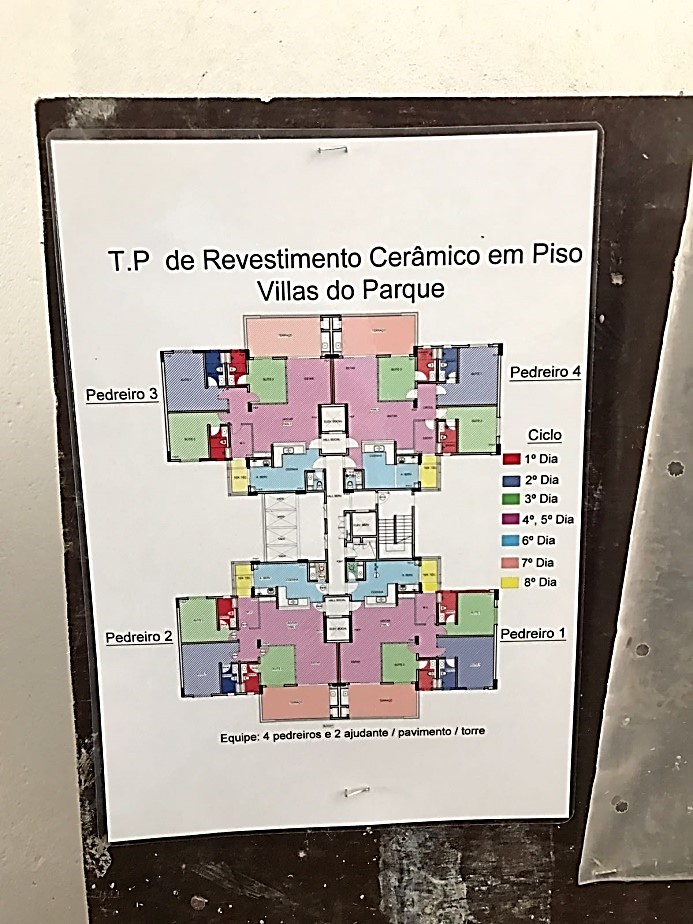
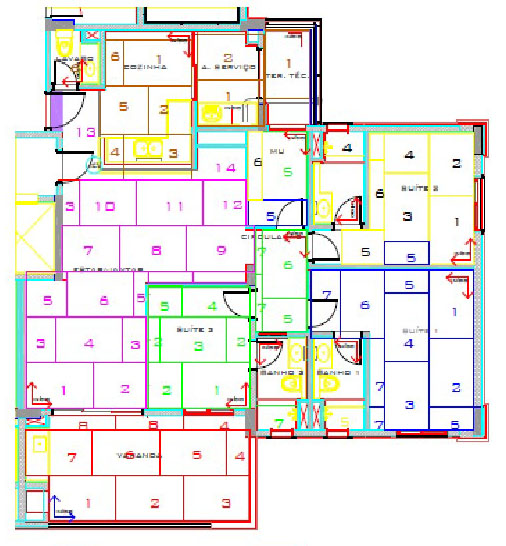
For example, for ceramic floor installation on one of the company's projects, the takt time was eight days. To meet this takt time, considering productivity per mason, the team was sized with four masons and two helpers per floor, with each mason responsible for one apartment (figure 1).
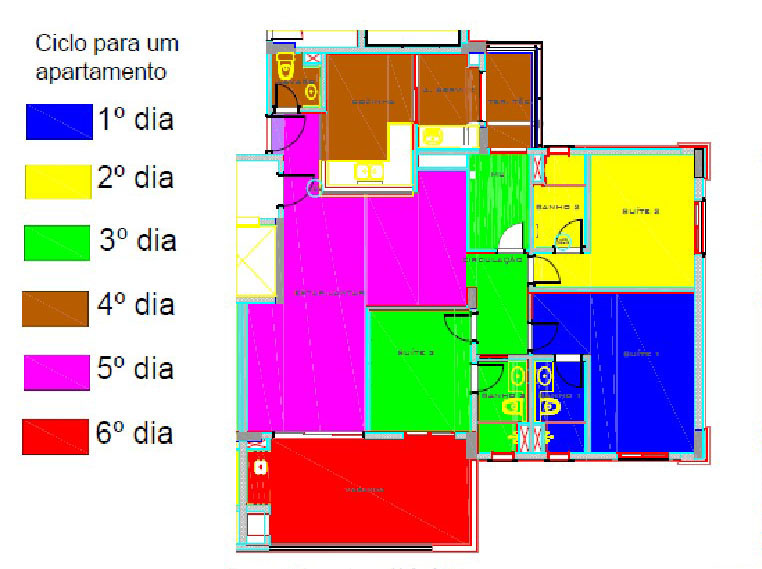
For each apartment, the best sequence was defined so that the team could progress with the best possible productivity. Thus, it was planned that the work would start in the bathrooms and then continue to the other areas, according to the colors shown in figure 1.
Visual management is also an essential element for communicating information quickly. In this case, the execution sequence was displayed on the job site floor in a format typical of lean visual management, so that the execution team could monitor and quickly identify any deviations that might occur (figure 1).
Logistics and placement of inventory on the floor
The placement of materials and equipment on the floors, following lean logistics concepts and practices, was also an important action taken by the company to mitigate motion and transportation waste.
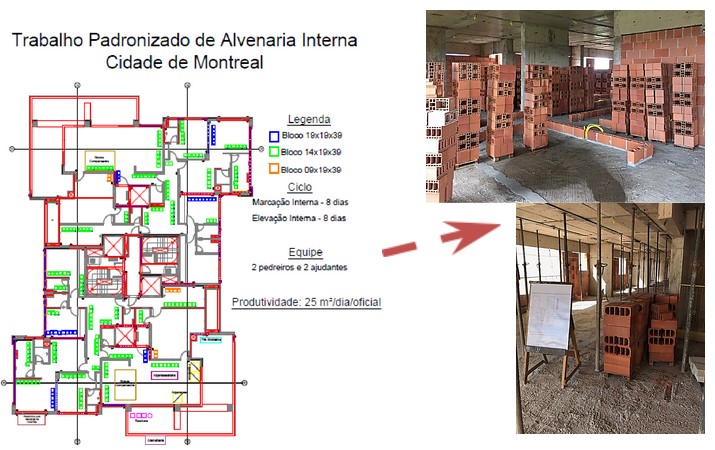
For the masonry work on one of the projects, a floor layout was prepared with defined positions for three types of blocks (figure 2).
The pallets were distributed according to the plan, and this was later modified according to the masons' suggestions, so that the layout would be in the best possible form to make the work easier.
In this sense, following this lean logistics, the block suppliers also began delivering the pieces on pallets already in accordance with the inventory placement plan.
More than that, the supplier began organizing the blocks on the trucks in advance, according to the layout plan that had been prepared, considering that the last pallets on the floor (the first to be distributed) would be at the top of the truck, aligning loading and unloading with the needs of the job, represented by the layout.
Controlling and improving the execution of the work
Control of the work was designed so that the field workers themselves could make the records. This generates immediate visibility for everyone: the team involved in the work, the engineer, the foreman and the interns.
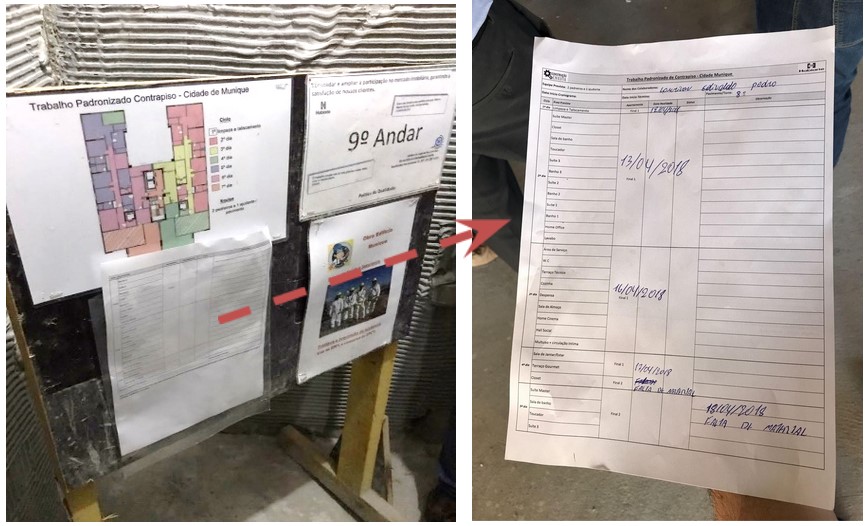
For each production team, a visual management board was set up on a mobile easel (figure 3). Thus, the team took its easel to each floor where it was carrying out the work.
Every day, the team leader filled in a spreadsheet and put it back on the board attached to the easels. By filling in this spreadsheet, the workers were able to monitor whether or not the work was behind the planned cycle time. At the end of the day, the intern collected and analyzed the data. The main problems were then discussed internally, with the aim of identifying the causes and planning improvement actions.
Involving the subcontractors
In all the steps mentioned above, the subcontractors took part, both in preparing the planning and in problem solving. For example: in the drywall installation on one of the projects (figure 4), it was noticed that there was a high level of material waste and, consequently, higher cost.
The subcontractor then saw the opportunity to improve this process, since his contract included both labor and material. So he drew up a detailed cutting plan in order to make the most of the cut pieces of drywall, generating a more detailed version of standardized work that indicated the cutting and installation sequence of each board (figure 5).
This initiative helped reduce material and disposal costs, also reducing motion and transportation waste. This example and many others show that it is entirely feasible to bring subcontractors into lean efforts to apply standardized work and improve the work.
Results
With the adoption of lean concepts and practices, the results obtained were surprising.
The trades in which standardized work was implemented recorded productivity increases of between 15% and 30%.
In addition, cost and schedule deviations that used to occur were completely eliminated after the implementation of lean concepts and practices, even resulting in earlier project completion and cost improvements, coming in, on average, 6% below budget.
Another important gain was the consolidation of standardized work as part of the company's culture. Today, 30 days before the work begins, on every project, the company prepares the standardized work following the steps described above, involving the job site team and subcontractors and ensuring that productivity gains continue and keep growing.
Habiarte found in lean ways to leverage productivity in pursuit of operational excellence across the whole company. In addition to these applications on job sites, lean has been used in other areas of the company, such as design, budgeting, procurement and technical assistance. Most important is the awareness that the transformation journey already brings countless results, but still has a long path of development ahead.
Does each team work its own way, and your job site loses efficiency? With lean construction, standardized work ensures quality, predictability and productivity at every stage of the job site. Turn scattered processes into consistent results. Talk to our consulting team and raise the standard of your project.







