

Lean in Internal Supply Logistics: A Case in the Pharmaceutical Industry

Every company seeks to grow. However, a growing market share brings the challenge of sustaining increased production with existing equipment. A large company in the pharmaceutical sector recently faced this challenge and turned to the lean philosophy to overcome it and expand its production capacity, which depended on increasing the efficiency of delivering a wide variety of materials and inputs correctly and at the right time to certain points of production with limited space. In other words, the degree of logistical difficulty would soon increase.
The situation presented itself as a characteristic problem of making the well-known Seven Rights of internal supply logistics feasible: delivering the right material, to the right place, at the right time, at the right cost, with the right quality, in the right quantity and to the right person.
In addition, the challenge incorporated several restrictions imposed by international and national legislation on the occupation of spaces and the handling of materials and inputs inside the production and storage area, typical of a pharmaceutical industry with high quality standards.
An initial approach by the managers pointed to investments in logistics automation, with negative impacts on profitability and requiring, in practice, a large-scale refit of the plant. The company's experience in applying lean in production paved the way for seeking a simpler solution by deepening its knowledge of the philosophy, now in a more specific application directed at the internal logistics problem.
The concept of lean logistics was applied according to the situational need of the problem and its diagnosis. It involved the practice of internal just-in-time through the internal milk-run tool. The implementation steps took place with strong interaction among internal teams, leading to the construction of an implementation roadmap whose completion achieved the expected results and added the lean concept to the traditional seven rights: logistics service and execution with the right-sized method and tool, summarized in the expression Right Size Tool, an element that James Womack already presented in his writings in the 1990s in the book “Lean Thinking”.
Milk-run
The milk-run allows deliveries to the right points to be controlled and carried out at regular intervals, working as a virtual conveyor that takes the necessary material to each point of use at the pace of the takt-time. No material is delivered beyond what is needed, only what is demanded in short production cycles, of one hour, for example.
Understanding the problem
In 2017, the company needed to pursue operational excellence to deal with the growth problem it was facing, but without resorting to large investments and without hampering the ramp-up with interruptions for changes. A typical challenge to be addressed with the lean approach: doing more with few resources, respecting people and considering their knowledge.
The first step was to create a value stream map, which revealed the root cause of the capacity increase problem: the lack of connections between flows. There was a mindset of pushing batches between operations through logistics deliveries of materials and inputs in large containers, which worsened the situation as space and time were taken up by large movements.

Figure 1: Current State Map
Value Stream Mapping
A simple diagram of all the steps involved in the material and information flows,
needed to serve customers, from order to delivery.
Next, a deployment of actions was drawn up based on the diagnosis and considering the true north that the company had established for its growth, in addition to profitability targets. Managers and leaders met and prepared a set of three child A3s for the logistics parent A3.
A3
A practice pioneered by Toyota in which the problem, the analysis, the corrective actions and the action plan are written on a single sheet of paper (A3 size), usually using graphs and figures. At Toyota, A3 reports evolved into a standard method for problem solving, status reporting and planning exercises, such as value stream mapping. A3 is the international term for a sheet of paper 297 millimeters wide and 420 millimeters long.
This set of reports and the practices intrinsic to their development led the company to plan its steps for solving its problems more accurately and, subsequently, to deploy them using the concept of hoshin kanri. The internal supply A3 had the role of being the start of the transformation and connecting the outbound and inbound flows based on the continuous flow of production that needed to be served.
Hoshin Kanri
A management process that aligns, both vertically and horizontally, a company's functions and activities with its strategic objectives. A specific plan is developed, usually annual, with precise objectives, actions, deadlines, responsibilities and indicators.
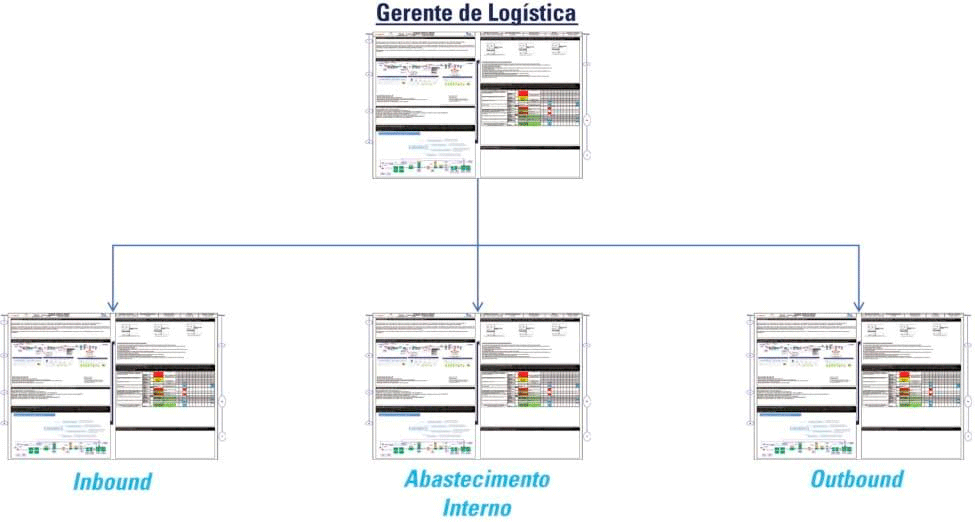
Figure 2: Set of A3s in the logistics operation
The main objectives established were to increase capacity by 30% over the course of 2018, ensuring increased demand and growth without large investments, and to reduce material inventory by 20%.
Reviewing the concepts of Lean Internal Logistics
First, the concept of continuous flow is central to building internal logistics without waste and in compliance with standards. In logistics, this concept is realized in the practice of just-in-time, by delivering the necessary material only when it is needed. In internal supply, one of the tools for achieving this with a high degree of precision is the milk-run.
Combining this delivery concept with production demand makes it possible to build a network of flows. An analogy can be made with a river basin and its tributaries, with no damming and with continuous flow between its junctions. This route is covered by the milk-run, a continuous movement of a set of towed carts at regular intervals.
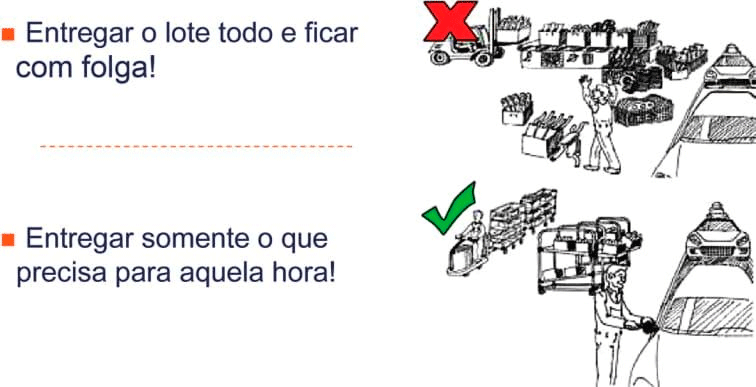
Figure 3: Change in basic thinking
The milk-run allows deliveries to the right points to be controlled and carried out at regular intervals, working as a virtual conveyor that takes the necessary material to each point of use at the pace of the takt-time. No material is delivered beyond what is needed, only what is demanded in short production cycles, of one hour, for example.
Delivery is carried out with the material handler's standardized work: the handler continuously travels a predefined route, with standardized stops for loading and unloading the carts, and planned movements and containers. Any delay or early arrival in the production and delivery cycle will be quickly noticed. It works as a poka-yoke of the flow, warning of any anomaly in relation to the plan. In this way, there are no surplus materials, which could potentially hide the failures that occurred. The goal is to achieve synchronization between deliveries and production.
Standardized work also extends to warehouse activities and to material movements in general. Packaging is predefined and storage addresses are established to speed up cart loading. The unloading points are also coupled with the standardized work of the operators of the automated machines, who know and follow the material supply schedule at regular intervals, supported by visual management that shows the day's production schedule, detailed hour by hour.
Everyone forms a synchronized team that knows exactly what will happen. And if any anomaly occurs, a delivery delay, for example, everyone quickly knows about it, and the help chain is triggered before there is any impact on production. The anomaly is studied and addressed so that it does not happen again. The root cause is investigated, and so the journey continues toward perfection in the seven rights.
Strict compliance with delivery times and quality is achieved as the standardized work of the whole team and its synchronization at the flow coupling points are improved, so that at a certain point in the implementation, the stability needed to include the pull system is reached, with scheduling guided by supermarket levels, which are also visible to the whole team on kanban boards.
Starting the lean transformation
The actions then began with connecting and synchronizing production with internal logistics, production line by production line, through the milk-run and the establishment of supermarkets inside the incoming and outgoing storerooms. Each milk-run route was designed to deliver all materials and inputs to each point of use of the equipment within a one-hour interval.
Thus, operators received the material on carts already ready to feed the machines, with no need to handle cardboard boxes. They received it in returnable containers with the exact quantity for hourly production. All the operator had to do was remove the standardized container from the cart and load the equipment's automated feeders. The logistics operator, in turn, took the loaded carts on the outbound trip, placing them at each stop and collecting the empty containers for the return trip. The routes were connected to the upstream supermarkets with the inbound of materials and to the downstream ones with the outbound of shipping.
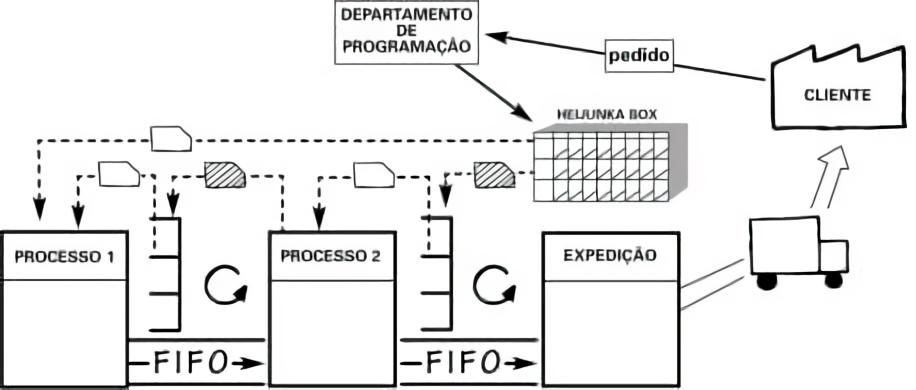
Figure 4: Continuous flow of materials and information
This implementation took place from May to October 2017 through a set of linked actions planned in the internal supply A3, carried out monthly in the form of on-the-job learning with deliverables established in the action plans for each stage:
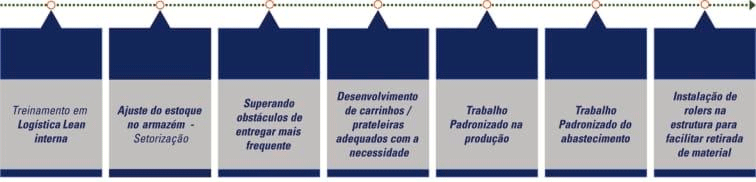
Figure 5: Action plan
In November 2017, the first internal milk-run route was properly coupled with the supermarkets set up in the storerooms and began running permanently after a growing series of experiments that gradually moved closer to the future state, as tests and controlled simulations were carried out from May 2017.
This was a distinctive implementation strategy in this pharmaceutical industry case, in which the novelty of applying lean in an environment of extreme regulation of changes required planning a series of successive tests and experiments. The first ones were carried out outside the production environment, in open spaces to visualize the future state, using approximate, inexpensive, low-fidelity materials. The goal was to establish the concept and level the understanding among the participants.
As these experiments and simulations built the understanding of those involved, the group gradually moved on to partial tests in the production environment. Initially with a test vehicle circulating along the proposed route, then followed by experimentation with packaging and cart prototypes, time studies and, finally, detailing the methods and movements together with production and logistics operators. Improvements were made test by test until the final solution was reached.
Results and Conclusion
At the beginning of 2018, the first results of the pilot milk-run route were followed by the implementation of the other supply routes, which were implemented more quickly thanks to the learning achieved.
In all of them, observation at the gemba showed reduced operator movement and greater control of the takt-time with planned schedules being met. The internal milk-run worked like a conveyor bringing the right materials to operators at the right pace.
Productivity increased by 22% with better use of operators in the 1-hour delivery intervals. Movement, for example, was reduced between the points of use and equipment feeding points, as can be seen in the spaghetti chart comparison.
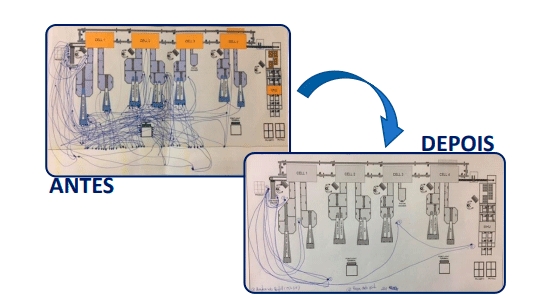
Figure 6: Comparison of spaghetti charts before and after implementation
On the other hand, the assurance achieved in having the right materials at the right time reduced production shortages, raising equipment OEE. Combined, higher productivity and improved equipment efficiency made it possible to meet the capacity increase without investments. In terms of inventory, a 30% reduction was achieved in production inventory, and there is still a goal of making progress on incoming inventory. A list of other results achieved can be seen below:
- 95% of material handling removed.
- 40% reduction in production order preparation time.
- 66% reduction in material transport.
- 97% reduction in production inventory.
- Zero ergonomic problems in production.
- 22% increase in productivity (2 operators per shift).
Finally, the case enabled methodological learning in applying lean logistics in an environment whose operating practices and validation of changes are strictly regulated, as is the case in the pharmaceutical industry. On the one hand, the practice of gradual experimentation until the future state was understood allowed the transfer of the experiment to the definitive environment to happen in a more secure way and with the confidence of all parties involved. On the other, establishing in these experiments the right degree of standardization in tools, carts and supply methods prompted reflection and the incorporation of the lesson of adding to the established seven rights of logistics an eighth element made possible by applying lean: the right tool and method.







