

Daily Management in Construction
Daily Management (DM) is the continuous process of ensuring that work is being done the right way and at the right time so that business success, as defined by the company’s strategy, can be achieved. It is the everyday follow-up of actions to check whether the expected results are being achieved and, if not, to ensure corrective actions are taken in time. The elements of Daily Management are:
- Visual management: in a visual and simple way, the necessary information must be passed on to everyone involved and must allow everyone to understand it. A simple board containing the main information is usually used to display goals, problems and actions taken.
- Teamwork for problem solving: It is necessary to create an environment in which hiding problems is neither acceptable nor possible. The right way to work, which lean thinking advocates, is exposing problems, solving them effectively and asking for help. Just displaying the numbers is not enough: Daily Management encourages (and, in fact, requires) teamwork and cooperation. The team must always engage in open discussions to understand the situation, do some analysis on the spot and decide which actions are needed in the case of a gap between current and expected performance.
- Help chain: In essence, the help chain turns the traditional organizational pyramid upside down, which allows the organization to move away from a command-and-control attitude and support a culture in which all the necessary support is given to the value-creating and problem-solving processes; in other words, it must be clear to everyone involved how problems should be escalated and how the actions to solve these problems are carried out.
- Leadership: Just attending the stand-up meetings is not enough. Leadership must be involved every step of the way. Leaders must be able to keep the meetings focused and all team members involved. Meeting routines create great opportunities to develop employees’ capabilities and change the way people deal with problems and work as a team.
The construction company and the project
The construction company Ápia has almost 60 years of experience in the market and works predominantly on infrastructure projects: paving, dams, drainage, railways, bridges and tunnels.
The pilot project chosen by the company was raising a tailings dam from elevation 229,60m to 245,00m. This project was basically divided into two work fronts:
- Materials processing: part of the material (coarse schist, fine schist and quartzite) used in the dam was screened and transported to the dam.
- Dam: the other work front was concentrated on the placement area for processed and unprocessed material (clay and filter).
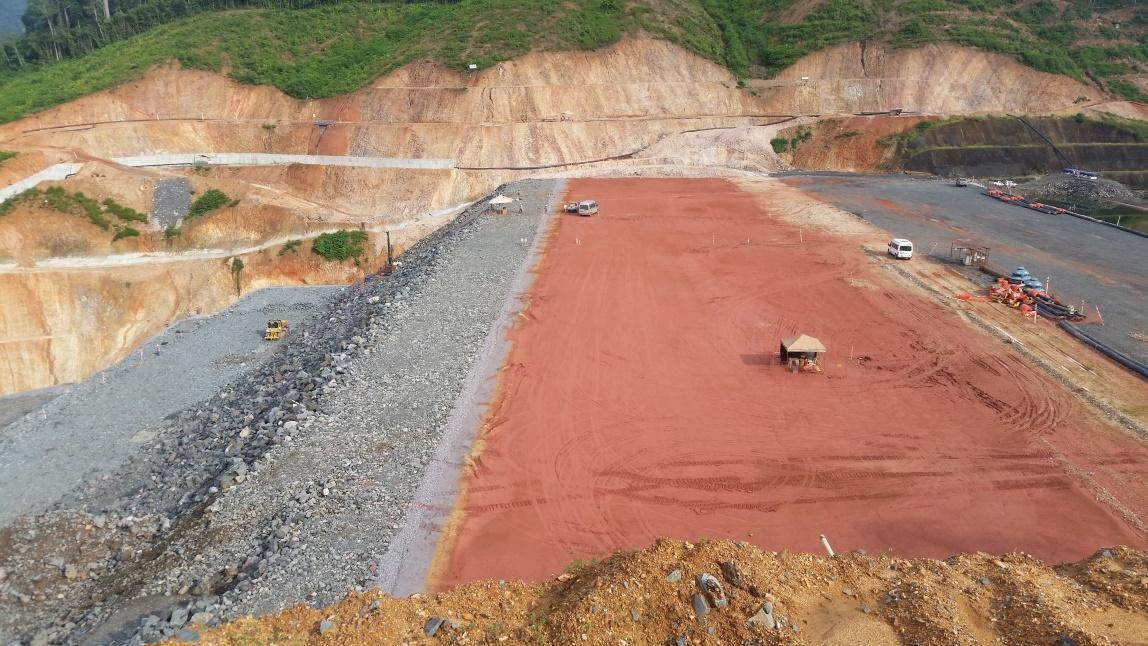
Figure 1: Dam being raised
It should be noted that carrying out this project involved the use of a lot of equipment, but the most used resource was trucks; in other words, between rental, fuel, labor and maintenance, truck costs represented approximately 70% of the project cost.
Implementing Daily Management
The first step was to go to the field (gemba) to identify the main problems. The team went to the 2 work fronts (processing and dam). Based on what was seen in the field and on the data the company had already collected, it was found that the process was very unstable, that is, there was significant variation in daily production on both fronts.
As a practice to stabilize the production process, it was decided to implement DM. The implementation of DM in Construtora Ápia’s pilot project followed the main elements of Daily Management.
Visual management
The first step was to create a visual management board (first version) for the materials processing task.
Based on what was already customary and also in line with the language used in the field, the team decided to use “trips” as the unit of production measurement and to measure productivity as “trips/trucks”. Finally, they held a meeting with the supervisors of the materials processing task to explain the new practice, set times and decide who would attend the meeting.
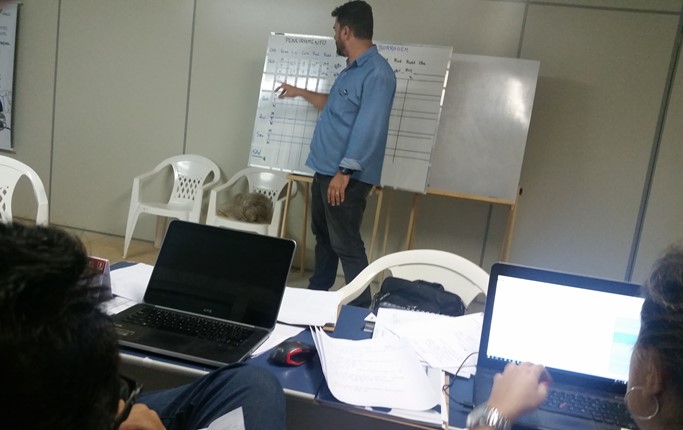
Figure 2: Meeting presenting the first version of the Daily Management board
After two weeks, the team had implemented and consolidated the daily meetings on the screening front. The supervisors showed resistance to the change at first. However, once the meeting routine was established, they realized its benefits. Daily Management was also incorporated into the dam task, with some adaptations to the board.
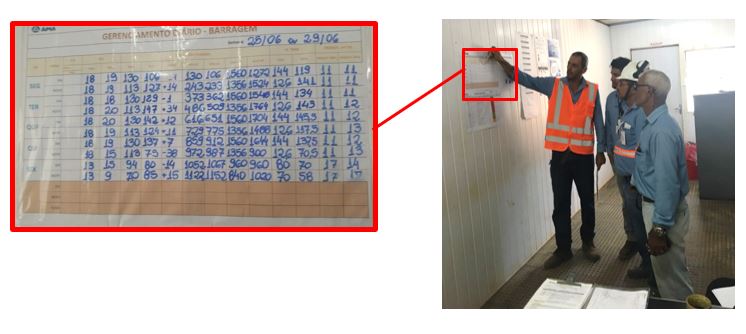
Figure 3: Daily meeting on the dam front
Visual management helped expose problems and, above all, helped with the practical understanding of the concepts of production and productivity. Before Daily Management, only production was controlled, that is, regardless of the number of trucks, the goal was always to reach the daily number of trips.
After the visual management board and the meeting routine were implemented, team members began to optimize the use of trucks, including several times a day to prevent trucks from queuing in the cycle when there was a change in the schedule.
It is important to note that the trucks were rented and paid by the hour; therefore, when queues occurred in a given cycle, this meant rental and diesel costs.
Teamwork for problem solving
Team involvement was a key factor in implementing Daily Management. Many problems were reported when the daily meeting routine was implemented. Simple problems were solved with immediate actions by the team, while larger problems needed further analysis with the engineering team.
During the first month, the team identified some recurring problems. The most recurrent problem for the materials screening process was instability in truck cycles. For the dam task, it was the number of trucks above plan. The constant change in the location from which processed material would be removed and transported to the dam caused production problems regarding the number of trucks and machines that would be used to carry out this task.
Some truck queues could be seen when walking through the field. Every day the client provided information shortly before the workday began or right after it started about which stockpile should be released for removing material to be transported to the dam. The change was due to the fact that a stockpile of processed material could only be released for transport once it was fully stocked, and the surveying team increased its volume.
The team then proposed as a countermeasure, after carefully analyzing the data, the creation of a spreadsheet that would map all possible scenarios and could absorb the daily changes made by the client. Therefore, all stockpiles and AHDs (average haul distance) were defined with data timed at the gemba.
The spreadsheet was distributed to all team members, which gave them more autonomy in the field and also better control of the correct number of trucks. A visual board was also created as a way of identifying daily where materials were being removed from.
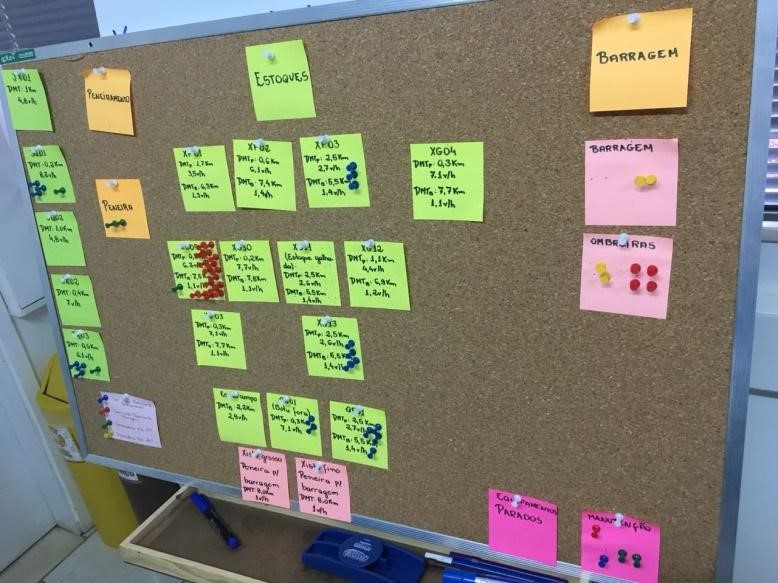
Figure 4: Visual control of stockpiles, trucks and machines
The help chain
The help chain worked informally, that is, actions were taken on some problems that came from the field, but there was no priority, control or follow-up of these actions. The contract manager and the planning engineer himself missed some of the field information more often.
Therefore, when the daily field meetings were already taking place as planned, the engineering team decided to hold a quick meeting (15 to 30 minutes) at 11:30 a.m., so that they could align field information daily, discussing, generating actions and monitoring them.
Some problems that were escalated from the field meeting to the engineering meeting came to be solved by immediate actions, while other actions required visual management for follow-up, so the team implemented a kanban board. In this way, a structured help chain with participation from the field and engineering was established:
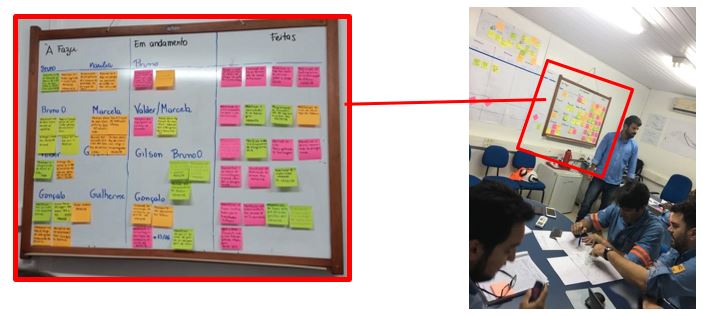
Figure 5: Daily Management in engineering using kanban
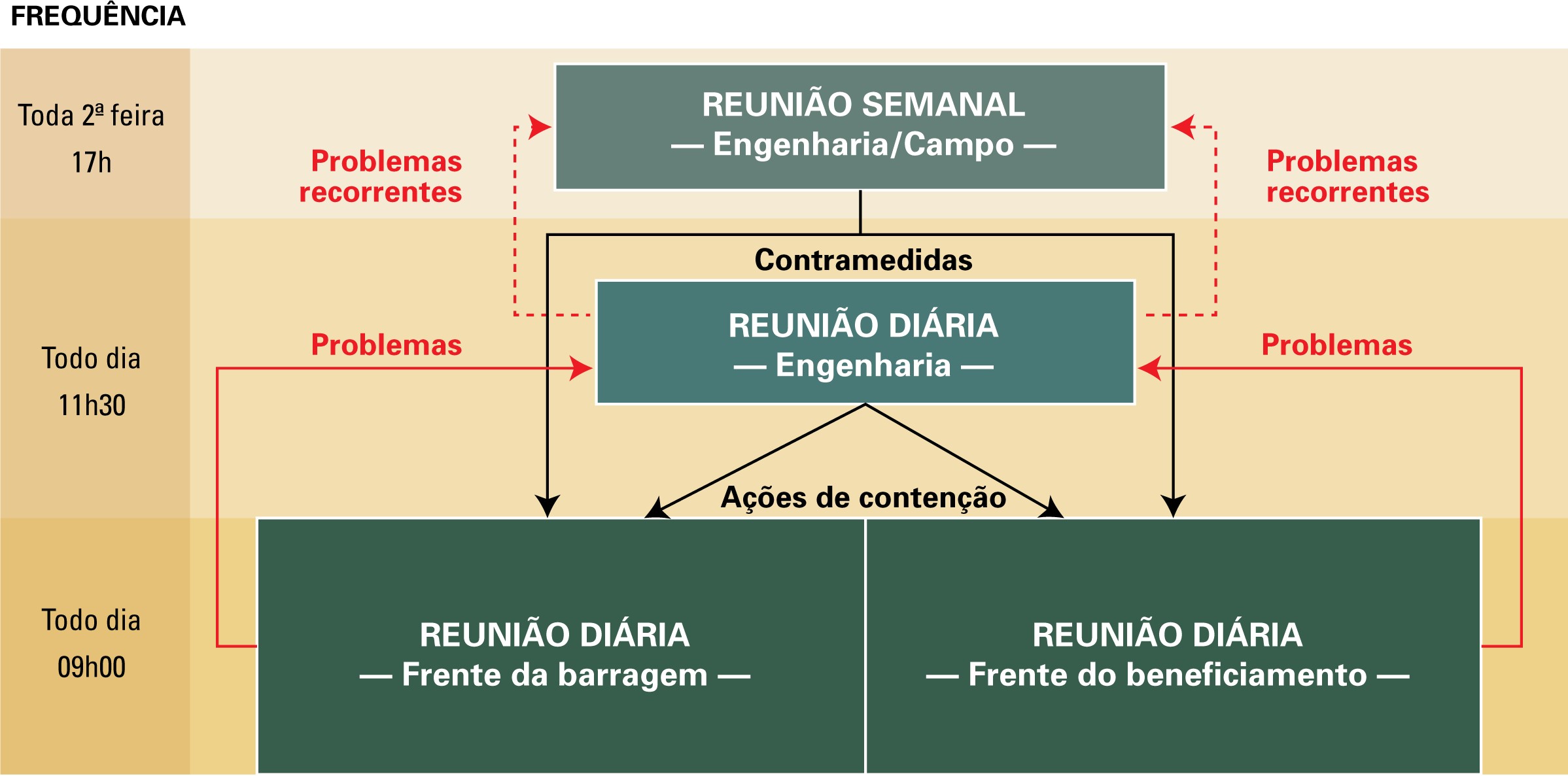
Figure 6: Help chain
Leadership
The role of leadership was fundamental in implementing Daily Management. The change in mindset of the engineering team was felt by the project team. The planning engineer and the project manager, who did not usually go to the gemba, began to go there more regularly, since a rotation of participation in the meetings (project manager, lean manager and planning engineer) was established. Therefore, at least 3 times a week, they attended the daily meeting in the field, in addition to attending the engineering meeting every day.
Over time, team members began to bring more problems and to participate more actively in the meetings. They reported the importance of the engineers’ presence and especially of the actions that were taken in the meetings with their help.
Overall results and next steps
After the project was completed, some data were collected, and the cost reduction became evident:
- Materials processing task – 4% cost reduction (R$ 486.000,00).
- Dam task – 7% cost reduction (R$ 535.500,00).
This result came mainly from reducing the planned number of trucks (representing 70% of the project cost) and from better use of the trucks that were available.
Transparency through visual management was also positive for the team. It made the data simple and easy for team members to control.
In addition, the project was completed within the planned schedule, and a change in behavior was noticed among managers and engineers, who began to focus not only on production but also on productivity. This concept helped them to always be aware of waste and daily problems.
Sustaining these practices daily helped the project stabilize its processes and also promote improvements. DM was considered a fundamental practice for the construction company, which will use the learning from this pilot project to expand this practice to other company projects.
Is the day-to-day of your construction site full of surprises, unproductive meetings and lack of alignment? With lean construction, we transform Daily Management into an agile, clear and results-oriented process. Improve communication, eliminate waste and deliver more value. Talk to our consulting team and learn more about our service.







