

Fertile ground for lean seeds
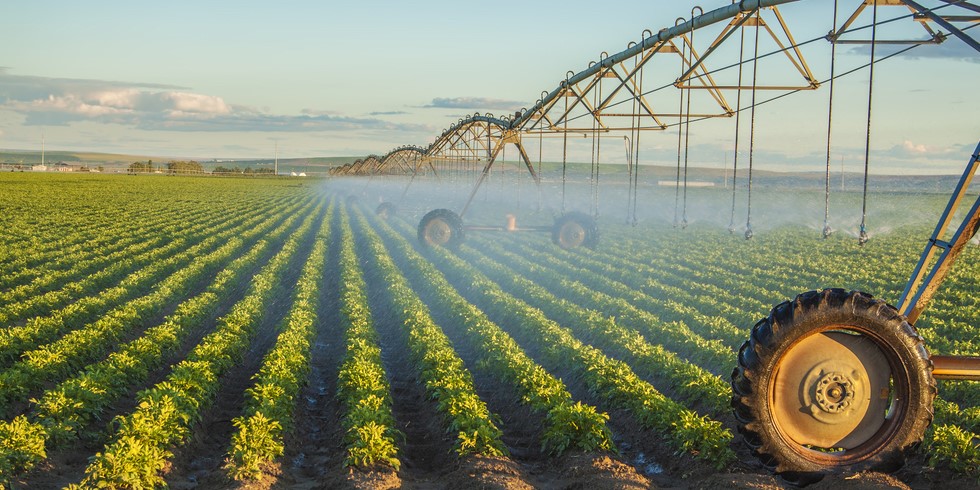
Every day at sunrise, rural workers across Brazil gather around a “capataz” (foreman) to find out what their work will be for the day. The work of these “peões” (farmhands) ranges from taking cattle to be vaccinated to planting seeds for the new crop to putting up a fence that allows a giant machine to maneuver.
The word “capataz” comes from the Latin caput (head). He – always he – is the person responsible for organizing and controlling the activities of a farm and representing the voice and authority of the owner (who usually does not live on the farm and therefore feels the need to hire someone to take care of day-to-day business). His role is to distribute the work by giving orders and telling people what to do. The workers – most with little education, often completely illiterate – follow instructions and do what is expected of them. For the foreman, loyalty to the owner prevails over competence and rationality: even with people who have received formal training, the management approach is still old-fashioned and lacks basic scientific principles.
It is in this environment that we at Lean Institute Brasil are starting our first lean experiments. We are bringing lean thinking to farms in the states of Mato Grosso and Mato Grosso do Sul. Both areas are considered centers of excellence for integrated soybean and corn crops and for cattle. The family-owned properties here range in size from 2,500 to 5,500 hectares of cultivated land and raise between 4,000 and 5,000 head of cattle.
In this article, we will share what we have learned so far about lean thinking applied to agriculture.
HOW TO START TRANSFORMING AN AGRIBUSINESS
In our first projects, we did not know where or how to start. We immediately noticed that the industry's tendency is to blame nature for every bad harvest – too much (or too little) rain, too many pests and other factors. Of course, nature plays a fundamental role in the performance of an agricultural business. However, there had to be more to it.
When we asked, for example, about machine availability, we could not get any answer. When we analyzed the cost structure and financial performance, we were able to gather very little reliable data. Although there are many publicly available indicators in the sector, they were not usually tracked on the farms we engaged with. Moreover, whenever we discussed what the problems, basic standards, needs or possible targets were, the answers we often got were “We don't know” or “We don't have that information”.
This reveals a lack of parameters for tracking business performance indicators and shows how primitive the management system in the agricultural sector is (the effort has been focused on technological advances rather than on improving management systems). Performance is assessed mainly in hindsight, after the production cycle has been completed. For example, to assess the efficiency of a crop, agribusinesses usually count the sacks produced. Likewise, success in cattle raising is determined after the animals are sold. There are ways to monitor the situation as it unfolds – for example, by checking the condition of the plants or how quickly the cattle are gaining weight –, but these actions are usually not taken in a structured way. That is why the gaps can be addressed.
Unfortunately, most business owners in the sector believe that there is nothing that can be done to control costs internally. Since agricultural prices are determined mainly by the international commodities market and vary according to many factors (mostly beyond the control of individual farmers), the prevailing mindset seems to be that “if nature helps, we will succeed”. Naturally, government subsidies play a role in sustaining the business in times of low profitability.
In a situation in which what happens on a given day or hour may be only loosely connected to the overall performance of the business, we set out to identify the best approach. Should we do an A3 to focus on the main problems? That sounded like a good idea, but defining the topic or problem to be solved was a nightmare. We even tried to define some vague problem or goal, but understanding scientific thinking and overcoming the lack of basic data proved a challenge for the participants in the exercise. Root cause analysis, goal setting, etc. simply seemed beyond their capabilities. We even tried a VSM exercise to identify systemic connections and problems in the flow, but it was also of little use. We did not give up.
IDENTIFYING AND UNDERSTANDING PRODUCTION CYCLES
We then decided to understand the work and the production cycles more deeply, in order to plan activities at a macro level and cascade them to define a weekly agenda and a daily management routine as a way to improve performance.
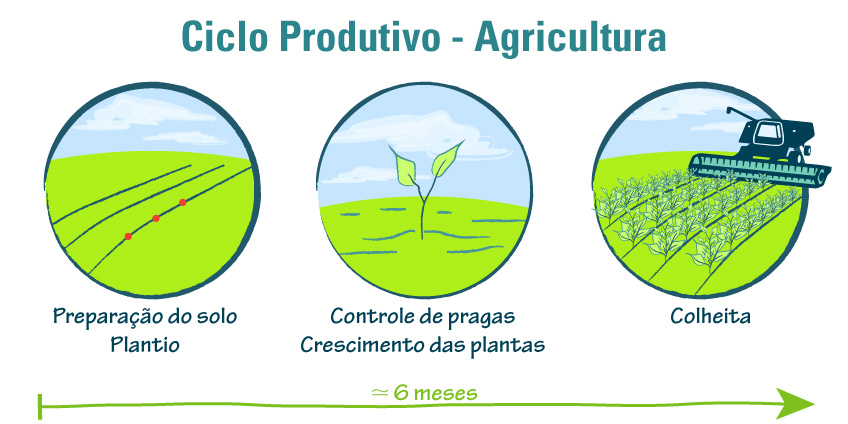
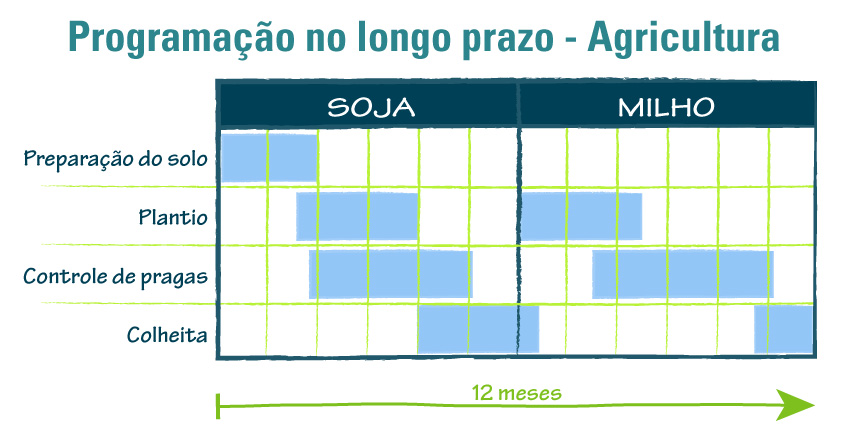
By production cycle, we mean the main steps of the production process. In crop farming, for example, they would be: soil preparation, sowing, pest control and harvesting. For soybeans and corn, this cycle takes about six months and takes place in the soil itself.
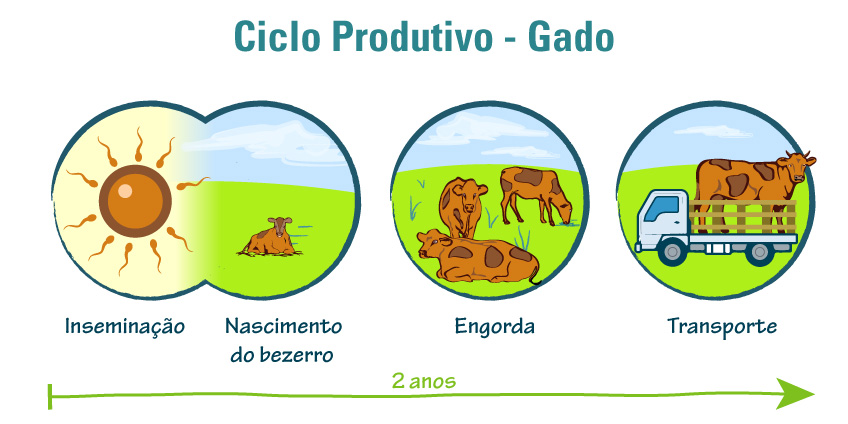
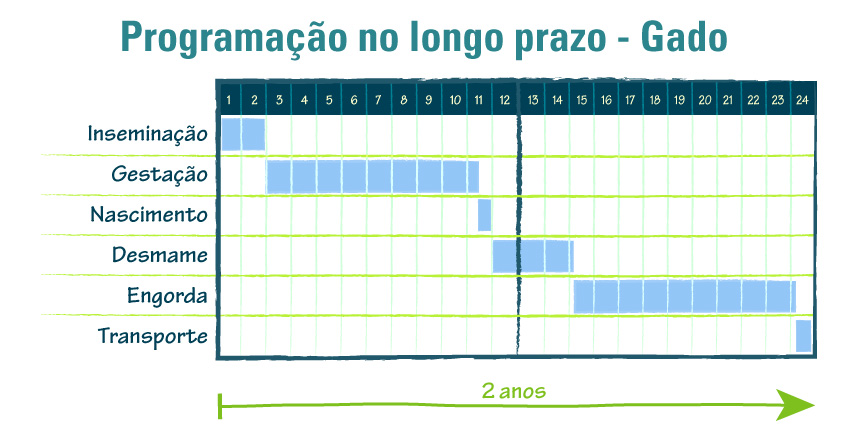
The cycle for cattle is very different, usually around two years, from insemination and the birth of the calf to fattening and transport to customers.
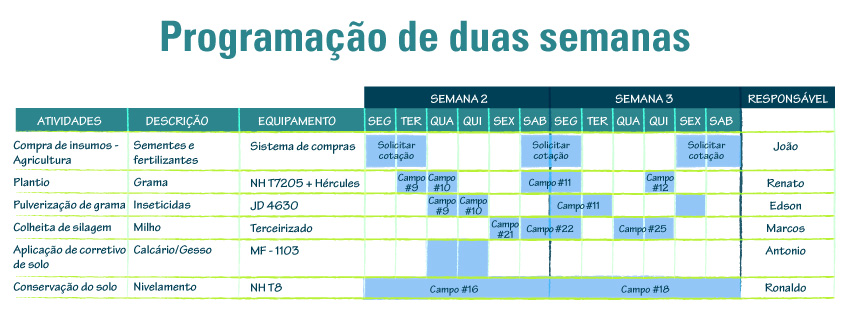
After that, we decided to focus on the work to be done over a two-week period and on the daily work (Monday to Saturday). We tried to enable the people who do today's work to better understand what the daily activities are and what the near future will bring.
To do this, we helped them break down the work and allocated the tasks to each individual on each day, based on the current stage of the production cycle.
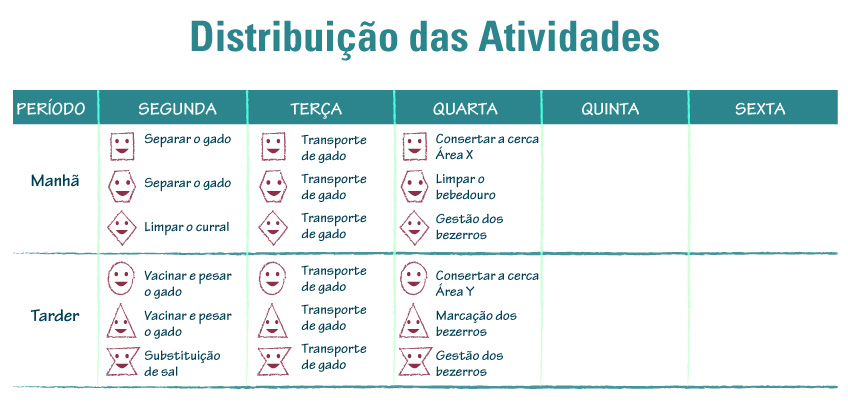
Let's take a look at the cattle activities, for example. On any given day, the teams will be divided according to the activities required.
This planning process was done visually on a board where the team started meeting every day before work began, usually between 5 and 6 a.m.
STARTING DAILY MANAGEMENT
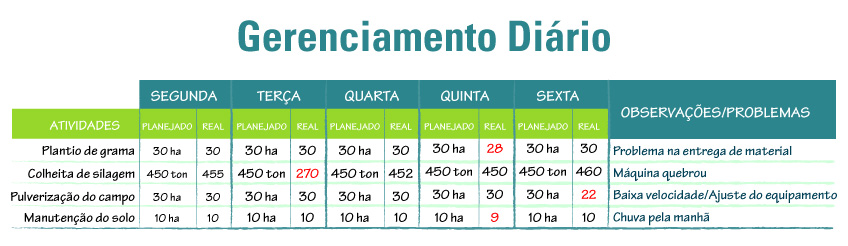
Defining daily activities allowed a more structured way of establishing the work to be done, which is now displayed visually and transparently to the whole team on a daily board. At first, each worker would be able to identify his or her activity (assigned by the supervisor) on the board, which explains the work to be done, highlights the challenges and so on.
To truly empower people, we suggested that the meeting take place with the whole team standing, with members taking turns at the board and reading aloud the task assigned to them. Naturally, this was not easy, as many proved very shy and reluctant to speak in public. Some of them had difficulty reading – literacy levels are low in the rural areas of Mato Grosso.
The initial difficulties were related to the lack of basic standards. Activities were generally very loosely defined, often without quantitative targets. For example, if the day's work was to plant seeds, there was no clarity about how much land would be used. To define some basic standards and job descriptions, we helped the team create simple videos.
As the first meetings started to happen, the first benefits emerged: workers began to feel more empowered and committed; leaders were able to make adjustments during the day; activities could be shuffled throughout the week to compensate for the interference of weather conditions with the daily work. By bringing objectivity to the definition of the work and clarity about who does what, the daily management board increased teamwork and reduced the workers' dependence on the foreman/supervisor. The board is now running the program and defining what needs to be done.
It was hard to get them to use the board to highlight the “reds” – instances in which the expected results were not achieved –, as they did not see the need to reveal and flag problems in order to correct them.
Over time, the daily meetings evolved to incorporate machines (and not just activities) – a key resource in this business –, and new visual boards and even A3s were created. One of them, for example, focused on planning machine utilization.
Daily Management provided many additional benefits to the agribusinesses we worked with. For example, during the harvest, identifying the expected daily results and comparing them with the actual results made it possible to create opportunities to intervene in machinery operations, such as harvesting, husking, etc. Because the harvesting process was outsourced (paid per hectare), there was no incentive to be effective and improve the volume produced per hectare – a crucial indicator on a farm.
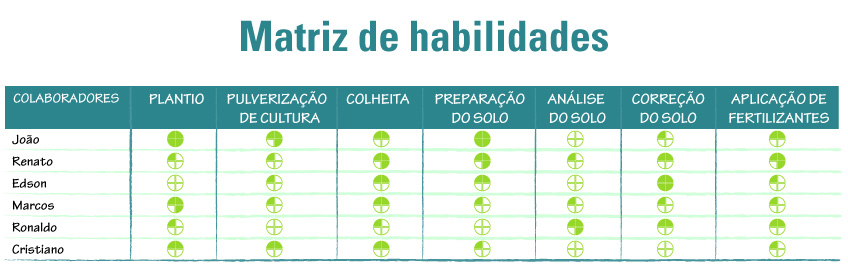
We also helped the team create a skills matrix, which is used to identify who is qualified to do the work. This tool is very useful when adjustments to the distribution of work are needed.
THE NEXT STEP: AN OBEYA
As the companies progressed in their lean journey, they began to focus on other elements of the work – machines, people, raw materials, etc. –, which required a more elaborate and complete way of setting and monitoring targets: an Obeya.
The first obeyas created featured the following elements: a definition of purpose (“Feed the world”), a two-year schedule, current crop activities (from start to finish), a layout of the land divided into plots, planning and scheduling of machine and equipment utilization, a schedule for fixing roads and fences, the definition of basic work standards, a work skills matrix and the A3s developed by the teams.
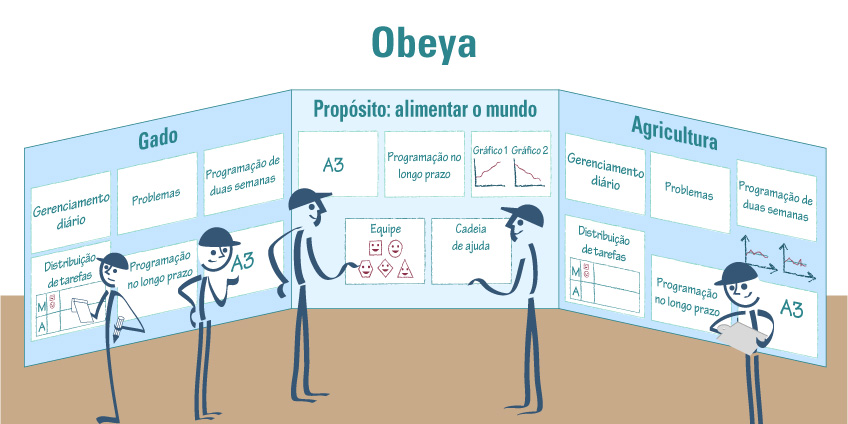
Having this information readily available during the daily meetings helps clarify all the connections between the different parts of the work and makes it easier to adjust when external conditions (such as the weather) change. Critically, it has also helped engage people even more. With so many different jobs going on at a farm, having everything aligned and mobilizing everyone around the same goals has proved a powerful mechanism for helping people understand that they can play an active role in ensuring the success of the business (instead of simply accepting whatever Mother Nature decides).
The businesses began to measure results during the different stages of production (traditionally, the farm's performance is only known after the crops or cattle are sold).
As the teams continue to progress, we expect them to see and capture positive results in terms of reduced losses during planting and harvesting, better utilization of machines and equipment, faster weight gain for cattle at lower cost, activities starting at the right time and better control during adverse weather.
IN CONCLUSION
In this initial phase, we focused on Daily Management because of its potential to improve the management system, change leadership behaviors and generate better results. However, there are many other gaps that we hope to address as our learning continues – starting with creating a better process for identifying emerging problems more easily.
We also plan to help organizations implement a more decentralized decision-making process that empowers the workers on the farm. Because they are the ones involved in the daily work, they are in a better position to make important decisions for the farm – which seeds to plant, when to sell cattle or determining the need for fertilizer – than the owner (who is often sitting in an office thousands of kilometers away), a raw material supplier or a cooperative that provides partial support to the farm.
The initial experiments we have carried out in agriculture here in Brazil prove that lean thinking and practice can be extremely useful in transforming agriculture. In fact, we believe that the agricultural sector is extremely fertile ground for applying lean principles. We are honored to have planted the first seeds.
Thanks to Adroaldo Taguti, of Copasul (Cooperativa Agrícola Sul-Matogrossense), Navirai/MS, for the opportunity to work with Fazenda Santa Marta, owned by Claudio Sabino, and with Fazenda 3 Irmãos, owned by Julio Jacintho. Thanks also to Miguel Sastre for giving us the chance to work on his Fazenda São Miguel, in Terra Nova/MT. We also thank Egidio Tsuji, Tharles Franchesco, Pedro Lopes, Perivaldo Carvalho, Wagner Zampiva, Dario Freitas, Marcio Carneiro, Murilo Saraiva, Ronaldo Palma, João de Jesus, Luiz Augusto, Cassiano, Giovani and others for their contribution, effort and enthusiasm in planting the lean seeds.







