

Improving the re-enrollment process with daily management
In this second article of the series, we will see how the group applied lean thinking in one of the areas that cause the most problems in higher education institutions in Brazil: the re-enrollment request service department.

In 2017, we saw how Ânima built a lean student relationship center. Since then, when the group began its lean journey, it has been possible to see the company's focus on ensuring the satisfaction of its students. This is a strategy that seems to be leading the company down the right path and fulfills one of the basic goals of the lean philosophy: always think about the customer. This time, the education group shows how it keeps trying to add more value for its students by trying to reduce the number of tickets related to the enrollment and re-enrollment processes at its educational institutions, ensuring that students receive more efficient service and face fewer problems in these processes.
When, in 2017, the re-enrollment department was given the challenge of writing its first A3, most people in that area didn't even know what the term meant. Just over a year later, the progress they have made is remarkable, both in the results related to the group's and the department's objectives and in their level of understanding of the lean mindset and all the tools it brings. Today, the department has an important lesson to share: engage with the lean philosophy and get your people engaged too. If that happens, and you use lean to the full, you will be surprised at what people are able to achieve without much effort or investment.
“How did all this happen?”, you may ask. Well, to answer that question, it is first necessary to understand the context the department was in before it began its lean efforts. To do so, we need to go back to a time when Ânima had not yet embraced the lean philosophy and was looking for ways to offer better service to its customers, who, in this case, are more than that: they are students, that is, the foundation for a better future for all of Brazilian society.
The context
In today's world it is very common to see people dissatisfied with products they buy, because they don't feel they received the value they expected for their investment. Even more common, however, is to see people dissatisfied with the services they receive, again because they don't see value commensurate with their investment. Today this is easy to see, because we have many tools, such as social media, that make it simple for customers to post their comments and complaints. A good share of complaints is due to the inadequate service that many companies, especially service companies, provide. The education sector is usually no different, particularly when it comes to the re-enrollment process.
The re-enrollment period is always a time of great rush and complexity for universities. During this period, the number of tickets opened by students requesting assistance increases exponentially. That is why Ânima sets up a temporary service structure, called the Virtual Registrar's Office, when this time of year arrives. The group had always had many problems and many complaints related to this structure, which has the difficult mission of handling the tickets opened by students who are having problems at re-enrollment time.
Before lean, Ânima's Virtual Registrar's Office faced difficulties related to communication, meeting deadlines, testing and reviewing processes. The process was inadequate and did not allow problems to be identified in advance. Corrections were made manually, which generated a high number of open tickets and a high level of dissatisfaction among students. There was no denying that something had to be done so that students at the group's institutions could feel that the value they were receiving matched their investment. But how do you solve complex problems in a department as complex as this one? The answer is by following them up daily.
The pursuit of daily management
It has always been very common practice in companies to hold follow-up meetings on a monthly, bimonthly, quarterly, semiannual or even annual basis. However, the lean philosophy holds that indicators need to be monitored on a daily basis if you want to have control over your processes and act whenever a problem is detected to prevent it from happening again. This tool, known as daily management (or DM), was the first to be introduced in Ânima's re-enrollment department and is still the foundation for everything they do.
One of the biggest problems daily management faces lies right at the start of the transformation: employee resistance. It is easy to imagine people resisting the idea of tracking the process numbers and indicators every day. To people unfamiliar with the subject, this seems like a tedious and unproductive task. However, bringing people on board is the leader's job, and it is vital to ensuring that daily management works. At Ânima, people's initial resistance was overcome, and today DM has become something natural for them, because people came to understand the essence of DM and to see that those fifteen short minutes invested every day paid off, since problems were promptly identified as soon as they occurred and did not happen again.
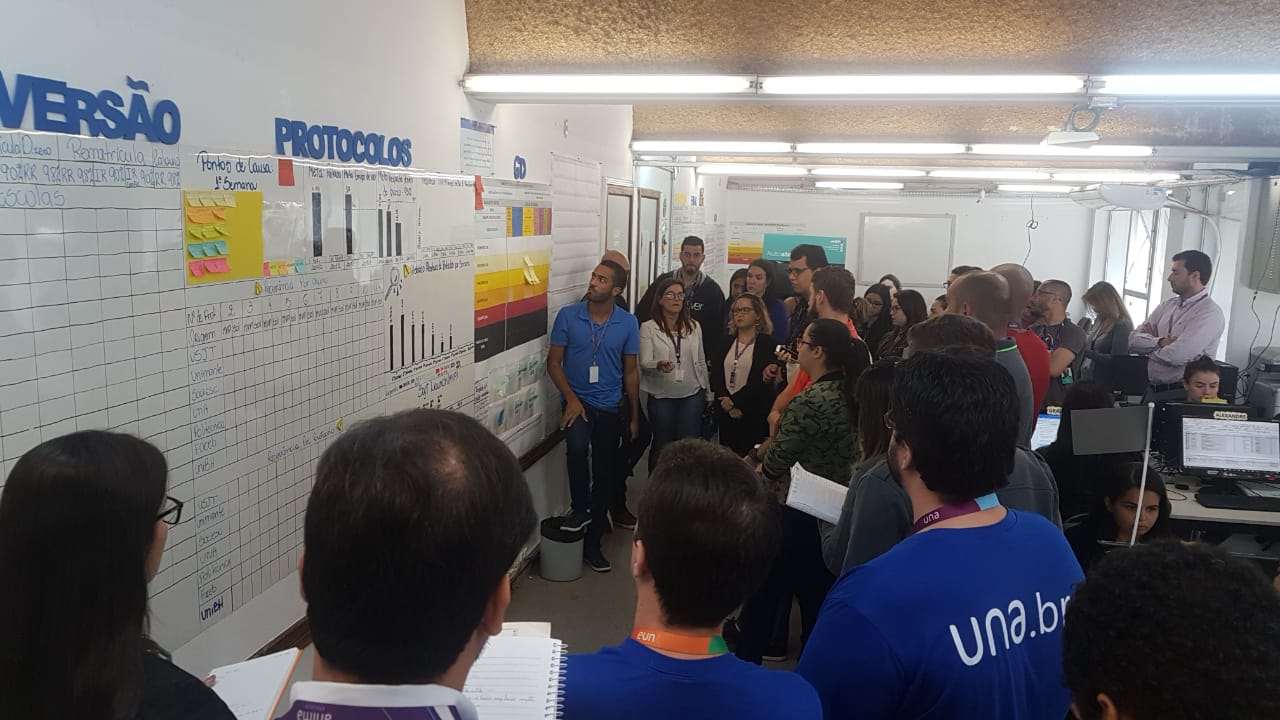
DM in Ânima's re-enrollment department
This practice brought excellent benefits to the company, both in the short and the long term. Based on DM, Ânima defined its true north, something the group had not yet made clear to everyone who worked there, built its first A3, which served to show what the situation was, where they wanted to get to, how they would get there and how they would track their indicators through the practice of daily management, and developed a series of kaizens to ensure that processes were continuously improved. This was where the department's lean turnaround was born.
Improving the process
Daily management and the subsequent development of the A3 and the kaizens allowed Ânima to reach some conclusions about what its targets should be to ensure that complaints related to the re-enrollment process dropped considerably. The main targets the area set included reducing the number of tickets received regarding this process and the time taken to handle them. However, there was another indicator that would show with incredible accuracy whether or not the process had really improved: the number of repeat requests, that is, the same ticket being opened by the same student a second time because their problem had not been solved the first time. At the time, this number reached 24% of the total number of tickets, meaning that 24% of students could not solve their problems with just one ticket.
With this clear view of what you want to improve, it becomes easier to carry out a cause analysis and look for countermeasures that can bring real benefits to the process and move toward the vision of the future state defined by the company. Ânima created plans, developed further A3s, kaizens and ways of tracking the indicators to reduce this statistic and make the process easier for its students. In a short time on this journey, the company has already achieved impressive results.
The results
During the period in which Ânima's re-enrollment department used daily management to track its main indicators, identify and quickly solve problems and pursue continuous improvement through kaizen, many results were achieved, both quantitative and qualitative. The role DM plays in the department today is evident, and it is also very easy to see the benefits it has brought as soon as you come into contact with the area. The main indicators that show the progress they have made are:
- A 26% reduction in the number of repeat tickets. This was achieved through a kaizen, which identified an opportunity for improvement in the way the universities contacted students.
- A 16% reduction in the number of repeat students. Linked to the same kaizen, this result shows how much easier it has become for students to solve their problem in a single interaction.
- Improvement in the indicator. After customizing one of the indicators, the area now works on preventing errors and, when it identifies one, acts on the root cause.
- Increased team engagement. From the moment DM became something natural for people, everyone began to see and understand the problems that occurred, becoming more aware, empathetic and helpful. Today, it is common to see the department's employees taking the initiative to help their coworkers.
Next steps
The company's re-enrollment department gained strength and confidence from these initial results obtained with its lean initiative. That is why they have already started thinking about new projects to invest in the future and extend lean to other situations. Through a conversation with the coordinators, they realized that there are other challenges that need to be tackled, because the work is never done, and there is always room for improvement.
The team has already started working on a new A3 to ensure a simple, easy and error-free enrollment process. In this way, they will ensure that their students receive the best possible value, so that they don't waste time complaining about this process and can focus more and more on their studies to transform the reality of our country and bring a lean turnaround to the society we live in.
Don't miss the third and final part of the Anima series, which will be released in a few days. It is an interview presenting the leadership's view of the transformation.







