

Hoshin Kanri at Itaú Unibanco
Do you solve problems during your workday? Certainly, yes. But are you and your team solving the right problems? Are you solving them effectively, or do these problems come back in disguise after a few weeks or months? Besides that, are the people on your team developing as they solve these problems?
The current dynamism in the day-to-day of large banks means they suffer from a lack of focus on solving their problems. Over time, people have become very good at putting out one fire after another. And at Itaú Unibanco's Retail Business Credit and Collections Directorate it was no different.
The problem is that a routine like this leaves no free space for process improvements, innovations or the development of new products and services, because the team will always be dedicated to the most important and pressing item on the agenda at the moment: putting out the next fire.
Hoshin kanri brings a structured solution to this problem so that senior leadership can, in fact, manage what matters most: deploy the strategy all the way to the front line and solve problems while developing people.
The term originates from the Japanese language and carries different meanings:
- Hoshin: Ho – direction / shin – needle ?
- Kanri: Kan – control / ri – logic, reason. ?
Defining and deploying strategy in large operations, such as those in a bank, is not an easy task, especially when the method used involves an often different culture: lean management.
But the concepts of hoshin kanri form a fundamental framework for any business to operate effectively, sustainably and lastingly. Below, we will see how to implement these concepts in any type of organization, with examples of each step at Itaú Unibanco.
Defining the focus: problems, we need to solve them!
As mentioned earlier, people are focused on solving problems quickly, putting out fire after fire. And the strategy, which at some point was thought through, remains only on the slide of the well-made presentation for that sudden committee meeting – which was also one of the fires “put out” by the team that put the presentation together.
The starting point of hoshin kanri is to give the team's strategic-level executives clarity about what the major problems of the operation are and where they are located.
Blocking off the calendar, stopping and reflecting on what the major problems really are — strategic problems — leads senior leadership to direct attention and energy toward solving these problems, instead of the smaller ones — tactical problems — which offer less impact and risk when compared with strategic problems.
That is what the Retail Business Credit and Collections Directorate – DCCV Emps did, an area of fundamental importance within the bank, focused on the aspirations of each customer and with an incredible power for achievement and social transformation.
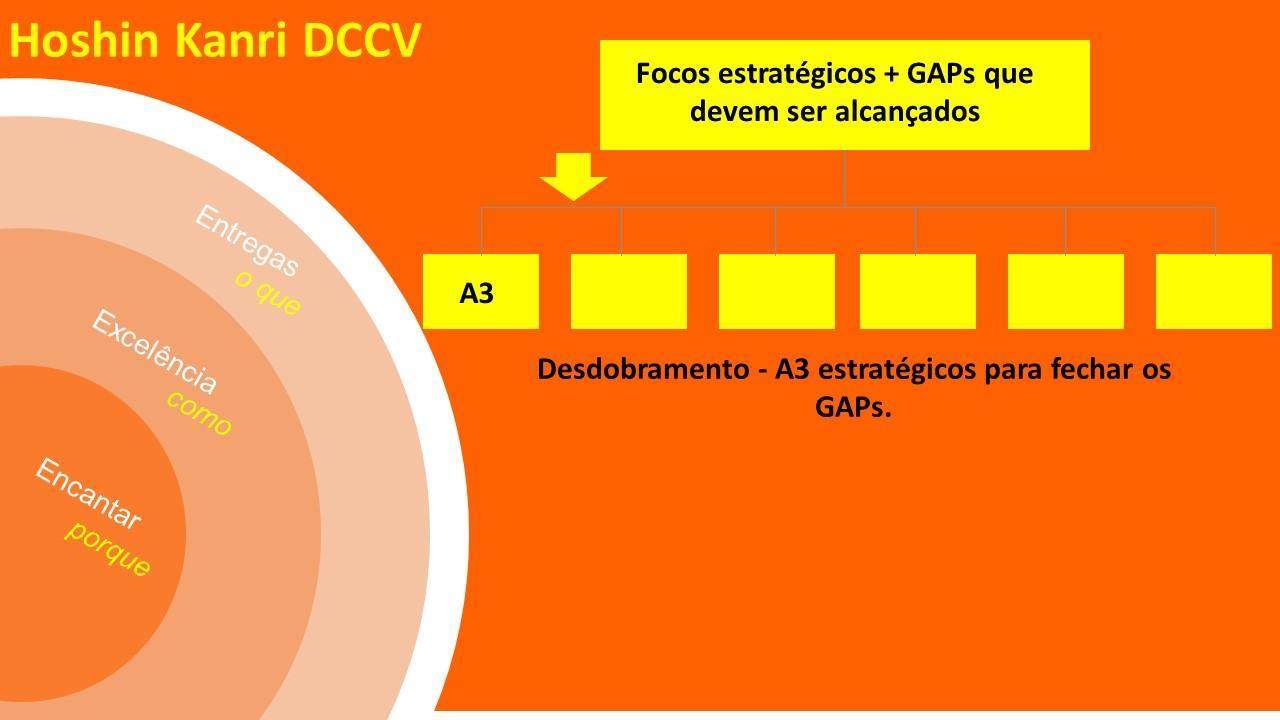
These attributes further increase the responsibility of having the right direction so that the team focuses on what is truly a priority. With this in mind, strategic focuses were set out, summarized as the “3Es” – Enchantment, Excellence and Execution (Entrega). This means:
- The customer at the center of everything. Transform the customer experience.
- A horizontal view of the value stream from account opening, including credit granting and the maintenance of these customers.
- Empowerment of people and leadership to drive the transformation.
The purpose was summarized in one sentence: We Enchant our customers through Excellence in risk management, ensuring sustainable Execution.
Deployment and Nemawashi: clarity through alignment and consensus
Drawing up a strategy and not deploying it for execution at all levels often amounts to wasted effort. The directorate knew it needed to try something different and more effective. So what would the next step be?
A good start was to hold a Nemawashi session. That is to say, to promote alignment and consensus among the executives about where the major pain points of the operation are. Literally translated, Nemawashi means “preparing the ground”. It takes maturity and an open, judgment-free space for people to feel comfortable sharing and talking about problems.
This alignment move is extremely important before any major change, so that together the director, superintendents, managers and coordinators can trim the sails toward the most important direction according to the priorities set.
In practice, after defining the priorities, the alignment and the next stages of the work were outlined following the steps below:
- A meeting with everyone involved in the process in one room.
- Drawing on a wall (with actual post-its) the Value Stream Map, VSM of the process in question. Step by step of the process.
- An individual 15-minute brainstorming and, under each step, a list indicating the related problems. One rule: everyone must contribute. Problems were pointed out and observed without any filter or hierarchical scale.
- Together, in the Nemawashi process, we grouped the problems that are related to each other;
- Prioritization of the most important problems of each process step based on the strategic direction presented.
After this important alignment, the result, as an output, was clarity about where and what the problems are that we need to tackle to take the business to a new level, in an aligned way and with consensus.
Some may think the next step would be to solve them! No. That would lead us to ineffective solutions, as it would not address the real causes. First, understand in depth, then provide solutions and test them. And an excellent practice for doing this effectively is A3 thinking.
Preparing for the plan with A3 thinking: learning from problems
A3 thinking is a problem-solving concept that is already well known and widely disseminated in all kinds of organizations. Even so, not all organizations know it or manage to put this concept into practice.
One of the premises of A3 is to investigate the root cause of problems in depth before moving on to decision-making and defining solutions. In this way, it is possible to effectively combat the common jump to solution behavior, highly encouraged not only in banking operations but in any other type of organization as well.
Developing and working on this concept here at Itaú Unibanco was very important for our operation and for the training of our leaders and employees.
A3 was used as a way to deploy the strategy, empower people and encourage teamwork. Six strategic A3s were drawn up addressing the priority problems in each of the existing steps of the value stream, including, essentially, one specifically for the empowerment and development of people.
We set aside groups of tactical-level leaders (managers and coordinators) to form the teams that would take part in the initiative. And as sponsors and mentors of the A3s, strategic-level leaders (director and superintendents).
The projects were completed in an average of 70 days in an intense dynamic. A true deep dive by the participants, which resulted in excellent root-cause conclusions about the problems and, consequently, efficient and effective action plans.
Over time, within 2 months, we already noticed changes in the teams regarding the approach of investigating the root cause of problems before discussing any kind of solution. It is a long road to travel, and every behavior contrary to jump to solution should be recognized and encouraged by everyone, leaders and team members alike.
It is important to stress that this first wave of deployment with A3s had two major objectives:
- Training people to use a different way of thinking and acting.
- Solving the most important problems of our Credit and Collections operation.
Execution - Obeya Room: seeing and managing what matters most
The hoshin kanri process relies on artifacts, visual elements and ceremonies that together make up the strategy of identifying a business's priorities and deploying them to all hierarchical levels while training and developing people.
To ensure the execution of the A3s that were created and, above all, of the actions that will bring the expected results, one of the main differentiators of this process was the creation of the obeya room, which is the place where leadership will meet to discuss and make business decisions.
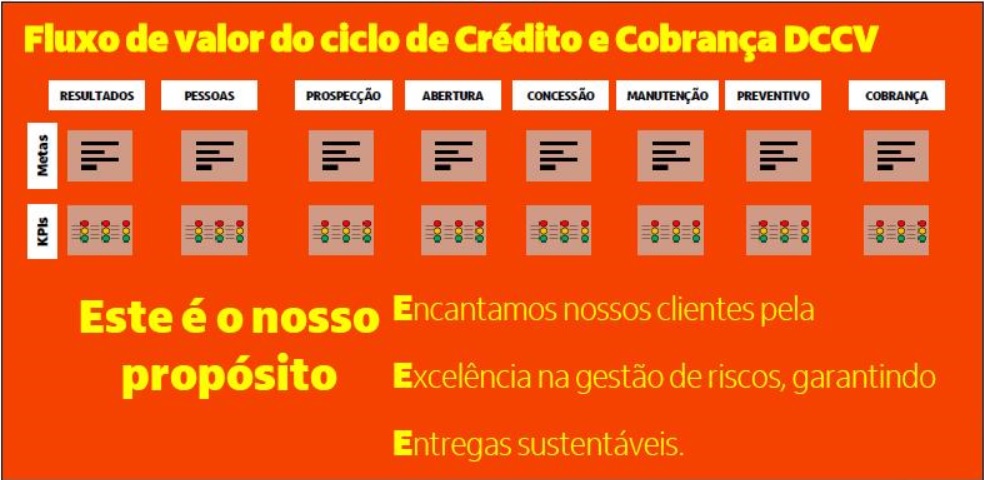
The name comes from Japanese and means large room. It is a room located very close to the gemba (the place where things happen). It is where the management elements that make up the hoshin kanri process are kept. Where we can follow, at different levels, the daily management of indicators and actions.
Here at Itaú, we started with an obeya room for discussion among strategic-level leadership, that is, the director and superintendents. As with every new process, it took a few rounds until the leaders got used to the new dynamic.
We established a few questions that helped us answer which information and indicators we needed in our room:
- True North: Visually display the business priorities, their goals and the challenges on the radar.
- What is the purpose of this company? And of this team?
- What results does this company intend to achieve?
- What goals does it want to accomplish?
- What level will this business be at in the coming months and years?
- Strategic A3s: also visually, display the A3 reports prepared for the strategic problems mapped in the Important for consultation and for tracking the schedule of action plans and implementation of the mapped countermeasures.
- Management boards: visual artifacts to support lean management.
- What will each level of management manage?
- Which indicators are the most important?
- How will we track the progress of the A3 reports?
- What will the dynamic for using the boards be?
- What is the operation's performance over the months?
It was a significant change in routine. In practice, even though we have a room full of numbers and indicators in visual form, the habit of always having a laptop and smartphone at hand as support makes it even harder to adopt the new format.
We needed to mature the process. From updating the numbers, which was done by focal-point analysts, to discussing the numbers, which looked more like a presentation to the leaders by those same analysts.
The big insight at this step was encouraging the superintendents' empowerment over the numbers. In other words, by outsourcing the process of updating and presenting the numbers to the analysts, we lost the essence of the obeya, which is expected to be a moment between leader and team members, in this case, director and superintendents, so that problems needing attention can be shared.
The evolution is continuous. With each ceremony, we keep solidifying the habit of using visual information, taking ownership of the numbers and sharing problems.
Always remember that problems are treasures; solving them is the path to serving the Customer better and better.
Daily Management (DM): changes in the way of working
You will only know whether you are heading in the right direction if you measure and track. Even better if you can do this in the shortest possible time, with people empowered at all levels of the organization. That is how we interpreted daily management and allowed ourselves to experiment with it in the retail credit and collections area.
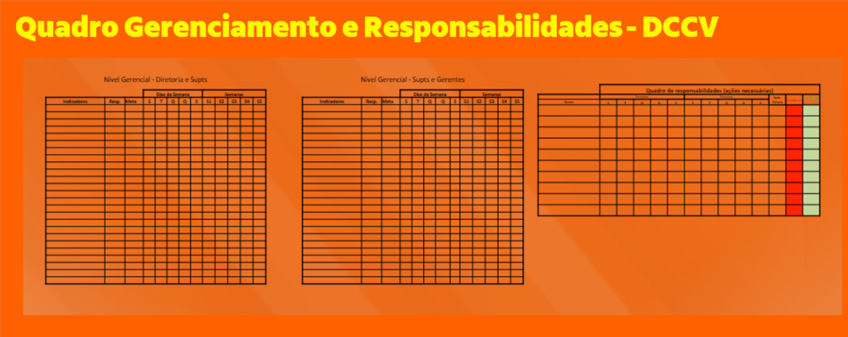
On the first DM board we made in our obeya, the biggest obstacle we had to overcome was getting participants engaged in doing something by hand, since all the information on the board was already in the reports on their laptops.
The gain from writing has a lot to do with our bodily senses and with what real engagement of people with problems, numbers and how they are handled means. Seeing, speaking, listening and giving opinions in a quick team meeting, centered on what is really important for customers and the business, proved to be a winning model.
In other words, when the superintendent picks up a red pen to write down one of his indicators that is not in good shape, his capacity to absorb and engage with the number is much greater than with a digital file, where all he has to do is close the laptop and he will no longer be in contact with the number.
An interesting lesson for the teams taking part in the A3s concerns the reflection carried out to determine the indicators of success. Many of these indicators are new; they are KPIs that did not exist until then and began to be tracked from the specific perspective of developing the A3s. We need to be sure that our interventions are having the desired effect. And, when necessary, quickly correct the direction.
This space is also where the indicators accumulated over the period and other indicators that make up the operation's analyses are kept. That is, indicators that are monthly or that require a longer window of analysis. It is a space for showing the movie of the operation (whereas in DM we show the snapshot of the operation).
The obeya is where we follow up on the activities, commitments and solutions to the problems discussed on the boards above, during the meetings.
At the start of the meeting, we define some important roles and responsibilities for the forum. They are the scribe (who will take notes throughout the meeting), the timekeeper (who will ensure the time is used as well as possible) and finally the observer, whose responsibility is to closely follow how the forum unfolds and, at the end, give their contribution to the team.
After the meeting ends, the scribe will go over this responsibility board with everyone in the room and will do a live follow-up with the people who have commitments agreed at the last meeting.
The practice of putting the next steps, solutions and small commitments on the board is a way to ensure that the most important things are being done, instead of activities that are not directly linked to the Core Business.
Cultural transformation: developing people at all hierarchical levels – some tips from our lessons learned
Any change or transformation of mindset in organizations is, without a doubt, a great challenge. The directorate, with an operation of about 700 people, has learned a lot and continues to learn every day in terms of change management.
The Retail Business Credit and Collections area's first contact with lean practices began in mid-2017, when one of its superintendencies took its first steps into concepts related to the visual management of work.
These practices of visual artifacts for better management, already widespread in the Technology and Digital Channels areas, gradually, if timidly, gained space on the agenda of discussions and decisions in the Business area. And that, in itself, already represented an important paradigm shift.
For about 18 months we have been experimenting with the best formats, testing and prototyping new ideas and dynamics at the operational level, with analysts, on the front line. In the meantime, the practice has spread to 100% of the superintendencies in the directorate. Hoshin kanri has been an evolution for us and for the bank.
Since then we have gathered important lessons related to 1) the change in the teams' mindset, 2) ways of conducting matters, 3) the way of talking about problems and, most importantly, 4) how to develop people through coaching in problem solving.
- On how to talk about problems. Talking about problems, in practice, is harder than you might imagine. As our lean dynamics matured, we frequently said and communicated to our teams that problems are treasures, and that we wanted to hear about problems so that we would know where to attack. In other words, we expect people to share problems, but at the outset these people are feeling a series of internal conflicts. Such as, for example, “if I expose this problem in front of my peers, they will think I can't cope” or “if I say I made a mistake, I won't be eligible for that promotion, I'll try to solve it on my own before sharing it with the managers”. Therefore, it takes careful attention to what people are really feeling when the topic in question is: problems. Below we see how we got around this challenge.
- On changing the teams' mindset. We know that learning happens through the union of concept and practice. And to get people to feel engaged, “bought in” to the transformation, it is extremely important to invest time in preparation, in building up knowledge, before jumping straight into practice. Practice and concept go hand in hand. We cannot just acquire concepts and not put them into practice, and likewise it is dangerous to jump into practice without taking ownership of the concepts.
- On the ways of conducting matters. Leadership by example. This concept is fundamental to change and recognized by many. Leadership needs to manage through the proposed management system. If leadership does not make an effort to communicate to their teams, through their day-to-day attitudes, that the new practices are important, the teams will understand that they don't need to make an effort either. Change, then, does not happen.
- On how to develop people through coaching in problem solving. The way we found to solve this problem was to create a group of lean representatives in each of the coordination units. These representatives have a more senior profile and, strategically, were responsible for sharing their own examples of problems, whether solved or not, during team meetings. In this way, coordinator and representative were able to set the example that it was fine to share problems. That problems in fact belong to the activities and not to the people. And, little by little, we were able to see people change.
Conclusion
We have covered how we used hoshin kanri and what our major lessons were during this important transformation journey of our directorate. We are sure we are still learning. It is a journey. A marathon, not a high-speed 100-meter dash.
We talked about the importance of discussing and solving problems clearly, transparently and without judgment. We detailed our lessons learned with the nemawashi method, and how to translate these alignment outputs into a structured problem-solving system (Strategic A3s). Then we showed where (the obeya room) and how (DM) to track this progress. And, finally, the great impact of whether or not people are engaged during a cultural transformation.
The great objective of the hoshin kanri process, with all these elements and meetings, is just one: empowerment at all levels of the operation so that we deliver Value and Excellence to our customers.
So that we all think more strategically. So that, in this way, we have more room on the agenda for innovations, new products, new services, etc.
Our next steps are to keep walking on this long journey, which only has a start date. It is important to highlight that there is no such expression as “we want to implement lean”, but rather “let's experiment with lean”.
Acknowledgment
To Tamiris Masetto Manzano, for editing and reviewing this article.







