

Beyond training: truly effective lean logistics capability building
For a long time, logistics training followed traditional approaches, focused on the theoretical transmission of knowledge, often far removed from operational reality. However, with the sector's high turnover and the growing difficulty of retaining and attracting talent, companies need to develop their professionals quickly and with quality, especially frontline workers, but also leadership. Historical methods such as Standardized Work, the Dojo and TWI are still relevant, and today, more than ever, capability building, including for leadership, must start from a sense of purpose, connecting each activity to the delivery of value. In this challenging context, this article explores how to structure effective capability-building programs that strengthen both the operational team and leadership, creating a more engaged work environment, with people solving problems every day.
An overview of people and culture development
The logistics sector faces constant challenges, driven by high turnover, the entry of Generation Z into the job market and continuous pressure to reduce operating costs. In this scenario, companies need to develop their newly hired employees quickly and effectively. Conventional training, often based only on theoretical classes or lengthy manuals, is not enough to engage and prepare workers for the dynamic environment of logistics. On the other hand, historical methods such as Standardized Work, the Dojo and Training Within Industry (TWI) still prove valuable and ensure consistency in the execution of tasks, accelerating learning.
Standardized Work (SW) lies at the foundations of Lean practices, establishing clear conditions for carrying out activities, reducing variability and increasing process predictability. TWI, developed during World War II, provides practical guidelines for training new employees, emphasizing the importance of teaching by example and ensuring that operators understand not only the “how” but also the “why” of each task. In addition, the Dojo space has been gaining ground as an effective approach to capability building. Inspired by martial arts, the Dojo creates a structured environment where employees can learn and practice skills in controlled situations before applying them in the real environment.
With technological progress, these approaches have been enhanced by new digital tools. Immersive training with augmented reality, interactive simulators and microlearning platforms allow learning to take place in a more engaging and personalized way, increasing knowledge retention and better preparing employees for real challenges. However, effective capability building should not be limited to one-off training sessions.
The concept of lifelong learning has become essential in the modern logistics environment. Continuous learning is indispensable for adapting to new technologies and methodologies, and for developing interpersonal and problem-solving skills, which are essential for continuous improvement. The Lean journey is not just about improving processes; it requires a permanent commitment to learning and cultural evolution. And culture change does not happen overnight.
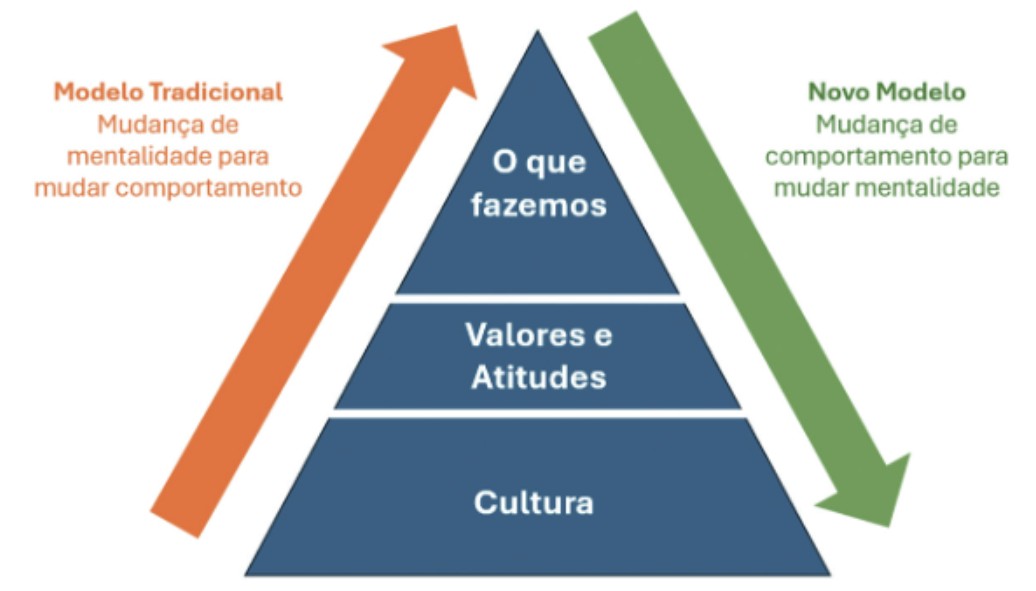
For John Shook, a former Toyota executive and the first Westerner to lead the implementation of the Toyota Production System outside Japan, cultural transformation happens through changing daily actions. The traditional model assumes that, to change behaviors, it is first necessary to change thinking. However, experience shows that the most effective path is the reverse: by changing what we do, we create new values and attitudes, which in turn shape a new organizational culture. This is what is represented in the image of “Shook's Pyramid”. Culture does not change instantly, but develops gradually as practices and behaviors are reinforced day to day.
Thus, to change “what we do”, capability building must be designed to teach techniques while transforming the way professionals work and interact with processes. By changing practices, we change attitudes and, consequently, create an environment more conducive to innovation and operational excellence. Below, we will explore the essential elements for Lean capability building to be truly effective and capable of generating lasting impacts in organizations.
Developing leadership to evolve the culture
If the Lean transformation in logistics operations begins with what we do, it can only be sustained through leadership. It is not enough to train operational teams to execute processes efficiently; leaders need to incorporate habits and attitudes that continuously guide teams toward improvement. Leadership development therefore becomes an essential element for the evolution of organizational culture.
The logic of lifelong learning applies even more strongly to leadership. Leaders need to update their practices and behaviors constantly. Structured development tracks with Lean concepts and practices have proven effective, not only for the transmission of knowledge, but for their direct connection with the organization's real challenges. These tracks are customized according to the company's strategy and its specific challenges, ensuring that each leader, regardless of their organizational level, has real opportunities for learning and practical application.
More than theoretical models, these development programs involve concrete projects, in which participants exercise leadership in leading improvements with their teams. This learning in action makes it possible to develop soft skills (behavioral skills) and hard skills (technical skills) simultaneously. The combination of these competencies forms leadership's power skills — skills that drive lasting transformations.
Lean leadership is a practice grounded in essential principles: Challenge, Teach, Teamwork, Listen, Support, Learn and “Go and see for yourself” (Genchi Gembutsu). However, for these fundamentals to be applied consistently and generate impact, other elements also need to be considered. Psychological safety is one of them — without an environment in which employees can express ideas, raise problems and propose improvements without fear of punishment, a Lean culture cannot be sustained. Likewise, the ability to engage teams in logistics, a traditionally operational sector oriented toward rigorous targets, requires leaders to develop a repertoire that goes beyond technique, encompassing continuous learning, innovation, assertive communication and awareness of cognitive biases that may guide decision-making.
Another challenge is strategy deployment. In many organizations in the logistics sector, the goals and guidelines defined by senior leadership are not always clearly understood at the operational levels. Effective Lean leadership needs to ensure that every logistics professional understands how their work contributes to the whole, which requires competencies such as inclusive leadership, trust and building connections. These aspects are not accessories, but rather fundamental to creating a culture of continuous improvement that endures over time.
These approaches have been applied successfully in different logistics organizations, demonstrating that leadership development is a determining factor for the impact and longevity of Lean transformations. Strengthening these competencies can drive improvements in process efficiency and contribute to a more engaging, collaborative and innovative work environment.
Connecting people to purpose, processes and technologies
In Lean practice applied to logistics, the recommended strategy for driving and sustaining results involves a conscious analysis of the current state of processes, relying on a clear purpose while continuously engaging the team. Successful Lean management journeys in logistics consistently show the combination of three factors: Processes, People and Purpose. The continuous development of people is part of this triad of factors and becomes a key element, including for enabling new technologies. See Table 1.
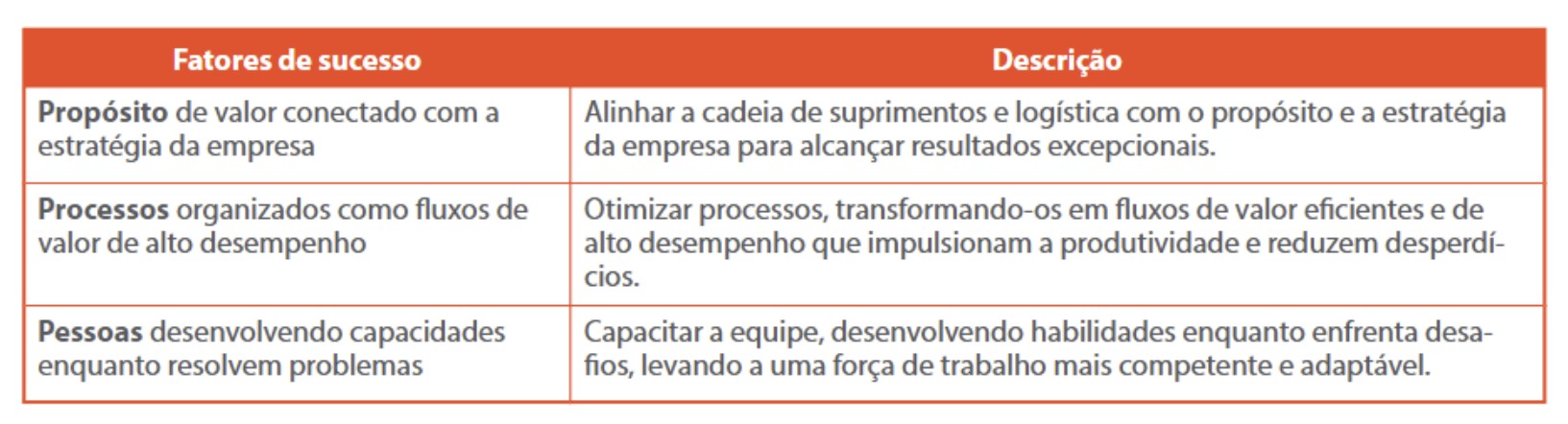
Taking these three factors as premises, it is possible to discuss the role of new technologies in delivering value and how human beings, properly trained, act as enablers of these technologies. In the combination of digital transformation and automation, the convergence of technologies such as autonomous robots, Big Data, augmented reality, cloud computing, IoT, Artificial Intelligence, among others, aims to achieve a high degree of integration with broad physical and virtual connection, without departmental boundaries or organizational barriers — aligned with the ecosystem vision of the Lean Supply Chain.
In this context, Lean management works to strengthen the capacity for critical analysis of processes through people, aiming to “think Lean” and be agile in solving problems before adopting technologies. Lean management plays an active role in developing people's analytical capabilities in support of digital transformation in logistics. Its application has given rise to new terms, such as Lean Automation and Augmented Lean, which aim to guide leaders not yet familiar with the synergy created by this thinking with digital efforts. This goes beyond fads and unprepared forays into adopting digital transformations that may, eventually, not deliver the expected results.
What makes lean capability building truly effective
To understand what is essential in developing logistics professionals within a Lean system, it is fundamental to distinguish between two concepts: training and capability building. Training focuses on teaching specific technical skills for executing operational and managerial tasks in the short term. Capability building goes further: it involves the continuous development of competencies, behaviors and mindset to face the real and complex challenges of logistics operations.
In Lean logistics, effective capability building is not limited to transmitting knowledge. Learning only generates value when applied directly to the operation's strategic problems, such as increasing productivity, improving OTIF (On-Time In-Full), reducing delays or optimizing the flow of information and materials. Lean logic establishes that all capability building must be linked to solving concrete business challenges. Otherwise, there is a risk of wasting time and resources on training with no real impact on supply chain performance.
The central point of effective capability building lies in the question: “What problem do we need to solve?”. This reflection is essential to align team development with the organization's strategic objectives. For this to happen, a psychologically safe environment is necessary, in which problems can be discussed openly and worked on without fear or hierarchical barriers. When capability building is connected to the real challenges of logistics, professionals become protagonists of continuous improvement, acting with engagement, and drive operational transformation.
The effectiveness of Lean capability building is measured by the impact it generates. If, after a capability-building program, there are no tangible advances in delivery reliability, waste reduction or improved operational efficiency, then time and resources will have been wasted. True learning in Lean logistics happens in practice, aligning knowledge, engagement and purpose to deliver lasting results.
The experience of the Practical Lean Training Program (PPFL) in logistics and supply chain
It is a fact that the Lean transformation in logistics requires more than mastering concepts: it requires the practical application of learning to solve the operation's real challenges. The Practical Lean Training Program (PPFL), offered by Lean Institute Brasil, is an example that for years has provided this connection between capability building and concrete impact, developing specialists and leaders, from different generations and levels of seniority, to be capable of leading lasting improvements in their organizations.

The PPFL combines a solid conceptual foundation with practical experimentation, ensuring that participants develop technical and behavioral skills essential to the logic of continuous improvement. One of the PPFL's instruments is the application of the A3 Form, a structured problem-solving tool based on the PDCA cycle (“Plan-Do-Check-Act”, or “Planejar-Fazer-Verificar-Agir”, in Portuguese), allowing each participant to develop a real project aligned with the company's strategic needs.
The PPFL has been offered in open classes, which bring together professionals from different companies, and in an in-company version, customized to meet the specific demands of each organization. In the in-company format, the structure of the program (with modules covering the main Lean approaches and tools for logistics) is maintained, and the content is adapted according to the company's priority challenges. Before the program begins, there is a strategic alignment with senior leadership to ensure that the projects developed are connected to the question of the “problem we need to solve”. This direction prevents dispersion of effort and ensures that capability building generates a real return for the business.
In the in-company format, another factor that has been essential to the program's success is the multidisciplinary and cross-sector composition of the participants. Logistics problems often have roots in different links of the supply chain, and the participation of professionals from areas such as receiving, transportation, loss prevention (in the case of retail logistics), purchasing, among others, broadens the understanding of systemic causes. Forming mixed groups enriches the analysis of problems, providing different perspectives and favoring more robust solutions.
The PPFL experience in logistics shows that the structured development of people, connected to the organization's purpose and strategic challenges, accelerates the evolution of a Lean culture. By developing leaders capable of multiplying this knowledge internally, the program has strengthened the building of an environment oriented toward continuous improvement, engagement and the pursuit of efficiency, generating lasting impacts on operations and organizational results.
Real transformation through effective lean capability building with lasting results
Lean capability building is essential for consolidating the continuous improvement journey and for a deep organizational transformation. In the context of logistics, for this capability building to be effective, it is fundamental that the knowledge acquired can be applied to relevant problems, aligned with the organization's strategic objectives. The question “What problems do we need to solve?” should be the starting point for any Lean initiative (whether through TWI, Standardized Work, the PPFL or any other approach), ensuring that capability building brings real benefits to the business.
The effectiveness of a capability-building program is reflected in the teams' ability to solve problems that directly affect supply chain performance and the customer experience. Delays, planning failures, low productivity and fluctuations in OTIF are examples of challenges that demand professionals prepared to analyze, understand and act based on Lean principles. Thus, before starting any capability-building program, strategic alignment with senior leadership is fundamental to define the priority topics to be addressed. Forming mixed work groups, with participants from various areas, is a recommended practice, making it possible to approach problems holistically and find more effective solutions.
The Practical Lean Training Program (PPFL) is an example of an effective approach that combines the concepts, tools and approaches of Lean logistics with practice. Throughout the program, participants develop projects focused on real logistics problems, driving continuous improvement and promoting a collaborative environment.
However, the Lean transformation goes beyond the simple adoption of tools and techniques. It requires a cultural change and an ongoing commitment to improvement. It is fundamental to create an environment where continuous learning is encouraged, psychological safety is ensured by leadership (which must also be continuously developed), and problem solving becomes part of the organizational culture. Lean development plays a vital role in developing people's analytical and managerial capabilities, supporting digital transformation and the creation of synergies between Lean practices and emerging technologies. The development of teams and leaders cannot be an isolated action, but an ongoing process that strengthens the connection between people, processes and technologies.
Finally, Lean capability building, when well structured and applied to concrete challenges, becomes an engine of evolution for logistics and the supply chain. Only by consistently integrating learning and practice can organizations achieve sustainable gains in productivity, quality and operational reliability, consolidating the Lean transformation as a long-term competitive differentiator.
References
Shook, John (2010). How to Change a Culture: Lessons From NUMMI. MIT Sloan Management Review, Vol. 51. No. 2. Winter, 2010.
Bonfanti, Iris C. P.; Bortolo, Otávio (2020). Acabou o meu treinamento sobre Lean, e agora? Lean Institute Brasil articles. Available at: https://www.Lean.org.br/artigos/725/acabou-o-meu-treinamento-sobre-Lean-e-agora.aspx. Accessed: 17/02/2025.







