

How a construction company survived the recession using lean
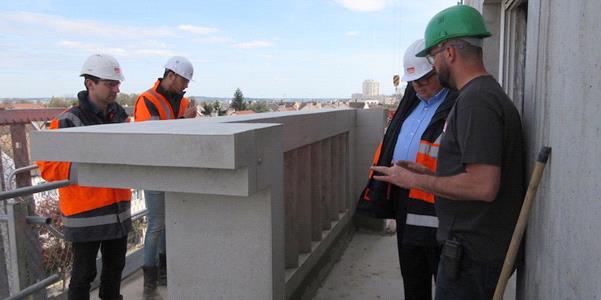
NOTES FROM THE GEMBA - With a strong focus on quality and on solving problems once and for all, Paris Ouest Construction managed to overcome the recession, as the author discovered during a gemba walk.
Although industries such as manufacturing and services are full of improvement stories here in France, there is one sector that seems rather indifferent to quality systems and lean management (even though it is full of complexity and risk): the office and housing construction sector. Look for books and stories about quality management in construction and you will be surprised at how little you find.
The reason for this is probably that a building is a unique prototype - which can be refined as needed - whereas industrial production runs at high volumes and needs to concentrate on getting it right the first time to reduce the cost of poor quality.
Yes, construction is a different story. That is why I was eager to discuss this subject with Jean Baptiste Bouthillon, CEO of Paris Ouest Construction, and to visit some of his construction sites. Jean Baptiste firmly believes in the power of lean thinking applied to construction - he spends 40% of his time walking around his sites, four a week - and the opportunity to go on a gemba walk with him was too good for me to turn down.
Like its competitors, Paris Ouest Construction suffered a major setback after the 2008 economic crisis: it is a small company, with 260 employees (and 60 temporary workers). With the slowdown, investment in buildings dropped drastically, even in Paris, and only now is business starting to pick up.
So how did Paris Ouest Construction manage to overcome the crisis?
As Jean Baptiste said as we walked toward the first building he wanted to show me: "We spend half our lives at home, so we need quality and comfort there. And when we build something, we physically change the environment - and for a long time - so we had better think hard during construction". For example, we can only guarantee low energy consumption over a building's lifetime if the construction work is first-rate.
Jean Baptiste explained to me that he likes to think in terms of "quality at delivery". But how do you measure that? While the automotive industry measures PPM (defects per million parts), the construction industry believes that five outstanding issues per delivered apartment is a fairly decent score for a "prototype". This led Jean Baptiste and his team to ask themselves how customer expectations of quality should be defined. Clearly, this is not easy, since the bid is awarded by an investor, the specifications and control are the prerogative of an architect chosen by that investor, operating the finished building is often the responsibility of third parties, not to mention the people who will live in the apartments or work in the offices (each will have a different definition of quality). We are talking about a very complex system here.
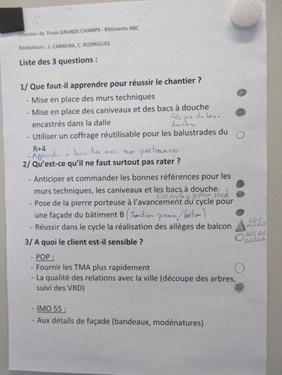
I had immediate proof that this really was a question on people's minds at Paris Ouest Constructio when I entered the first construction site and met the site's local managers. There were three discussion points posted on the wall of the builders' office:
- What new challenge do we need to learn and tackle in this building? The answer was prefabricated bathrooms.
- What are the customer's specific expectations for this building? Avoiding excess water consumption (this building will be a residence for low-income people, and water will not be billed to each individual tenant).
- What can we not miss in this building? Controlling the different cycle times for the new parts of the building and the parts we are simply renovating: the different work content between new construction and renovation can alter the sequence of trades that come in one after another in each of the apartments (drywall specialists, plumbers, electricians, painters, etc.).
Focus is important, and Jean Baptiste has made it his routine to begin every gemba walk with these points in mind (it is so easy to get distracted by the many processes and contracting problems that typically occur on a construction site). In fact, at the second site we visited, the same three questions were again the starting point of our walk.
At the first site, we quickly turned to the problems listed on the office wall: an interesting discussion began about rework related to the prefabricated bathrooms. They had all arrived in one batch just before the summer holidays and were quickly placed in each of the future apartments. When construction work started again in September, partitions were put up, and the plumbing teams went in and discovered that two bathrooms had been placed in the wrong apartments. The partitions had to be taken down and the two bathrooms swapped.
It is important to stress that the discussion was not about the rework itself, but about how the company could avoid this kind of mistake in the future. Jean Baptiste went even further at the second site we visited, challenging the team to think more deeply about the idea of standards and an employee's ability to check his or her own work for any anomalies. The ability to clearly define OK work and not-OK work is one of the most fundamental skills we can develop in people.
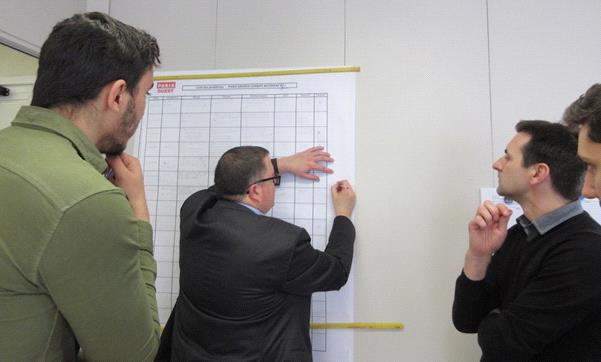
Jean Baptiste has a clear idea of what he wants. "I ask them to list at least one problem a day and discuss how they can avoid it in the future", he told me. "No problem is too small. In fact, I think the smaller the problems discussed, the higher the final quality will be. What worries me is having no problems!".
The last phase of Jean Baptiste's gemba walks (before walking the construction site) is a macro schedule of the key dates in the process, as they were initially set. They are closely tracked to try to "lock in" each of them and keep to the original schedule. At both sites, the goal was not to check the managers' ability to produce a detailed Gantt chart, but to keep them focused on important milestones. This systematic "lock in the milestones" approach, together with the small-batch attitude I will discuss in a second, helps Paris Ouest Construction complete projects in 13 to 14 months, whereas its competitors typically take 18.
LEARNING THE BUSINESS
At the second site we visited, I also saw different experiments encouraging learning in the workplace.
Stock replenishment based on consumption, for example, is being tested on technical wall parts (technical walls are put up with all the piping and wiring inside, which saves up to 0.5 square meters of space in the apartment). Paris Ouest does not work directly on the pipes and valves (that work is outsourced), which normally happens at a later stage, but the technical walls need to be supplied: the company is taking advantage of this new supply flow to learn pull flow.
We also saw a kaizen board reflecting on a new technique for producing concrete balconies (we looked at the experimentation plan and then went to see the result of the test on site, a rare opportunity to see a learning process live).
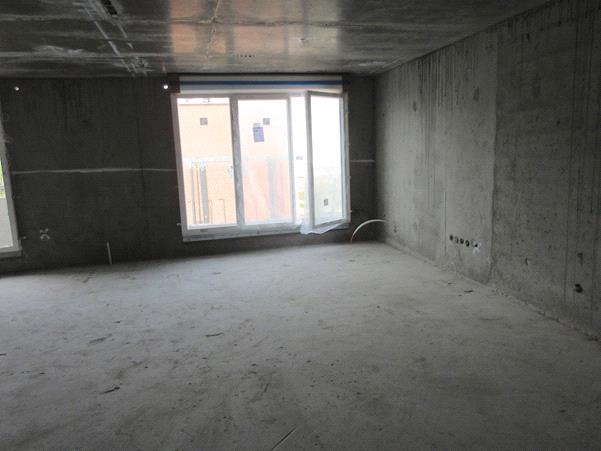
Most of us have seen a construction site at least once. All kinds of jobs happen on it all the time, but the most important thing in managing its work is sequence, since partitions need to be put up before a plumber can connect the pipes, before an electrician can do the wiring, etc. And all of that has to happen before a painter can paint. In a large building, many subcontractors work at the same time, with an approximate takt time of one apartment per day, but what really impressed me as we walked from one apartment to the next was the cleanliness of some of the future apartments where a contractor had just finished their work.
I expected to see tools, debris, people, scaffolding and ladders everywhere. So I asked Jean Baptiste how they had achieved this, and he told me about the two rules he and his team had set for subcontractors to limit rework and idle time.
- Clean the workspace as soon as they have finished and before moving on to the next apartment (removing the rubble, putting away the tools, etc.). This is more than 5S or respect for the next worker: just as in industry, workers tend to do activities in batches, selecting a week's worth of work and the corresponding area and "occupying" the whole space so they can stop and resume work whenever and however they want. Since the takt time is one apartment per day, they tend to occupy an area of five apartments per week. In doing so, however, they prevent other contractors from working (even though they don't spend more than 8 hours in each of the apartments over the course of a week). Paris Ouest Construction's "Finish and Move" approach forces workers to break the week into smaller one-day batches: they now finish one plan per day and immediately clean the apartment. This approach allows simultaneous work in different apartments, reducing the total delivery time.
- Self-inspection by each worker, which means that the expectations of the next contractor coming in must be well understood. To that end, Paris Ouest Construction designed a one-page document, a kind of "first step" template, in which working conditions are defined, as well as quality requirements. The document is discussed with the worker before the job and an action plan is defined if necessary. This was a great way to move away from the traditional checklist audit carried out after the work is finished.
When we came back from the apartments, Jean Baptiste began the debriefing of the gemba walk by talking about the safety issues he had discovered. "Protecting the worker is the first step of quality management and the foundation of respect", he said.
BUILDING IN QUALITY
Jean Baptiste's approach to quality management has nothing to do with ISO (which, most of the time, is no more than a front). It is people-centered and based on two fundamental ideas:
- Understanding customers' expectations and, if they cannot be easily understood, trying to see the building through the customer's eyes at all times - because waiting for feedback on the apartment after or just before final delivery is too late. In addition, the "Finish and Move" approach encourages contractors to see their work partners as customers.
- Once the exterior is built, the work consists of following the right sequence of contractors on a site (all belonging to external tier-1 subcontractors, who sometimes hire tier-2 workers). Building trust is therefore key, because it brings transparency and open discussion of problems. That is why Paris Ouest Construction has tried to create a safe working environment where people can point out problems and easily fix them or escalate them (if they need help).
The company's approach to quality management is lean thinking at its best - regular gemba walks, a real focus on the customer, consistent monitoring of what must be achieved or improved, openness to learning from problems, senior management presence on site and attention to safety, delivery and quality.
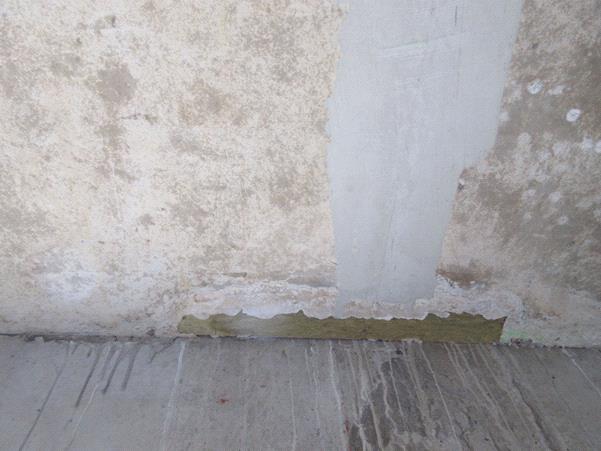
Although it is not easy, paying attention to detail eventually paid off for Paris Ouest Construction, leading to a series of innovations: for example, its in-house solution for thermal bridges (one of the main sources of energy waste in a building), which is a best-seller and outperforms off-the-shelf solutions in terms of aesthetics, effectiveness and ease of installation. The development of the solution resulted from observation carried out on construction sites (the teams were not satisfied with the previous solutions) and from the collaboration of several departments.
If you are still not convinced that this approach works, here are some numbers: the delivery time for structural work (managed directly by Paris Ouest) has improved greatly, with an increase from 40 to 80% of jobs completed in full and on time. Progress is also being made with the contractors' work, although this is obviously harder to map and measure.
There is more. The number and severity of accidents have declined consistently over the years, thanks to the continuous focus on safety.
Finally, innovation and kaizen contributed to a 47% reduction in carbon emissions by Paris Ouest Construction in the four years between 2010 and 2014.







