

Supply Chain Ecosystems – an evolution of the Lean approach

- Introduction
The evolutionary aspect of business management practice can be seen historically through the evolution of concepts in response to the empirical challenges that managers of the most diverse businesses face. An exemplary case of this is the concept of Supply Chain. Over the last 30 years, supply chains were initially studied and managed as sets of relationships using the concept of bilateral contracts negotiated pair by pair, until they reached the point of needing to be managed as adaptive network systems in which certain relationships go beyond contracts. Naturally, this evolution ended up meeting another concept that correlates with the relationship-management aspect: the concept of ecosystem.
Ecosystems emerged in business management as a biological metaphor in which organizations related to one another through processes of competition and collaboration, reaching equilibrium in the market, just as can be seen with living beings in Nature. Today, ecosystems are positioned as governance structures that organize relationships among companies taking part in a common purpose, or that share a platform or common interests.
The relationship element, common to the concepts of Supply Chains and Ecosystem, has caused confusion in management practice, leading to a poor distinction between them and, as a consequence, to lost opportunities in management practice to exploit differentiators in the business model, such as, for example, transportation service chains and event promotion chains benefiting from deeper collaborative relationships in their businesses, evolving from stakeholders into collaborators, or the microelectronic chip chain interacting with the various product chains to build a disruption-free supply network.
Lean management practice, in turn, recognized for its effective application based on facts and data, has been identifying, through its management tools (A3, Hoshin Kanri, Daily Management, VSM, etc.), the transformation of the business environment into a complex of relationships that require new governance structures. Thus, ever since the examples of Toyota building Supply Chains founded on collaborative relationships, the well-known Keiretsu, it became natural for Lean practice to identify another set of relationships, of another degree, which it began to incorporate into governance actions to support Supply Chain relationships. Thus, a conceptual distinction that guides these practices more clearly became necessary, finding this foundation in the concept of ecosystem and making it possible to formulate the Lean concept of Supply Chain Ecosystem.
- Ecosystem and Supply Chains – relationships and distinctions
The role of concepts, misunderstood as theory to fill the pages of books, is in fact to provide input for new governance structures that need to deal with new elements of reality. Recently, the study of ecosystems has sought to distinguish its contribution from other forms of governance, including supply chains. However, this has led to a mistaken position of portraying supply chains in a reductionist and simplistic way. A position very far from what is normally done with Lean Supply Chain
Supply chains were described in the past as a series of steps that transform raw materials into goods. Over time, as these steps were increasingly carried out by multiple suppliers, supply chain governance gained strategic importance. By the end of the last century, the phenomenon of capitalist competition was described as being, in fact, competition between supply chains and not between firms, as postulated in Neoclassical economics. Indeed, the governance of inter-firm relationships in supply chains benefited from Toyota’s Lean example, whose practice of management and collaboration with suppliers, often extra-contractual but forming an explicit governance structure, effectively influenced the modern understanding of supply chain relationships.
Studies on transaction costs have shown how the make-or-buy decision based solely on values made explicit in contracts puts financial flows at risk in the face of opportunistic behavior or resource-dependence relationships. Agency Theory, in turn, prescribes the need for governance structures to monitor and align the various agents in a chain, with their information asymmetries and diversity of interests.
The spread of Lean management in supply chains – Lean Supply Chain – contributed to describing supply chains as complex adaptive networks in which, for example, the choice of a product’s material is influenced by the socio-environmental demands of regional communities. Lean Supply Chain practices added to the changes in the business world, showing in practice the need to shift supply chain management from a logic of unilateral control over other companies to a logic of collaboration and supervised autonomy encompassing different agents. This change occurred because the complexity and dynamism of supply networks require abandoning the monopoly of unilateral control over the rest of the chain. Even though we still have ongoing examples of the traditional concept, it is only a matter of time before it becomes anachronistic in the face of the intense changes the business environment has been going through.
Although the concept of ecosystem also encompasses this modern perspective of the supply chain as a complex adaptive system, in which managing the various relationships among companies from several sectors is central to shaping business strategy, ecosystems have the advantage of allowing us to look beyond the current position of interdependence in the chain. By extending the analysis to the surroundings of companies’ operations in the market, where supply and distribution flows take place, the concept of ecosystem makes it possible to reach new relationships existing in the business environment, even if hidden from governance, and, on the other hand, also to discover other potential relationships so as to understand how to design better performance in order to cooperate and compete.
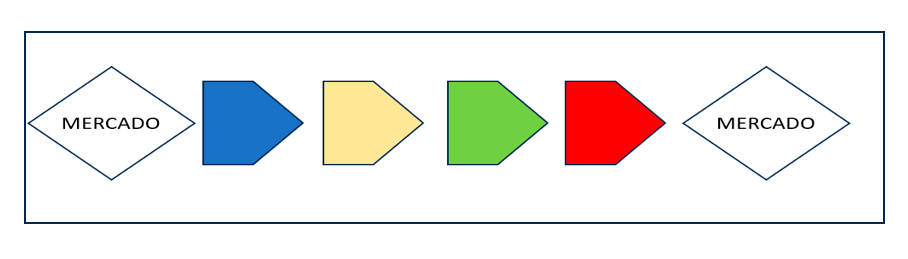
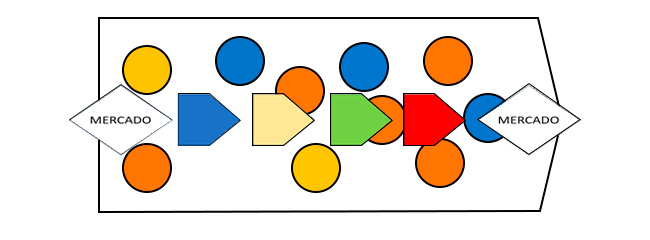
Figure 1 presents the traditional, basic image used to represent the concept of the supply chain, even when we refer to the Lean management of relationships, because our concern with management ends up focusing on the most frequent flows of materials and information over time. In Figure 2 we see this chain immersed in a scattered set of organizations of the most varied kinds - including other economic and social sectors – which finally illustrates the Supply Chain Ecosystem concept proposed here for the strategic governance of the Supply Chain. Imagine, reader, that the other organizations floating around our supply chain in Figure 2 also establish relationships with our business, though less frequently and of a nature yet to be made evident, since they are neither analyzed nor the object of formal understanding on the part of Management. This means that if we ask the C-Level of any manufacturer what its company’s relationship is with a digital search platform, the answer will probably be generic and with little practical agreement.
Poor identification and poor managerial treatment of relationships that have not been made evident may mean future difficulties in adapting the supply chain to new contexts, putting its members in difficulty, and also mean a substantial reduction in the capacity to innovate.
This statement can be observed empirically in new business models that have emerged with digital transformation, especially in so-called platform businesses. Such value propositions consist of a systemic technological structure around which orbit not only supplier and distributor relationships, but also complementary agents and others, innovators, who create on the basis of this platform. An ecosystem is thus formed around the main company and its supply chain, whose members complement the business, innovate and influence the value proposition for customers and consumers.
An emblematic example of this concept is the case of a mobile phone manufacturer that develops, produces and distributes cell phones by managing its supply chain, and whose value proposition depends on an operating system such as Android to work as a platform. The relationship between the Android platform and the cell phone industry is a two-way supplier-customer relationship. On the other hand, a series of app and accessory developers orbit around this supply relationship, creating various apps, accessories and services, constituting an ecosystem of the main chain, which influences the success of that main chain, is influenced by it, and also creates innovations that sustain or modify the main chain’s value proposition. On the other hand, this ecosystem also has relationships with competitors, since developers and other devices operate in parallel with another platform, iOS technology.
We can use this concept of supply chain ecosystem to reinterpret classic, traditional businesses. Imagine, reader, a concession highway as a technological platform. Vehicles and the Concessionaire form a main supplier-customer chain, but how many complementors, innovators and competitors are orbiting around this chain, many of them not the target of formal analysis by management, even though they influence and impact the value proposition? In this example, everything from a mobility app to the planning of new companies depends on the main Vehicles-Concessionaire chain.
It is important to highlight that there are other instances of the concept of ecosystem. Over the course of managerial and technological evolution, authors have developed the differences between Business Ecosystems, Innovation Ecosystems and Platform Ecosystems. They all have in common a conceptual openness to identifying and analyzing interdependence relationships beyond supply and distribution relationships. They thus incorporate relationships with companies and agents from other sectors and markets, depending on whether the purpose is to structure a certain business, create an innovative environment or shape a specific platform.
This concept of expanded relationships is also, of course, common to the supply chain ecosystem illustrated in Figure 2. The fundamental difference, with practical implications for Lean management and for business, is that the supply chain ecosystem takes as the starting point of the strategic analysis not just the company one wishes to highlight in the analysis, but the company together with its supply chain. The relationships are not just with the highlighted company, but with its entire main supply chain. This makes it possible to strengthen the company’s collaborative principle with its partners, and to jointly manage relationships with the ecosystem, escaping the low visibility of problems and opportunities that company-centered analysis brings to traditional management models, which, in an effort to modernize, end up using the concept of ecosystem with a narrow focus and little impact. Thus, our proposal to choose Lean management to operationalize the analysis of the ecosystem starting from the supply chain has important managerial implications in practice.
- Managerial Implications
Considering that the supply chain is immersed in or surrounded by an ecosystem implies unprecedented opportunities to direct the company’s governance toward new relationships that support or innovate the business. In Lean management, identifying these relationships and incorporating their management fits the governance structure better than in other management models, because of its collaborative principle, which permeates the nature of its management tools and promotes a culture of collaboration and help. From the macro view in value stream mapping, situations described and analyzed in A3 plans, the building of future-state maps, all the way to problem solving or process improvements and the development of innovations, Lean practice is carried out through interactive, cross-functional and heterogeneous groups, with various names depending on their purpose, such as kaizen, jishuken and kaikaku, which together give the company a system of collaboration, bringing greater acceptance and ease in incorporating the analysis of relationships with the various agents inside and outside the company that make up the ecosystem.
Within this collaborative culture and these collaborative practices present in Lean management, and drawing on the concept of supply chain ecosystem, a sequence of steps is proposed for the evolution of governance over relationships of influence and impact on the organization.
- A statement containing the value proposition of the business operating in the supply chain, and the general commitment among the agents of the ecosystem. This statement should guide the building of relationships. Relationships among agents of the supply chain and of the ecosystem surrounding it must have an ethical, transparent and collaborative commitment to promoting the value proposition. On the other hand, they may differ relatively in the degree to which these aspects are deepened and in how often they need to occur.
- Map and classify the agents that influence and impact the value proposition of the chain’s business, starting from the supply chain and moving out to its surroundings. Classification of agents by degree of influence and impact. Influence represents the extent to which the business’s value streams, in the current state of the market, are stimulated directly or indirectly by the current relationship with a given agent. Impact is the extent to which a given change in the current degree of relationship would cause a change in the degree of influence. From these analyses, groupings of agents are identified and classified according to degree of influence and degree of impact. Relationships with high influence and low impact direct governance toward consolidating stability, but raise concern about stagnation and the need to promote innovation in the relationship. On the other hand, agents whose relationship with the supply chain is of low influence and high impact are priorities for investigating innovations in the business model by incorporating greater influence from these new agents.
- Build an A3 Plan in collaboration with the supply chain that carries out cycles of incorporating the identifications and analyses made about the ecosystem. The incorporation cycles can range from better support for the stability of the supply chain in delivering the value proposition to customers to proposing changes in the value proposition and in the chain. Conflicts with constituent partners of the chain may emerge, whether from disagreeing with the analyses or from divergences in choosing the path of change; therefore, incorporating ecosystem analysis may give rise to radical changes in the chain, but always carried out with the Lean management characteristics of transparency and reliance on facts and evidence, aspects that make conflicts manageable.
- Follow the incorporation cycles operationally at the GEMBA, and managerially in OBEYA rooms, promoting visibility and interaction among the representatives of the Chain’s agents and, where applicable, of the Ecosystem organizations targeted by the incorporation process. This follow-up should be part of a set of Supply Chain Management projects checked in short weekly or biweekly cycles, as part of a PDCA cycle in which the checks should prompt the Acting of continuing with or pivoting the original plans.
The conclusion for supply chain management practice is to use the concept of ecosystem combined with Lean Management to build a new governance structure that anticipates the systemic problems of the supply chain, making it more resilient, while at the same time the impacts of the ecosystem on the supply chain are transformed into innovations in the business model and/or products, seeking to improve or innovate the value proposition.
Bibliography
IYER, Ananth V.; SESHADRI, S.; VASHER, R. A gestão da Cadeia de Suprimentos da TOYOTA. Porto Alegre: Bookman, 2010
Legenvre, H.; Hameri. A.; Golini, R. Ecosystems and supply chains: How do they differ and relate. Digital Business, 2(2), 2022. <https://doi.org/10.1016/j.digbus.2022.100029>.
Moore, J. F. Predators and prey: A new ecology of competition. Harvard Business Review, 1993.







