

Pull production: the future of supply chains
One thing Covid-19 has proven unequivocally is that global supply chains, across all industries, are broken. When the pandemic began, we saw it in the empty supermarket shelves around the world. Later, we saw it in the painfully slow distribution of vaccines in many countries, due to supply problems. The fact that global supply chains are broken is not new, but the fact that everyone now knows it is. Nor is it new that the method that could dramatically improve the situation is being blamed for the failure: the pull system created by Toyota more than half a century ago, known as Just-In-Time. Therefore, the release of Christoph Roser’s book All About Pull Production, in 2021, was very timely[1].
What is a pull system? Here is a bit of context.
Roser’s book explores in depth the details of the pull system, a method of aligning supply and demand that is widely referenced but poorly understood. The most accepted academic definition of a pull system comes from Wally Hopp and Mark Spearman, who state, in their influential 2004 paper, that the defining characteristic of a pull system is the presence of limits for inventory control: “A pull production system is one that explicitly limits the amount of work in process in the system”.
This is a simple definition, which makes it appealing; but it is incorrect. Toyota developed the pull system and supply chain design through real-world practice, at a time when it had no access to automotive suppliers and therefore needed to innovate. Inventory was not the main problem they were trying to solve (nor is it today). The critical problem of the supply chain (or, as lean thinkers prefer to call it, the value stream) is that every point in the chain needs to know, at any given moment, exactly what to produce and what to move. This does involve the inventory problem, which leads to many other associated problems (including storage costs, among others). For this reason, experts, academics and even practitioners tend to focus on the piles of stuff we call inventory without looking further to understand the deeper causes. The piles are there. They keep growing. They block our view.
A pull system, like Toyota’s broader Just-In-Time system, addresses the problem of supply chain design not just from the standpoint of inventory control. How can we organize all the work, all the material and all the time involved in a long supply chain so that it operates as effectively and efficiently as possible? How can we get each step to produce exactly what the next one needs, at the right time and in the required quantity? Is a top-down planning process the best way, telling each step of a large supply system what to produce and when? Such an approach can work, if everything happens as planned. But unfortunately, in the real world, everything going as planned is increasingly rare. Things go wrong. Machines stop working. Trucks break down. Humans make mistakes. And in any case, in today’s world, customers make last-minute decisions. People change their minds. So how can we organize all this complexity when the beginning of the supply chain is half a world and half a year away from the customer?
These are the problems that pull systems address from a set of unconventional premises. Keeping inventory to a minimum is desirable, no doubt, but (sorry, Hopp and Spearman) setting inventory limits is not the defining characteristic of a pull system. The amount of inventory needed is the result of actions taken and decisions aimed at solving multiple problems — above all, how to ensure that what is needed gets where it is needed, when it is needed, neither too late nor too early
Here is the definition of pull production from the Lean Lexicon: “A method of production control in which downstream activities signal their needs to upstream activities. Pull production strives to eliminate overproduction and is one of the three major components of a complete Just-In-Time production system”. And note that, although minimal inventory or even 'zero inventory' may be 'ideal', in the real world inventories can be used strategically in six distinct ways to make the overall system more effective and efficient, and not just locally efficient.
Toyota discovered early on (as, more recently, has Tesla) that the automotive industry presented a multitude of complex problems beyond the obvious ones of designing, building and selling the product. There are employees to be hired and trained, parts and materials to be purchased, products to be sold and services to be provided, as well as regulatory issues to be dealt with. And there is the difficult question of managing the thousands of parts and materials that make up a car. As simple as it may seem, organizing the steady flow of materials can be as challenging as turning them into the final product!
Kiichiro Toyoda, Toyota’s founder, came up with the idea – and even coined the curious name – of 'Just-In-Time' in the 1930s, during a reconnaissance mission in the United Kingdom. He missed a train connection, which taught him an unforgettable lesson about the importance of punctuality, inspiring the vision that one should arrive exactly at the right time. While his company in Japan was learning to manufacture automobiles, the plant faced the problem of constantly running out of parts and materials. The solution was to bring in materials daily, just in time (just in time) to be manufactured or assembled.
A decade later, Kiichiro’s production manager, Taiichi Ohno, began experimenting with simple pull systems on the shop floor. He noticed that workers in downstream steps often ran out of the materials they needed, while upstream steps were busy producing the wrong items. To solve the problem of 'overproduction' (producing too much or, as many overlook, too early), he reversed the flow of information – using Kanban cards or the empty containers themselves – instructing each operation on what to produce and move. (Ohno did not invent the pull system; he developed the definitive, sustainable pull system). (A note for lean geeks: Value Stream Maps, also known as Material and Information Flow Analysis, track control or instruction information – not all the information circulating in any work system. This is an especially critical distinction when 'mapping' – to analyze and improve – a system in which the product is a transformed form of information).
In the end, two simple rules prevailed: 1) never produce or move too much, 2) nor too little. Simple, indeed. But turning these simple rules into a rule in the real world requires reversing the logic: pull, don’t push. Start by connecting individual processes. Make production flow, ideally one piece at a time wherever possible. Where it is not possible to flow directly from one value-creating step to another, connect separate processes through some mechanism (such as Kanban) to allow downstream processes to pull from upstream processes what they need, when they need it. With these connections made, and single-piece flow (one piece flow) established where possible, focus on shortening the cycle times between each step, resulting in a high-velocity, highly responsive value stream. Simple! And brilliant!
But simple doesn’t mean easy, and brilliant doesn’t necessarily mean intuitive.
My first exposure to Toyota’s pull system was in the first half of 1984, on the shop floor of the stamping plant at the Takaoka Assembly Plant. Toyota was preparing for the start of operations at NUMMI (New United Motor Manufacturing Inc.), the company’s joint venture with General Motors in Fremont, California. My 'eureka' moment – 'Oh, so that’s what JIT means!' – came later, and not during my training at the plant, when I was supposed to learn all about TPS.
Although I was still new to the process, I was already in the position of explaining TPS to visitors, most of them from General Motors. Although I had learned enough to offer a basic explanation of Kanban and 'pull production vs. push production', I didn’t really understand it fully. One day, when I was pressed to really explain what pull production was and why it was so important, I got frustrated with one GM production manager in particular, just as he was frustrated with me.
A mid-level manager with decades of experience pressed me: 'I don’t get it. So what? I hear what you’re saying, but I don’t see what the big deal is. Why should I care about 'pull instead of push'? I don’t see the advantage.' I was as frustrated as he was, annoyed that he couldn’t understand the same explanations that seemed to be enough for the others. My frustration grew when I realized that I myself didn’t know exactly what the big differentiator was.
I think my frustration – first with the visitor and then, gradually, with myself – was the spark that led to the insight and my 'eureka' moment. I was suddenly struck by the power of all these rapid replenishment cycles repeating seemingly endlessly throughout the supply chain. The small cycle of material and information flow we were observing was fractal. The next day, we visited outside suppliers connected to the plant by Kanbans, where the Kanbans circulated up to eight times a day. A system with feedback loops, self-correcting and truly revolutionary.Systems within systems, within a system.
Within a few months, NUMMI was in full operation and the world outside Toyota was getting its first direct contact with a successful pull system in operation. Even so, what observers can see on the surface – such as low inventory – is only the result. The behind-the-scenes work to run a system that seems so simple is, in fact, deceptively simple. To this day, it is rare to find companies willing to invest in developing the organizational capability needed to successfully transform to a pull system. (Toyota considers the conversion from push to pull production a defining characteristic of the advanced functioning of its Just-In-Time system, which is a major component of the Toyota Production System. However, the pull system is only one part of JIT, along with the concepts and practices of creating continuous flow with a defined Takt Time. A complete JIT system – the right item, in the right place, in the right quantity and at the right time, without shortages or overproduction – requires many other elements beyond pull (which, after all, is just one technique), including the location and scale of capacity installation, OEM-supplier relationships and, above all, a precise and deep understanding of customer needs!
MISUNDERSTANDINGS, FALLACIES, CONFUSION AND THE DAMAGE DONE
It is truly unfortunate that the most viable path to fixing supply chain problems is often blamed for their failures. Academics (like those mentioned above) do not have a monopoly on spreading misunderstandings about supply chain dynamics. Periodically, even the most respected magazines publish articles blaming Just-in-Time or lean manufacturing for supply problems. Shortages of goods, such as those that followed 9/11 (Jim Womack and Dan Jones responded at the time in the Lean Enterprise Institute - LEI column) or the disruptions caused by the great earthquake and tsunami that struck Japan in 2011 or by the Covid-19 pandemic (predictably debunked by Womack in 2006), invariably lead to absurdities such as the feature article in the Wall Street Journal at the end of 2020: 'Why are there still not enough paper towels?' In it, the author writes: 'Blame lean manufacturing. A decades-long effort to squeeze out more profit by keeping inventory low left many manufacturers unprepared when Covid-19 hit them. And production is unlikely to increase significantly anytime soon.' (LEI responded to this with a letter to the editor).
In early 2021, the global supply chain crisis – which involved items perhaps more challenging than toilet paper – included semiconductors and geopolitical issues. Policies that had led to three decades of chasing the lowest unit prices in China ended up being reversed. The pendulum swung again. Amid all this, there is a better way
A WAY FORWARD
Introducing Christoph Roser’s timely book, All About Pull Production. With his work, Roser does not intend to offer us a quick 1,500-word simplification for casual readers. The content of these pages will require you, practitioners, to make some effort.
Roser presents several techniques and tools that will help reconfigure supply chain operations. But more importantly, by exploring various approaches and methods, he challenges readers to rethink their strategies, reconsider what their supply system needs to achieve and why. How do you get every item in the right place at the right time? How can the thousands of people and processes in an extended value stream do the right work at the right time?
The true nature of a lean enterprise is a holistic business system. In it, everything is connected. Therefore, the discipline of point optimization – which was the focus of decades of supply chain research and has become a now-accepted dogma – typically creates waste throughout the system, except at the point being optimized. Until supply chain leaders turn their gaze to the entire value stream, savings will be illusory and improvements unsustainable.
The power of lean manifests itself in the gemba through the way activities are connected, and disconnecting these links – whether on the shop floor or in the extended value stream – destroys the key dynamic of a lean system: the ability to learn and adapt. Fragmenting supply chain management into disconnected points with the lowest piece price or into optimization algorithms results in losing the ability to build a rational, practical and adaptable supply chain, configured as a living system that learns. This challenges managers to deeply understand how their value streams currently work and to design improved versions that are manageable and adaptable to rapidly changing real-world conditions.
System designs that ignore the human side of decision-making and hope to control supply chains solely or mainly through technological solutions will not solve our problems. Centralized decisions (made by humans in command-and-control style or by machines using AI in 'black box' style) are doomed to failure for two reasons: 1) in today’s world, they cannot match the dynamic adaptability of a distributed decision-making system, and 2) every time you separate decision-making from the responsibility of those doing the work, you take away those people’s sense of ownership and engagement, increasing the likelihood of errors and even sabotage, due to alienation. By contrast, the pull system via Kanban or any other means – along with the other elements of a Just-In-Time production system and, indeed, all the tools and methods of a lean system – distributes responsibility to the place where the work is happening. Ohno spoke of 'Kanban democracy', an elegant system with responsibility and authorization distributed dynamically based on need and transparent rules of engagement.
Supply system designers have countless problems to solve and approaches to tackle them. The shift to a pull system is a technical challenge, but it also requires a fundamental change in mindset not only of supply chain professionals, but also of CEOs. And that requires teamwork on a large scale. There is no denying the need for effective supply systems that meet the rapidly evolving complexities of the 21st century. Learning the principles and practices of pull production is a great place to start.
[1] The book All About Pull Production, by Christoph Roser, in Portuguese, is available at LeanShop.
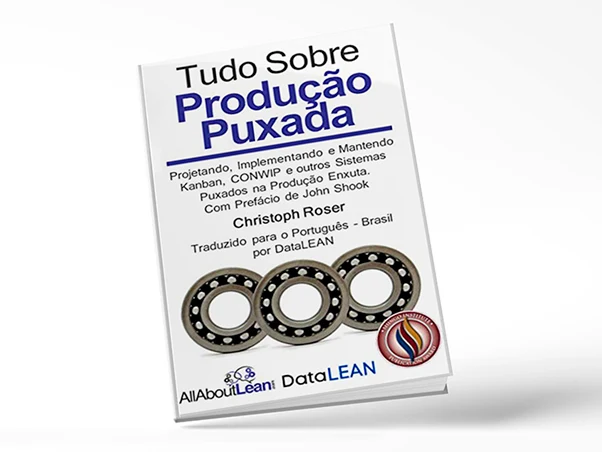
Christoph Roser’s book All About Pull Production is available for purchase here.






