

Lean in government needs a holistic approach
At the National Audit Office (NAO), we have been looking at government through the lens of the management system for the better part of the last seven years, either as a regular part of our audit work for Parliament or at the request of specific government organizations.
Some of the things we discovered during this period were discussed in a previous article here on Planet Lean. Since then, in September 2015, we produced a new paper: "Managing business operations – what government needs to get right" (in English), which considers the British government's ability to manage and improve its business.
As we have systematically assessed a total of 32 government bodies and 86 operational areas, we have built up a broad body of knowledge about some of the problems and patterns present in the British government.
The report is an opportunity to share what we are learning about what seems to work best when government organizations adopt lean or other improvement approaches to manage and improve their business.
So, what did we find?
We collected a lot of data from our assessments of government, and our analysis identified four critical areas on which organizations should focus:
- Focusing on the customer.
- Understanding and managing the system end to end.
- Using information to lead change in their business.
- Creating an environment in which people can manage and lead in a way that enables them to achieve good management of operations.
Not only are these areas critical for organizations to “get it right” in becoming better at managing and improving their business, but they are also the areas that many government organizations seem to be struggling with.
The NAO's work also highlights the need to understand and reflect on the impact of different approaches to change, as we have identified problems both with top-down structural change and with project-by-project improvement initiatives.
KEY FINDINGS
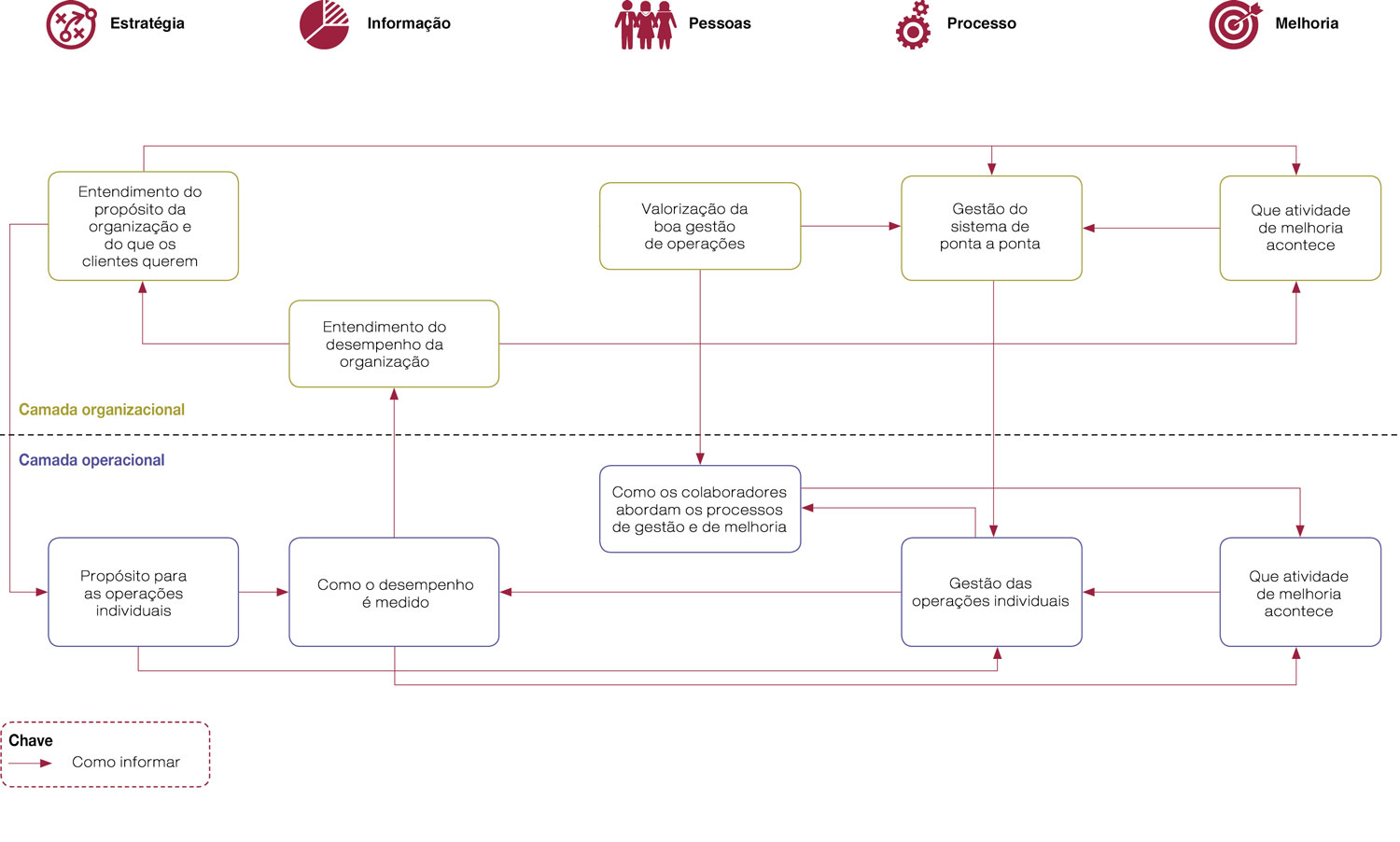
What is interesting about these four areas is that they are made up of characteristics from both the organizational and the operational layers of our assessment. The NAO framework considers five areas in each business – strategy, information, people, process and improvement – and across two layers – organizational and operational.
Exhibit 1: below is an example of relationships between the parts of the management system:
Analyzing the relationship between how an organization performed against one of the two layers (organizational and operational) and its overall maturity, we realized that, perhaps counterintuitively, there was no relationship.
In other words, we found that government organizations that focused only on their organizational layer (the “corporate center”) had little impact on how services were delivered.
And those organizations with very stereotyped approaches (“lean programs” led by consultants or using a separate internal continuous improvement team) were able to improve their improvement capabilities, but nothing more – business results were not sustained and were limited to the operational pockets on which the improvement activities focused.
This finding confirmed our thinking – and this is our biggest learning – that a holistic system is needed to make change stick. The individual parts of the management system do not exist in isolation. They need to interact seamlessly with one another. The overall effectiveness of the management system depends on the capability of and the interaction between its component parts.
Our evidence suggests that different approaches are needed if government wants to improve, but also that improvement is possible. There are many examples of success out there, both in the British government and internationally. One interesting example is “Results Washington,” an improvement initiative undertaken by the government of the state of Washington, USA (Planet Lean interviewed them here – in English). At the NAO, we became very interested in the work of “Results Washington” because it reflects a combination of two of the four challenges the British government faces: the ability to understand how the different parts of the system interact for the benefit of the citizen.
Two important lessons we learned from the experience of the Washington government (which I have had the pleasure of visiting a few times) were how to make the system work end to end when responsibility is shared among government agencies and that the absolute focus has to be on the end user.
The importance of the user perspective is evidenced by our own work at the NAO: our research revealed that the single characteristic most related to the overall maturity of the management system is how an organization responds to changes in customer demand. So an organization's understanding of its customers and the types of demand, as well as its ability to deal with variability in that demand in a fast and responsive way, is critical.
There are a few more important findings in our recent report. One is that organizations performed better in our management system test when they demonstrated capability in the people section. This may partly explain why the benefit of improvement programs may be short-term if the focus is on doing improvement activities in isolation.
Our last finding is about the broad applicability of the principles in approaches such as lean. We often hear the argument that these principles are only applicable in organizations focused on frontline delivery (and not in those of the British government that are more focused on policy making) and that they cannot be applied in complex operations. So we ran a test to see whether the complexity or the type of organization had an impact and found that neither was a determining factor in the capability of the management system or a barrier to adopting improvement principles. Interestingly, the more policy-focused organizations scored better than those with a large operational scope.
These findings show that we are not putting the British government through a test for no reason: this is what all good organizations are doing to try to improve.
SO WHAT?
Many of our findings are not revelations, but a confirmation of what we already believed to be true. It is important, however, that we test our assumptions, or they will remain mere hypotheses and nothing more.
It is our own “so what?” that we want to answer. One of the things the organizations we assessed were most interested in was finding out where they could go to learn how to improve. What we see is that there is no organization that has “got it all figured out” and achieved a complete turnaround. Instead, there are parts of organizations that have done well in specific areas. That is what makes collaboration and sharing across government so important. But it is also critical that every organization applies the learning to its own context and thinks about learning from the “how” rather than copying the “what.”
When an organization asks to see another that is greatly improving its services, we start by asking what gaps in performance they are trying to close. We then use the answers to match organizations. Often, this brings together organizations that never thought they had anything in common.
Bringing in examples of good practice and sharing information across government has great potential to improve the sector as a whole.
For the NAO, the report is just one step toward the long-term goal of helping people better understand their business. Our intention is to start using this content in a way that is relevant to different groups within an organization – what can they start thinking about, individually and collectively, to improve their business? We want to put knowledge in the hands of those who can do something with it. Whether or not we succeed depends on our ability to convince people to take this knowledge and run with it.







