

Chinese hospital built in 10 days shows the importance of integrating product, process and management
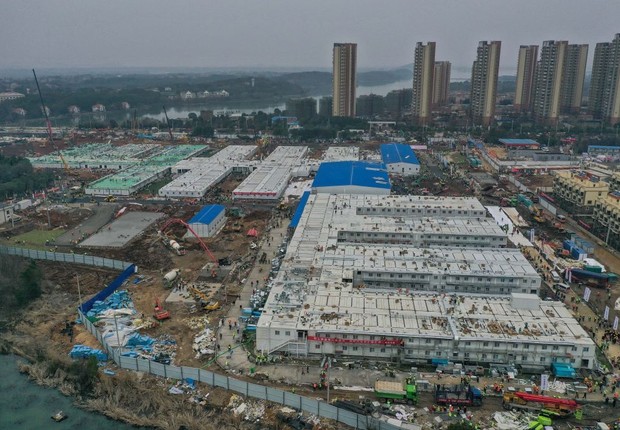 Epicenter of the coronavirus outbreak in Wuhan (Photo: Anadolu Agency / Contributor via Getty Images)
While the world follows, with enormous concern, the evolution of the coronavirus epidemic in China, one piece of news had a great impact: the construction of a hospital in the affected Chinese region in just 10 days.
For those in the construction sector, feats like this are nothing new. Several similar videos, for example, showing 30-story hotels being built in China in 15 days, have been circulating for almost a decade. This kind of Chinese achievement continues to impress the world, and rightly so, since it is not achieved in other countries. Just think of the many construction projects in Brazil that suffer countless delays, drag on for years or are never finished.
In this context, I have frequently heard three questions: How do the Chinese manage this? Would it be possible in Brazil? Why are we so far from dramatically fast deadlines like this one in our construction projects? I will analyze and try to answer each of them.
The Chinese achieve this with a specific combination of “product, process and management”. Buildings like this one fall within an effort of “industrialization of construction”, which consists of moving activities previously carried out on construction sites to factories, turning construction into a rationalized assembly, faster and with greater precision.
The concept gained momentum after World War II in the reconstruction efforts and has evolved since then, moving from heavy and inflexible systems to elements that can be combined, including in almost finished modules, as is the case of this Chinese hospital.
The product itself (the building, its walls, installations, etc.) is conceived from the start with the manufacturing and assembly processes also in mind. In the lean system, we call this simultaneous development of product and process.
These two elements, however, only come together efficiently on the job site with one more fundamental component: management. Everything has to be very well planned and coordinated: people, materials, equipment, information and financial resources.
A conventional construction project, as it is normally done in Brazil, uses around 80 hours of work for each square meter built. If it is rationalized, without major technological changes, it can reach 40 hours/m2. With a prefabricated structure, 20 hours/m2. Using three-dimensional modules, as was done at the Chinese hospital, it can reach 10 hours/m2 or less.
The data on built area and on the number of workers who took part in this hospital project in China are consistent with this last figure, and therefore it is not something out of the ordinary.
In Brazil, there are companies that provide similar solutions that already reach this productivity, but, of course, without the scale the Chinese operate at. Many other types of industrialized systems are also already used in our country. Recently, for example, we took part here in Brazil in the construction of a house in 24 hours, an experience I described in a column titled “This house is built in just 24 hours”. This Brazilian experience achieved productivity rates similar to those of the Chinese hospital, but, of course, using far fewer workers and producing a proportionally much smaller area.
What is really impressive in the Chinese case is the level of concentration of resources, which produced the 25,000 square meters of construction with 4,000 workers working in just 10 days. Applying the entire industrialized construction system always requires a lot of planning and careful management in execution, in every detail involved. This Chinese project, done in such a short time, certainly demanded much more of all of this.
I can state that in Brazil we already have the technology to produce buildings with processes similar to the one used at the Chinese hospital. And even the planning and management knowledge for coordination in a very short time is available among our professionals. In the field of residential buildings, for example, we already have cases of smaller projects completed in weeks. So why do we hardly ever see projects with such impressively short deadlines happening here?
This is where other factors come in, which are more complex to resolve. From a proper understanding of the scale of the demands to be met, through the determination to seek solutions in really short timeframes, to the ability to bring together different social and economic agents and the prospect of continuity of actions that makes the necessary investments viable.
Going back to the case of the Chinese hospital, the design of this type of building had already been done before. The development of the product and the process, the setting up of factories, the training of teams, etc. had already been carried out, with a view to continuously meeting a large demand.
In Brazil, there are also needs for this type of large-scale construction, whether for housing, hospitals, schools, etc. The issue here is to define the pace at which these demands are to be met, as well as the planning of material, financial, human and technological resources, among others, that can guarantee continuity for this type of construction and that can make the business viable in a way that is attractive to all the agents who need to be involved.
If we manage to develop this whole context, we may not immediately have large buildings built in 10 days, as in the Chinese case, but perhaps in a few months – and not in several years, as often happens in Brazil.
For this, planning could not be limited to the physical and construction aspects, but would also have to include the aspects of the entire life cycle of use of the infrastructure created. For example, in the case of health services, the entire operating chain, and even the training of specialized professionals, would have to be compatible with the desired pace of delivery of the units for operation.
Of course, all this coordination is quite complex and requires many conditions to happen in a country like ours, which has decision-making processes and an economy very different from China's – and which here depend on the coordination of many independent agents, involving the whole of society.
Technology, knowledge, companies and qualified professionals we already have to reach a new level of reduced deadlines in our civil construction.
Perhaps what we lack is coordination, as a society, that can generate a real and proactive will to bring about this paradigm shift, of course, in the cases where it is necessary and makes sense. It would certainly not be easy, but with this attitude and a greater sense of urgency, we will probably be able to gather the resources needed to put this type of construction into practice, systematically and routinely, in order to meet our demands and such pressing structural deficits within timeframes better suited to the needs that keep piling up.






