

A Lean Approach to Supply Chain Management: A Practical E2E Case


Integration, collaboration, synergy, competitiveness, visibility… many words are used to describe the attributes desired for a supply chain. However, rather than presenting or idealizing the flow through impactful keywords, it is necessary to describe the how, that is, the concrete, proven model or approach for conducting the improvement process in the Supply Chain. And from end to end (E2E, end to end).
The Supply Chain view, end to end, from the value-delivery perspective of Lean management, is a practical approach that aims to efficiently integrate the entire supply chain, from the acquisition of materials to delivery to the customer. This encompasses all the steps involved (purchasing, transportation, planning, warehousing, delivery, etc.) converging toward a common goal: optimizing the whole, not the parts.
By Lean Supply Chain, we mean the set of direct, indirect and support flows for value creation, from origin to destination, as well as reverse flows, designed and coordinated to deliver that value without waste, focusing on solving and preventing problems through people, with a view to achieving high performance.
Because of its holistic nature, the Lean Supply Chain approach values not only physical flows but also encompasses information and financial flows. In other words, everything that is relevant to the provisioning flow (that is, the flow that serves a consumption) is considered and analyzed through the lens of customer value. This is where discoveries of often hidden waste, problems and rework emerge, like treasures waiting to be found.
To carry out this approach in practice, Lean Institute Brasil structured the Lean Supply Chain framework in which the end to end of the value stream in the supply chain is handled in cycles. The framework is based on the SCOR model (Supply Chain Operations Reference), created by the Supply Chain Council (SCC), and is integrated with the practice of Lean thinking through the vision of delivering value to the customer, eliminating waste and solving problems with people.
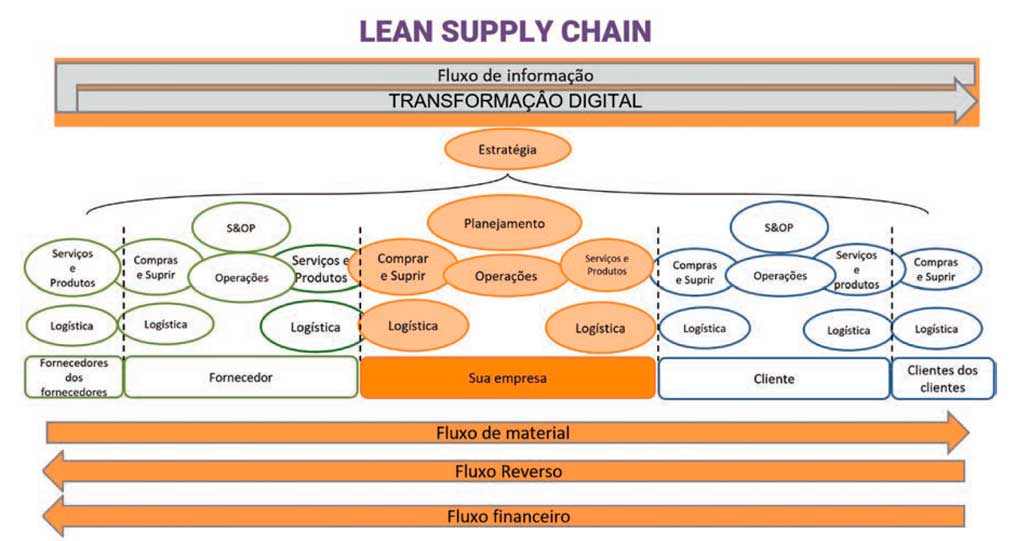
Figure 1 — Lean Supply Chain Framework
Figure 1 presents the Lean Supply Chain framework and represents its constituent cycles (for example: strategy, planning, operations, etc.). It shows not only the organization’s internal situation, but also the levels of suppliers and customers.
In this framework, the links and their respective work cycles are considered in their particularities without losing integration with the strategy, as shown by the bracket at the top of Figure 1. Strategy is the upper cycle, integrating with the reality of all the information on customer demand, product inventory levels and suppliers’ production capacities, among other factors.
The strategic focus: a differentiator for lean transformation
When we deal with new businesses — those being planned for future operation —, the integration of the links in the chain to form an end to end flow benefits greatly from the Lean approach. It guides the design of flows and organizational architecture toward conceiving waste-free work flows and evidence-based decision-making, thanks to data sharing among the parts of the flow that begins right at the strategic design stage.
However, most organizations already have their chain in place and, in some way, seek to operate it with a corporate strategy. In this case, aligning strategic efforts with the needs of the supply chain means being able to identify and prioritize fronts of action to optimize the end to end flow. This represents the ability to find, in the company’s current extensive and complex chain, which parts need to be singled out and prioritized without, however, affecting business operations; on the contrary, adding incremental improvements along the way. It is about making a strategic cut in the business. A curative surgical act— we might say, to use a medical metaphor — in which our patient is the organization and Lean Supply Chain is the treatment.
To help along this path, Figure 1 is combined with the Lean Transformation Framework (LTF) (Lean Institute Brasil, 2015). The LTF, developed from decades of work with organizations and individuals seeking transformation, is a heuristic framework used as a guide for experimentation, problem solving and learning to help organizations become Lean enterprises.
In the Supply Chain context, applying the LTF becomes possible through reflection on and assessment of the cycles in Figure 1 in light of five dimensions. These five dimensions are associated with the overall structure of the LTF and, once oriented to the Supply Chain, allow reflections and assessments to be conducted through questions such as:
- Purpose: What are the main difficulties in getting the strategy to clearly permeate the various levels of the supply chain? How can the true north (common goal) be translated for the different business areas and different companies? What is the purpose often hidden in day-to-day activities? How do routine activities connect to the strategic needs of the end to end chain?
- Process: What are the main fronts of action to close the gaps and problems along the supply chain? What are the improvement focuses in work and information flows? How should the value stream be designed to support and enable continuous improvement of the work?
- Human capabilities: In which specific skills or knowledge does the team need to develop to achieve the common goal? How well are the tools and methods used day to day understood? How do people engage in absorbing and embracing the common goal, moving toward the future?
- Leadership and the management system: What changes are needed in leadership relative to what is expected in order to effectively lead the strategy-driven transformation? What are the routines and frequencies of management meetings? How are problems exposed and addressed? How is performance tracked across the entire supply chain?
- Basic thinking: What are the fundamental assumptions that permeate the Supply Chain? Is the “coffee-break talk” aligned (or not) with the strategy and common goal? What noise or gaps need to be addressed so that the culture of eliminating waste and solving problems daily is understood and adopted by everyone, at all levels?
From these questions, it is possible to identify the main sticking points in defining the Supply Chain strategy and executing it. Aligning efforts and channeling energy toward the real priorities makes everyone know “how” and “why” to move in that direction.
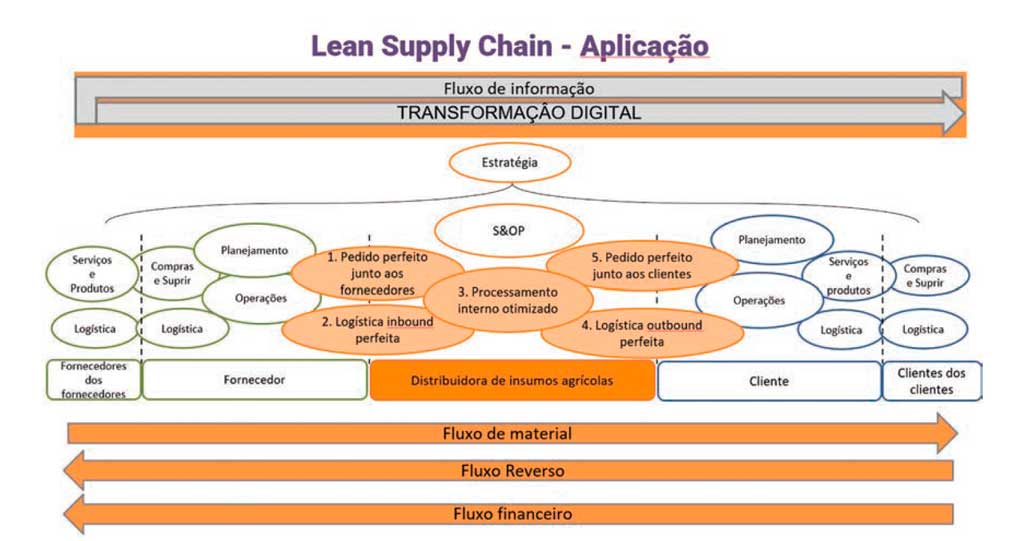
Figure 2 — Cycles identified for improvement fronts at an agricultural inputs company
Case study: an agricultural inputs distributor
One application of the Lean Supply Chain approach took place at an agricultural inputs distributor in Brazil. An initial diagnosis was carried out at the Gemba (a visit to the actual place of operations) and, based on questions associated with the LTF (as described above), interviews were conducted with managers and the team directly involved in the processes.
From the diagnosis, the cycles of the Lean Supply Chain framework to be considered as improvement fronts were identified. The choice was therefore based on the strategic focus, that is, on identifying the weak, unarticulated points of the supply chain strategy and operation.
In other words, when investigating the main fronts of action to close the gaps and problems along the supply chain, the view of processes and the management system (items 2 and 4 of the previous section, respectively) was related to purpose (item 1). In this way, the main difficulties in getting the strategy to clearly permeate the various levels of the supply chain were elicited.
By way of example: there was a clear purpose of integration and full traceability of the flow between the parts of the chain, including internal departments — as a way of avoiding flow stoppages and rework. This purpose was not being fulfilled, for example, in the operational process with suppliers, where deliveries were systematically made with failures and poor quality. This practical approach, aimed at connecting organizational purpose with real operations, was only possible because it involved an appropriate diagnostic method. This method consisted of a visit to the Gemba (the actual place of operations) supported by an assessment developed by Lean Institute Brasil to objectively consolidate the observations, allowing them to be systematized based on the model in Figure 1.
Thus, the approach would be subdivided into five cycles, represented in Figure 2, namely:
- Perfect order with suppliers;
- Perfect inbound logistics;
- Optimized internal processing;
- Perfect outbound logistics;
- Perfect order with customers.
Each of these cycles involves several departments, which were identified and aligned through a Lean technique called supply chain value stream mapping.
Thus, in each of these established cycles, assessments of problems and waste were conducted, as well as training of the teams and managers and alignment in pursuit of the common goal. Next, an integrated value stream was designed, with the aim of promoting product traceability from origin to final delivery to the customer. Figure 3 presents an excerpt of this mapping, showing a section of the “Perfect order with suppliers” cycle.
In Cycle 1 (perfect orders with suppliers), redefining the value stream (future-state map) produced a 65% reduction in lead time (total time to execute the flow). The rework and defect rates (measured by the “complete and accurate” indicator) improved from 68% to 85%. “Complete and Accurate” is an indicator unique to the Lean approach in the Supply Chain. The 65% rate, for example, meant that of all the work flowing between the activities of Cycle 1, 35% of that work had inaccuracies in one of the activities, resulting in the need to stop the work flow to correct or complete the information. After the improvements, this rate rose to 85% (reducing inaccuracies to 15%).
In Cycle 2 (inbound logistics), the reduction in lead time was on the order of 90%, while complete and accurate jumped from 52% to 84%. This reflected the identification and removal of waste, such as significant waiting times (for example: a buyer waiting) and various activities that did not add value. In addition, the routines for obtaining information were standardized and ensured throughout execution.
On the other hand, the “Complete and Accurate” indicator was even more critical in Cycle 4 (outbound logistics): at 41%. With kaizen measures, it was possible to reach a future state of 86%. Kaizens are small but important improvements in handling the flow of information and materials, which, in the case analyzed, focused on standardizing and identifying reliable data and on changing the layout of the shipping operation.
Similar results were also seen in the other cycles, where the method of identifying waste and carrying out kaizens likewise led to the overall improvement of the value stream.
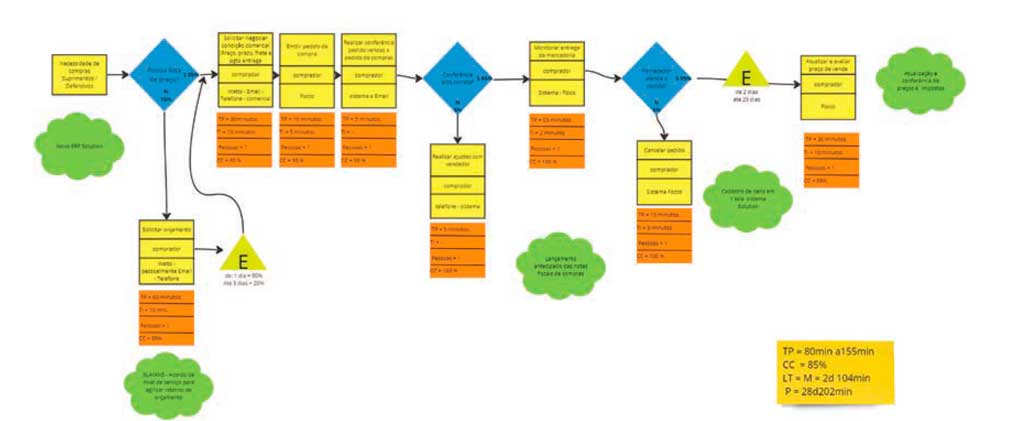
Figure 3 — Excerpt of value stream mapping - Future State. Perfect order with suppliers cycle
Overall result of the approach
The definition of purpose derived from the strategic focus applied by the Lean method to the specifics of the business. When supplying inputs to the agricultural sector, it is essential to value accuracy in scheduling, delivery, predictability and the reduction of obsolete inventory.
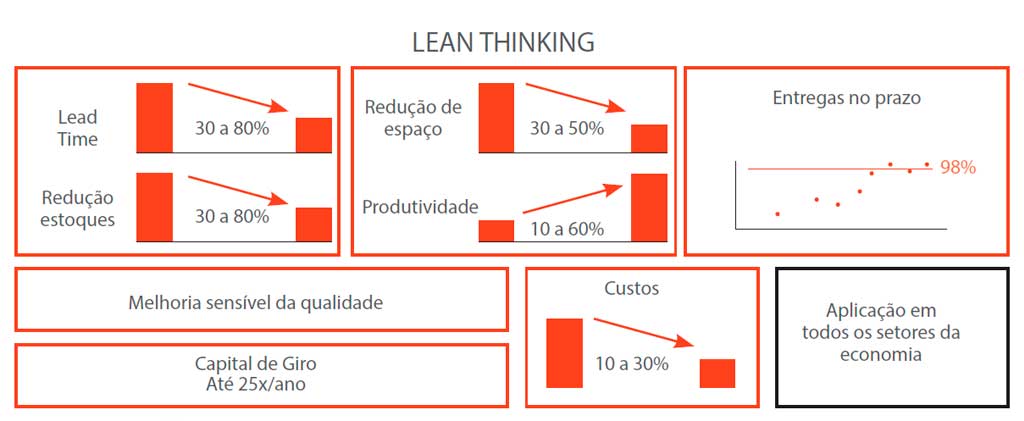
Figure 4 — Typical results of practicing Lean thinking
For example, if a customer reports a nonconformity with a given chemical product, the distributor can now quickly trace the source of the problem and take steps to correct the situation promptly. In this way, harmful effects on the business and the environment are avoided, while seeking to maintain customer satisfaction. In short, to promote full product traceability in line with the purpose identified, the integrated value stream was implemented to connect and integrate its five constituent cycles (represented in Figure 2). Called the “integrated supply management system”, the functions of inbound logistics, internal processing, shipping and commercial management were connected, and the shared view of value was spread across these links of the supply chain, generating more collaboration and synergy as a whole. With this extended, integrated and collaborative view, it was possible to achieve higher levels of forecast accuracy (for the purpose of preparing and planning the chain), as well as to optimize operations scheduling (based on firm orders). In addition, more efficient routes were designed for receiving and delivering products. As a result, inventory levels were reduced and substantial improvements were achieved in delivery service levels to the end customer — which made it possible to expand market share.
Dissemination and lessons learned
Lean Supply Chain in practice can take organizations to new levels of overall operational performance. Leaps in improvement make it possible to achieve broader goals, such as portfolio expansion, the pursuit of new businesses, acquisitions and new partnerships. The end to end view accommodates the organizational ecosystem, with different stakeholders converging on a strategic consensus that optimizes the whole and enhances the delivery of total value to the customer.
In this sense, the agricultural inputs distributor decided to continue the improvement work and expand it to new fronts (for example: Tier 2 suppliers). The expansion gains momentum as results are disseminated and new participants in the extended chain join the improved Supply Chain value stream.
As it broadens the view, the Lean Supply Chain model also makes it possible to consider sustainability and social responsibility across the end to end. This includes adopting environmentally sustainable practices and ensuring fair working conditions for those involved in the flow and for the other actors in the extended chain. This follows from the same practical perspective of reducing waste, maximizing value and optimizing the whole.
Adopting this approach has brought countless benefits to companies — among them cost reduction, increased efficiency and improved product quality and customer service, both internally and externally. Some general indicators, observed and collected from companies that have already begun the Lean transformation and illustrated in this article by the case described, are presented in Figure 4.
The future of business depends on delivering results — which in turn passes through and stems from the supply chain. Developing and improving the extended value stream in the Supply Chain is a matter of survival. The Lean Supply Chain approach is a proven, consolidated path to enable transformation and reach new levels of overall results across the end to end.







