

When your DM delivers results, it's time to improve: the Tilibra example
Tilibra, which has already achieved great results with lean, has been experimenting with the concept and practice of DM (Daily Management) since 2020, with great success. The results are impressive. They achieved an OEE (Overall Equipment Effectiveness) 3% above the established target. In addition, they met the production plan, exceeding the established target. As a result, gains in productivity, efficiency and reduced downtime were achieved, giving the company more capacity to take on new business for the unit where DM was implemented and making it more competitive in its industry.
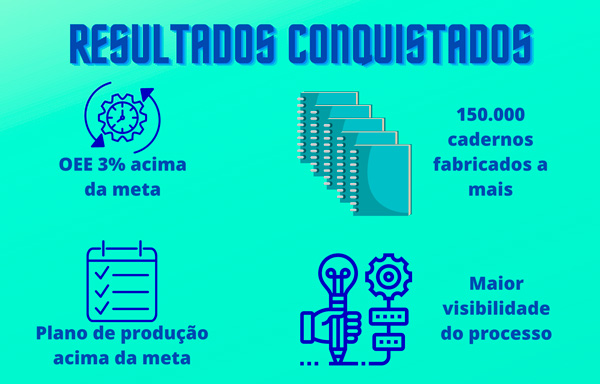
Even with all these good results, in 2022 Tilibra took another look at each of its operational DM processes and has been implementing improvements ever since, such as (re)defining the purpose of each one, improving the help chain, understanding that new areas also need to start their own Daily Management practices, and that they need a managerial DM for a broader, more strategic view of the company.
We set out to understand how they reached this new level of management in an exclusive interview with João Marcos Linares, Lean Coordinator at Tilibra, together with Fabio Rogerio e Silva, sponsor of the Lean Project at Tilibra.
you started applying DM at Tilibra?
João Marcos and Fábio: Sure. We started with our pilot cell in 2020. Tilibra has two production units in Bauru, and our pilot was in one sector of Unit 2. From there, we began replicating the initiatives across the rest of the plant.
In Unit 2, we have already managed to implement four DM boards: three in the plant and one in maintenance.
In Unit 1, we started the work in early 2021, a little later, but since then we have already managed to implement six boards: five in the plant and one in maintenance.
In addition to these ten boards (four in Unit 2 and six in Unit 1), we have recently been working on implementing nine more, some virtual and others in person: three in controllership, one in procurement, one in PPC (production planning and control), two in the distribution center (in order picking and in the administrative area), one in quality and safety and one in the materials warehouse. So I can say we are implementing very quickly; we are building a robust management system.
LIB: And what impacts of DM can you see at Tilibra today?
JM/F: I think it all starts with stability. What DM gives us first of all is more stable and predictable processes, which allows us to deliver orders faster and right the first time, eliminating the need for costly rework.
It is very clear to those who are working, to those who are in there every day, that DM has greatly improved our processes, but even for those on the outside, all it takes is a look at our indicators, such as OEE, to see the change. Today, all of them are on target, whereas before we struggled a lot and only managed to reach a few targets. All of this happens because today problems are shown more clearly; they become evident to everyone, who actively work to solve them.
I think another important point is the A3s. Before DM, we already did A3s, but they were always very random: we decided to do an A3 based on our (often flawed) assumptions. When we began to understand the indicators better, we realized that we were often doing A3 reports that were not needed, wasting our employees' valuable time, while what really needed an A3 was not being addressed.
Finally, we were able to see that DM gave people a much greater sense of ownership over their processes. Today, they understand that the processes are theirs and that the improvements made will make the work they do easier. In this way, a culture of improvement was created in every corner of the company, with people empowered to take the reins of the processes.
LIB: What obstacles have you encountered on the journey so far, and how did you overcome them?
JM/F: One difficulty we are still working on concerns the help chain. Before DM, our help chain was very informal and poorly structured; we used WhatsApp groups for our official communication. DM showed us that we need to structure the chain better; it is a necessity if we want to become more efficient in this very important aspect of DM. It is something we have already improved a lot, but we are still working on it.
Now, one of the things that has helped us most recently in our DM efforts was the book Gerenciamento Diário para Executar a Estratégia (Daily Management to Execute Strategy), by José Roberto Ferro and Robson Gouveia, the newest book released by LIB, which addresses the subject. When we heard about the publication, we immediately planned to read the book together and conduct our hansei based on it. So we formed a reading group, in which at each meeting a different person explained a part of the book. We only held the meetings if everyone had read the agreed part; otherwise, we postponed the meeting.
The book opened our eyes to many things: we realized that we had skipped the important step of defining a purpose before doing DM, which made it disconnected from what we were trying to achieve. With the book, the quality of the DM we were doing increased very quickly. In a short time, we had to change the targets, because many of them (which we used to struggle to reach) turned blue, that is, we managed to reach or even exceed them; the book made our targets very easy to reach, so we had to raise the bar. In addition, it helped us realize that many problems kept coming back because we had not properly solved the root cause.
LIB: And how was people's engagement? Was it easy to bring everyone on board?
JM/F: When we ran our pilot, employees had a lot of questions; many did not believe in it. But it did not take long for them to start understanding what DM was and, consequently, to come on board. They soon realized that DM allowed them to be heard and to solve process problems. So they realized that DM is in their interest.
We made an effort to show this from the start, and I think that was productive, because we did not feel very strong resistance from them. That does not mean there is no difficulty with participation; of course there is. But in the medium term, we were able to eliminate the attendance list, because people saw the value of being there.
Actually, one of the barriers we faced in terms of engagement came from the leadership. It took quite a while for them to realize that sharing information there made their work easier too, because they no longer needed to run around the plant looking for some piece of information they needed. We were already doing something similar to daily management in the manufacturing areas, and after reading the book we improved our method of running the meetings. From then on, they also realized how DM could help them in their role as mentors, becoming true sensei for the employees.
LIB: And what are the next steps for Tilibra now?
JM/F: We have already implemented DM in almost all of Tilibra, but the key word there is “almost”. We still need to implement it in several departments.
In addition, we need to get our managerial board started, because so far we have only implemented operational boards across the plant. We have already started the process of implementing the managerial board, but we are still very much at the beginning, so we need discipline to continue and sustain it.
What we have in mind is that we always have to evolve, and we need the humility to recognize that our management process can still improve a lot, so we are going to work on that. We are very excited about the direction we are heading in, but we are aware that a slight lapse can take us off course; that is why we are always looking for ways to improve our DM, as we did recently with the LIB book.







